
The automotive industry is currently navigating its most profound shift since the internal combustion engine was first developed and popularized. As electric vehicles move from experimental curiosity to the backbone of global transportation, the limitations of standard energy storage have become more apparent to engineers and consumers alike. Current lithium-ion systems rely on liquid electrolytes to ferry ions between electrodes, a process that is efficient but inherently limited by safety and energy density constraints. In this context, the solid-state battery has emerged as a disruptive architecture that replaces these flammable liquids with solid ceramic, glass, or polymer separators. This design change is not just a minor upgrade but a total reimagining of battery physics. By utilizing a solid electrolyte, manufacturers can integrate lithium-metal anodes that offer significantly higher energy potential. This shift promises to solve the core anxieties of the electric era, including range limitations and long charging cycles.
Key Performance Advantages: Global Innovation Drive
Significant Improvements in Performance Metrics
The primary appeal of solid-state technology lies in its superior volumetric and gravimetric energy density, which dictates how much power can be packed into a specific space or weight. Conventional lithium-ion batteries are reaching their theoretical limits, forcing car designers to choose between heavy, bulky packs or restricted driving ranges. Solid-state cells can theoretically store double the energy of their liquid counterparts, allowing for sleek vehicle profiles that do not sacrifice endurance on long trips. For the driver, this translates into a future where a single charge could easily cover distances exceeding five hundred miles while reducing the total weight of the vehicle. Lighter cars require less energy to move, creating a virtuous cycle of efficiency that could fundamentally change vehicle dynamics and tire wear patterns across the entire transportation sector.
Beyond the sheer distance a vehicle can travel, the transition to solid electrolytes addresses critical concerns regarding safety and charging velocity. Liquid electrolytes are volatile and susceptible to thermal runaway, a condition where a damaged or overheating cell can catch fire and become extremely difficult to extinguish. Solid-state materials are inherently non-flammable and remain stable at much higher temperatures, providing a layer of passive safety that current designs lack. Furthermore, the solid medium allows for faster ion transport without the risk of dendrite formation that plagues liquid systems during rapid charging. This capability is expected to reduce charging times to roughly ten minutes, effectively matching the speed of a traditional fuel stop. By removing the safety stigma and the waiting time, solid-state technology positions itself as the final piece of the puzzle for universal electric adoption.
Leading Stakeholders and Strategic Industrial Alliances
The race to commercialize this technology has created a high-stakes competitive environment where legacy automakers and specialized tech firms are forming deep strategic alliances. Toyota has emerged as a frontrunner, leveraging a massive portfolio of thousands of patents to drive toward a commercial launch by late 2028. For the Japanese giant, solid-state batteries are the primary weapon to reclaim its leadership in the zero-emission market and leapfrog competitors who focused earlier on liquid lithium-ion production. Meanwhile, the partnership between Volkswagen and QuantumScape has moved into a critical implementation phase. The recent launch of their Eagle Line pilot production facility represents a major shift from laboratory success to industrial application. This facility provides the necessary testing ground to ensure that the individual cells can survive the rigors of real-world driving environments.
In the Asian markets, giants such as Samsung SDI and BYD are refining their own chemistries to maintain their dominance in the global battery supply chain. These companies are currently focusing on integrating solid-state cells into premium, high-performance vehicles where consumers are willing to pay a premium for cutting-edge capabilities. The International Energy Agency has noted that this top-down approach is necessary to absorb the high initial costs of specialized manufacturing. By starting with luxury models, these stakeholders can fund the gradual scaling required to bring the technology to more affordable segments. These strategic moves illustrate that the transition is no longer a matter of if the technology works, but which alliance can first solve the complex puzzle of large-scale manufacturing. Cooperation and competition are happening simultaneously as the industry prepares for the next decade of growth.
Manufacturing Challenges: Navigating Market Realities
Transitioning from Lab Prototypes to Scale
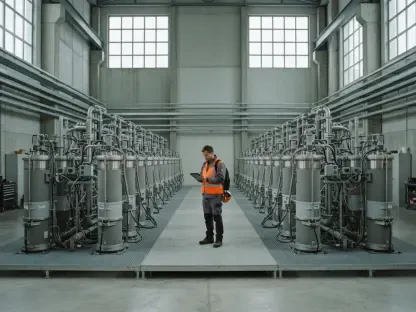
A defining trend in the current landscape is the shift of focus from theoretical chemical breakthroughs to the gritty realities of manufacturing engineering. While scientists have successfully demonstrated the superiority of solid-state chemistry in controlled laboratory settings, translating those results to a high-speed factory line is a massive undertaking. The consensus among industry experts suggests that the fundamental chemistry is proven, yet the mechanical processes required for mass production remain elusive. Unlike traditional battery manufacturing, which has decades of refined processes to draw upon, solid-state production requires entirely new methodologies for material handling and cell assembly. This challenge is forcing companies to rethink their entire capital expenditure strategies as they design factories that can produce millions of units with surgical precision and zero defects.
To mitigate the risks associated with this technological leap, many manufacturers are currently adopting a phased implementation strategy using hybrid designs. These semi-solid batteries utilize a small amount of liquid or gel electrolyte to ensure consistent contact between the solid components, acting as a functional bridge toward all-solid systems. This interim step allows automakers to gain significant energy density improvements and safety benefits without the extreme difficulty of maintaining perfect atomic-level contact in a completely dry cell. By rolling out these hybrid versions first, the industry can collect valuable data on performance and durability while continuing to refine the more complex all-solid-state manufacturing techniques. This pragmatic approach ensures that progress continues in the market even while the ultimate engineering goal of a pure solid-state system remains under intense development.
Identifying Barriers to Mass Market Commercialization
The most significant technical hurdle currently facing the industry is the maintenance of interface stability between the solid electrolyte and the electrodes. In a liquid-based battery, the fluid naturally flows into every crevice, ensuring constant contact even as the battery components physically shift. In a solid system, the materials must maintain perfect contact at the atomic level to allow ions to flow freely. However, batteries physically expand and contract during every charge and discharge cycle, a phenomenon known as breathing. This mechanical stress can cause the solid materials to pull away from each other or develop microscopic cracks in ceramic electrolytes. If these cracks form, they can serve as pathways for metallic lithium spikes called dendrites to grow through the separator, eventually causing a short circuit and battery failure.
Beyond the physical integrity of the cells, the economic reality of material sourcing and factory conditions presents a formidable barrier to mass adoption. The specialized lithium salts and high-purity ceramics required for solid-state electrolytes are currently much more expensive than the components used in standard lithium-ion or lithium iron phosphate batteries. Furthermore, the manufacturing environment for these cells must be maintained at extremely low humidity levels to prevent chemical degradation during the assembly process. These requirements drive up the cost of building new production lines, making the initial units far more expensive for the end consumer. Until the industry can develop more cost-effective material processing and lower the capital intensity of the factories, solid-state technology will likely remain restricted to the premium automotive sectors where high price points are more easily justified.
Future Outlook: Understanding Consumer Adoption
Consumer Skepticism and Practical Driving Needs
While the technical promise of solid-state batteries is undeniable, a segment of the consumer market remains skeptical about whether these benefits outweigh the expected costs. In enthusiast circles and industry forums, there is a growing consensus that current battery technology is already meeting the needs of most daily commuters. Lithium iron phosphate batteries, for instance, have become highly popular due to their exceptional durability, lower cost, and safety profiles. For a driver who rarely travels more than a hundred miles in a single day and has access to home charging, the incremental range and speed offered by solid-state cells might not justify a significant price hike. This creates a challenging market dynamic where solid-state technology must prove it offers a truly transformative experience rather than just a marginal improvement over existing, reliable options.
The successful adoption of solid-state vehicles will ultimately depend on how well manufacturers can communicate the long-term value proposition to a broader audience. Beyond simple range and speed, the potential for these batteries to outlast the vehicle itself could change the economics of car ownership. If a battery pack can survive thousands of cycles without significant degradation, it could hold substantial residual value, making the initial high purchase price more palatable. However, until these longevity claims are proven through years of real-world use, many buyers may prefer to stick with the proven track record of liquid-electrolyte systems. The industry must navigate this period of skepticism by demonstrating that the technology is not just a high-end luxury feature but a fundamental improvement in the reliability and longevity of the modern electric vehicle.
Strategic Importance and Long-Term Timelines
The strategic pursuit of solid-state technology is both a defensive and offensive necessity for the modern automotive manufacturer. Offensively, it offers a clear path to resolving the remaining pain points of electric ownership, potentially capturing market share from competitors who remain tethered to older chemistries. Defensively, no major automaker can afford to be left behind if a rival successfully cracks the manufacturing code, as the resulting performance gap would be nearly impossible to close quickly. Current projections suggest a gradual top-down evolution of the market, where high-end performance cars and luxury SUVs will feature the technology before it trickles down to budget-friendly models. Most analysts expect this transition to unfold over a decade, with pilot vehicles appearing in the coming years and mass-market saturation not occurring until the middle of the next decade.
In the final analysis, the transformation of electric mobility is deeply tied to the industrialization of these advanced storage systems. The industry moved beyond the limitations of volatile liquids and embraced the stability of solid architectures, which allowed for unprecedented levels of safety and efficiency. This shift necessitated a complete overhaul of global supply chains and manufacturing standards, proving that the move to electric power was as much an engineering challenge as it was a chemical one. The true breakthrough arrived when the manufacturing processes finally allowed for the production of affordable units for the middle-class consumer. This evolution ensured that the electric vehicle finally surpassed its internal combustion predecessor in every measurable performance category. As the technology matured, it redefined the limits of transportation and solidified the path toward a fully electrified and sustainable global automotive landscape.