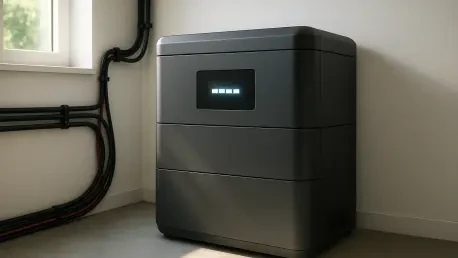

Christopher Hailstone brings expertise in grid reliability and renewable integration to our discussion on the shifting landscape of residential power. As homeowners look for ways to buffer themselves against rising utility costs, the transition toward compact, high-performance energy storage has never been more relevant. We explore how modular systems are transforming energy independence and making battery technology a standard, accessible feature for millions of modern households.
The STREAM 5000 delivers 5,000W of solar input and 3,000W of output from a 45kg unit. How did the team achieve this 40% footprint reduction while maintaining high power?
The team achieved this 40% reduction by optimizing internal cooling and component density within the 45kg frame. This engineering allows the 3,000W output to remain stable during peak usage without the massive floor space required by older systems. The cabin-bag size was a specific design choice to ensure the unit fits into standard household spaces like garages or utility rooms easily. It proves that high power density can be physically accessible and practical for the average modern home.
How does starting with a single 5kWh battery simplify the initial setup, and what are the specific steps for expanding this into a comprehensive whole-home energy system over time?
Starting with a single 5kWh battery provides a modular foundation that does not require a massive initial investment or complex home renovation. Homeowners can physically place the unit in a utility room and immediately begin storing solar energy for their daily needs. To expand, they simply integrate additional modular batteries as their energy demand increases, eventually building a whole-home system. This step-by-step approach removes the technical and financial hurdles that typically stall energy independence projects.
This system is rated to run appliances like tumble dryers and dishwashers. What are the performance metrics during peak usage, and how does the four MPPT configuration improve energy harvest?
The system is built to handle heavy-duty cycles from dishwashers and dryers using its robust 3,000W output capacity. During peak usage, the battery provides the necessary surge power to keep the household running smoothly without relying on the grid. The four MPPT configuration is crucial for energy harvest, as it allows the system to manage 5,000W of solar input from panels on different roof faces. This maximizes efficiency for varied roof layouts, ensuring every available watt is captured regardless of the sun’s position.
How does making battery storage more compact change the financial return on investment for the average household, and what are the practical space-saving benefits in smaller homes?
Making storage 40% more compact significantly improves the financial return by reducing installation complexity and the need for specialized storage areas. For the average family, this means avoiding the high costs of structural modifications to accommodate bulky equipment. In smaller homes, the space-saving benefits are vital; I have seen units tucked into cupboards that previously could not house any battery technology. By lowering these physical barriers, solar savings become accessible to millions who previously lacked the room for such systems.
How does this platform automate the storage of daytime solar energy, and what software features help users visualize their savings and monitor the health of the 5kWh battery?
The platform uses smart automation to capture up to 5,000W of solar input during the day and store it for use when grid prices peak in the evening. Through a dedicated software interface, users can visualize their daily savings and track the flow of energy from their panels to their appliances. This software also provides real-time monitoring of the 5kWh battery health, tracking charge cycles and performance metrics to ensure longevity. It turns a complex electrical process into a simple, visual dashboard that empowers homeowners to manage their costs effectively.
What is your forecast for home energy storage?
I believe energy storage will soon become as standard as a water heater in every modern residence. We will see a rapid shift toward high-density, modular units that require zero technical expertise to manage, effectively democratizing energy independence. As systems become more compact and power-dense, the distinction between being grid-connected and self-sufficient will blur, allowing neighborhoods to become more resilient through distributed power. Ultimately, smart companions will manage a home’s expenses and carbon footprint without the owner ever having to lift a finger.