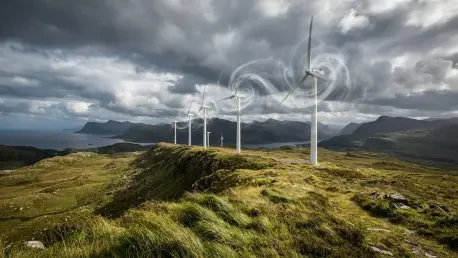

The traditional industry assumption that wind power increases with the cube of wind speed fails to hold true when turbines are placed on steep hilltop terrain. For years, wind energy developers have prioritized elevated ridges and summits, operating under the long-standing belief that the natural acceleration of wind over sloped landscapes would guarantee a significant boost in electricity production. This fundamental principle of wind physics suggests that even a minor increase in velocity should lead to a dramatic rise in kinetic energy capture. However, as the global energy transition moves into high gear in 2026, real-world data and advanced simulations from the Technical University of Denmark suggest a more complicated reality. The interaction between massive rotor blades and the rugged contours of the earth creates aerodynamic friction and pressure changes that standard industry models frequently overlook. Consequently, many high-altitude wind projects are currently failing to meet their projected energy targets, forcing experts to rethink the relationship between terrain and efficiency.
Rethinking Efficiency: The Impact of Complex Terrain
Challenging Assumptions: The Limitations of the Cubic Law
Traditional wind resource assessments have historically operated on the premise that a turbine’s maximum efficiency remains a constant value regardless of its geographical placement. This “one-size-fits-all” approach assumes that as long as the wind speed is known at a specific hub height, the total power output can be calculated using a universal formula. Research utilizing high-fidelity simulations has now demonstrated that this assumption is fundamentally flawed when applied to mountainous or hilly regions. By testing virtual 10-megawatt turbines across diverse landscapes, scientists found that the landscape itself dictates the theoretical efficiency ceiling of the machinery. When a turbine is positioned on flat ground, it operates within a stable flow field, but as the terrain becomes more complex, the air no longer interacts with the rotor in a linear fashion. This shift means that the actual efficiency is a dynamic variable that changes based on local topography, rendering standard cubic law predictions unreliable for projects located on steep inclines.
Aerodynamic Constraints: The Blockage Effect on Summits
The physical mechanism behind the energy loss on hilltops is primarily driven by how the terrain influences the movement of air after it has passed through the turbine rotor. In a typical setting on flat land, the wake or “used” air behind the blades expands and slows down in a predictable, unobstructed manner, allowing new wind to flow through the system. However, the unique geometry of a hilltop crest causes a sharp deceleration of the air immediately behind the turbine. This localized slowdown creates what aerodynamicists call a “blockage effect,” where the lingering air acts as a physical barrier to the incoming wind. Because the air cannot efficiently clear the area behind the blades, the pressure builds up in front of the rotor, forcing a portion of the incoming wind to flow around the turbine rather than through it. This reduction in mass flow through the rotor disk directly translates to a lower energy extraction rate, meaning that even fast winds on a ridge may produce significantly less power than expected.
Mechanical Performance: Identifying Operational Gaps
Breaking Discrepancies: Physical and Logic Failures
Quantitative analysis of recent simulation data has provided a stark look at the energy deficit when turbines are placed on ridges, showing that the maximum power coefficient can drop by over eighteen percent compared to flat ground. This finding essentially invalidates the cubic scaling law for these environments, suggesting that the actual relationship between wind speed and power is closer to a quadratic one or even lower in extreme cases. Interestingly, the research also identified a slight efficiency increase at the foot of hills, where the upward slope acts as a natural vacuum that helps pull air through the rotor more quickly. However, because wind speeds at the base of a hill are generally lower, these gains are rarely enough to offset the overall performance issues found at the summit. The current industry modeling tools fail to capture these subtle geographical nuances, leading to a systematic miscalculation of expected yields across complex landscapes that once seemed ideal for development.
Mechanical Blindness: The Failure of Standard Control Systems
Beyond the external physics of the wind, the internal mechanical logic of modern turbines contributes to the performance deficit. Most utility-scale turbines are equipped with standard torque controllers designed to maintain an optimal ratio between the generator’s torque and the square of the rotor speed. These systems were originally calibrated for flat-terrain environments where airflow is relatively horizontal and stable. When these same machines are installed on a hill, they continue to operate using flat-land logic, unaware that the local aerodynamic conditions have shifted. Because the controller is blind to the topography, it fails to adjust the blade pitch or generator load to account for the decelerating flow at the crest. This lack of situational awareness causes the turbine to settle into an operating state that is mismatched with the physical reality of its surroundings. This specific failure in machine logic results in additional systematic efficiency losses that persist over the entire lifespan of the project.
Future Modeling: Advanced Solutions for Yields
Beyond Speed: New Metrics for Performance Accuracy
As the industry continues to evolve in 2026, there is a growing consensus that measuring wind speed at hub height is no longer a sufficient metric for predicting project success. The latest research emphasizes that streamwise flow development—the complex behavior of air before and after it interacts with the rotor—is a much more critical variable for accurate forecasting. Traditional assessments often ignore the three-dimensional nature of the wind and how it interacts with the massive scale of modern hardware. As turbine rotors grow to diameters exceeding two hundred meters, they become comparable in size to the hills they are placed upon. This parity in scale makes the interaction between the machinery and the landscape increasingly volatile. By moving away from simplified cubic models and focusing on the full lifecycle of the wind as it moves through the entire farm, developers can finally begin to create more realistic expectations for hilltop sites and reduce the financial risks associated with underperforming assets.
Adaptive Yields: The Role of Real-time Optimization
To combat the systematic overestimation of power on hilltops, the wind sector is pivoting toward the implementation of adaptive control strategies that adjust to local conditions in real-time. One of the most promising technologies is extremum-seeking control, a software-based approach that allows a turbine to constantly probe and test different torque constants to find the actual local optimum for energy production. Unlike standard controllers that rely on fixed tables, an adaptive system can respond to the specific aerodynamic signature of a ridge or a valley. This allows the turbine to self-correct for the blockage effect and the pressure changes caused by the terrain. Implementing such technology could claw back a significant portion of the efficiency losses currently seen in hilly environments. While hardware costs for these advanced systems are higher, the long-term gains in efficiency and the reduction in mechanical stress offer a clear return on investment for operators looking to maximize the output of their high-altitude fleets.
Strategic Implementation: Optimizing Future Wind Development
The realization that hilltop turbines frequently underperformed relative to their theoretical potential necessitated a fundamental shift in the wind industry’s approach to site selection and machine calibration. To rectify the discrepancies identified by recent aerodynamic studies, engineers moved away from the simplistic cubic power law in favor of high-fidelity, three-dimensional flow modeling. It became clear that addressing the blockage effect and optimizing controller logic were the primary pathways to closing the performance gap. Moving forward, developers should prioritize the installation of lidar-based sensing and adaptive software updates for existing hilltop assets to recover lost efficiency. Furthermore, future planning must incorporate the specific slope and wake interaction data at the earliest stages of project design. By adopting these more rigorous standards, the energy sector ensured that the next generation of wind farms delivered the reliable, high-capacity performance required to meet global sustainability targets.