
Achieving an indicated thermal efficiency of over thirty-eight percent in a research engine demonstrates the potential for biofuels to compete with diesel architectures. The global transportation sector stands at a critical juncture, balancing the logistical demands of modern industry against the urgent necessity of environmental stewardship. Mechanical engineers and automotive researchers are currently navigating a landscape defined by the projected consumption of fifty-four percent of global primary energy by transportation between 2026 and 2050. Despite the high-profile expansion of battery electric vehicles, internal combustion engines (ICE) are projected to remain the primary power source for approximately eighty-five percent of road vehicles through 2040, particularly in heavy-duty transport, maritime shipping, and industrial power generation. Consequently, the research focus has shifted toward advanced combustion strategies and alternative fuel chemistries that can drastically reduce the sixteen percent of worldwide carbon dioxide emissions currently attributed to petroleum fuels. Among the most promising developments is Homogeneous Charge Compression Ignition (HCCI), which operates by auto-igniting a premixed, highly diluted fuel-air charge through compression heat, eliminating localized high-temperature flame fronts and fuel-rich zones that produce harmful pollutants.
Chemical Synergy: Balancing Reactivity with Stability
To address the inherent control challenges of HCCI, modern researchers have turned to fuel reactivity tailoring, which involves blending fuels with disparate chemical properties to create a mixture that responds predictably to the thermal environment of the engine cylinder. The focus on a dual-fuel blend of butanol and diethyl ether (DEE) creates a chemical environment that engineers can manipulate. Butanol, specifically second-generation biobutanol, is an alcohol-based fuel produced through the fermentation of non-food biomass. It is highly regarded in the engineering community for its superior energy density, low moisture absorption, and excellent miscibility with diesel compared to ethanol. However, its high research octane number (RON) and significant resistance to autoignition make it difficult to use in a lean HCCI environment without assistance. This chemical “laziness” requires a companion fuel that can initiate the ignition process under the lower-temperature conditions typical of high-efficiency, lean-burn cycles.
To compensate for the stability of butanol, diethyl ether is introduced as a highly reactive oxygenated fluid characterized by an exceptionally high cetane rating and a low autoignition threshold. When blended, these two fuels create a chemical “tug-of-war” that allows for precise combustion control. The DEE acts as a reactive trigger, initiating the low-temperature oxidation reactions necessary to start the combustion process, while the butanol provides the energy density and knock resistance required to sustain a controlled power stroke. By adjusting the volumetric proportions of these two components—categorized in this study as B15 (15% butanol), B30 (30% butanol), and B45 (45% butanol)—investigators are able to map a precise operating window where efficiency is maximized and mechanical stress is minimized. This synergy allows the engine to exploit the benefits of both high-reactivity and low-reactivity fuels, providing a pathway to stabilize HCCI across varying load conditions.
Experimental Framework: Mapping the Combustion Window
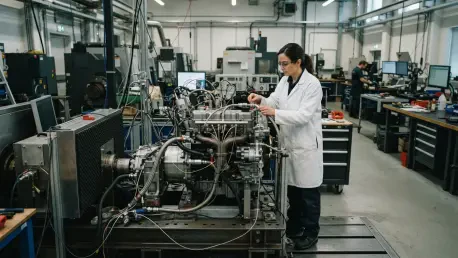
The empirical investigation was conducted using a modified four-stroke, single-cylinder research engine with a displacement of 450 cubic centimeters, providing a controlled environment for testing these complex fuel interactions. This specialized test bench was equipped with a 30-kilowatt direct-current dynamometer, allowing for precise control over engine speed and mechanical loading. A critical modification involved the installation of customized low-lift camshafts to manage internal gas dynamics. Standard engine profiles often trap too much residual exhaust gas, which, in an HCCI setup, can lead to premature autoignition and destructive engine knocking. The low-lift cams restricted this gas entrapment, providing a more stable environment for testing lean fuel charges. To ensure data integrity, the engine was preheated using conventional spark-ignition mode until the coolant and lubricating oil reached stable operating temperatures of 85°C and 90°C, respectively, before transitioning to HCCI mode.
Rather than relying on a trial-and-error approach, the research team utilized Response Surface Methodology (RSM) coupled with a face-centered Central Composite Design (CCD). This statistical framework allowed the researchers to evaluate three independent variables: the butanol blending proportion (15–45%), the air-fuel equivalence ratio or lambda (2.4–3.0), and the engine speed (800–1200 RPM). By running fourteen unique experimental configurations, the team generated second-order polynomial regression models to predict engine behavior across a wide range of conditions. This method identifies not only individual factor impacts but also the complex interactions between fuel chemistry and engine speed, which is essential for developing robust control logic for commercial applications. The use of CCD ensures that the experimental data points are distributed in a way that maximizes the accuracy of the resulting mathematical models, allowing for a thorough exploration of the engine’s operational limits.
Thermodynamic Performance: Efficiency and Consumption Trends
The primary metric for any advanced engine strategy is its ability to convert chemical energy into mechanical work while minimizing fuel consumption. Analysis of brake-specific fuel consumption (BSFC) revealed that the butanol ratio was the most significant factor influencing fuel economy, as confirmed by the high statistical significance in the analysis of variance. Interestingly, because diethyl ether has a lower heating value than butanol, mixtures with higher DEE concentrations required a greater fuel mass to produce the same amount of power. This highlights a fundamental trade-off in fuel reactivity tailoring: while higher reactivity improves ignition stability, it often leads to higher mass-based fuel consumption due to the lower energy density of the ignition promoter. Consequently, optimizing the blend involves finding the minimum amount of DEE required to ensure reliable ignition without unnecessarily diluting the energy content of the total fuel charge.
Elevating the butanol fraction to forty-five percent (B45) significantly improved the indicated thermal efficiency (ITE) across the testing range. This improvement was largely due to the way butanol interacts with combustion phasing, delaying the start of ignition and shifting the main heat release closer to top dead center (TDC). This synchronization ensures that the expansion stroke can extract the maximum possible work from the high-pressure gases generated during the burn. The highest experimental thermal efficiency recorded during the trials reached 33.9%, which represents a substantial improvement over the 25–27% range typically observed with lower butanol concentrations or standard ignition strategies. These data suggest that high-alcohol blends, when properly managed with reactive additives, can bridge the efficiency gap between traditional gasoline engines and their diesel counterparts while maintaining the clean-burning benefits of a homogeneous charge.
Mechanical Load: Capacity and Operational Stability
Indicated mean effective pressure (IMEP) serves as the benchmark for an engine’s load-carrying capacity; findings showed that IMEP increased as both butanol concentration and engine speed were raised. The high latent heat of vaporization of butanol plays a crucial cooling role during the intake stroke, which increases the density of the air-fuel charge and allows for a more robust chemical energy release during the expansion phase. At 1200 RPM with the B45 blend and a lambda of 2.4, the engine achieved a peak IMEP of 4.6 bar. This ability to maintain higher loads is a significant development for HCCI technology, which has traditionally been limited to low-load idle or cruising conditions. The cooling effect of the alcohol fuel effectively acts as an internal charge cooler, allowing more oxygen and fuel to be packed into the cylinder without reaching the thermal limits that trigger pre-ignition.
Increasing the load in an HCCI engine often comes at the cost of operational stability, which is quantified by the coefficient of variation (COV) of the IMEP. High COV values indicate erratic combustion that can lead to misfiring or rough engine operation. Data showed that higher lambda values (leaner mixtures) and increased butanol content helped stabilize the engine by suppressing the violent pre-ignition tendencies of pure DEE. By slowing the initial chemical reactions, butanol allowed for a smoother transition between cycles. Statistical analysis confirmed that lambda and butanol content were the primary determinants of this stability, while engine speed had a negligible effect on cyclic variation. This suggests that the chemical composition of the fuel is a far more powerful tool for governing HCCI stability than mechanical adjustments, such as changing engine speed or intake pressure.
Structural Integrity: Managing Cylinder Pressure Peaks
One of the most dangerous phenomena in HCCI combustion is an excessive maximum pressure rise rate (MPRR). If the fuel charge ignites too rapidly, the resulting pressure spike can exceed 10 bar per crank angle degree, leading to “knocking,” which can cause catastrophic mechanical failure, shattering pistons and damaging bearings. The experimental results demonstrated that butanol acts as a potent mechanical stabilizer in this regard. By increasing the butanol ratio from fifteen to forty-five percent, researchers were able to drop the MPRR from a dangerous 12.24 bar per crank angle degree down to a safe 5.08 bar. This reduction is attributed to butanol’s ability to distribute the heat release over a longer interval, preventing the instantaneous energy “dump” characteristic of high-reactivity fuels like diethyl ether. This mechanical damping effect is vital for extending the lifespan of high-compression research engines.
The study identified the air-fuel equivalence ratio, or lambda, as the most influential factor in controlling these pressure spikes, reinforcing the idea that lean dilution is essential for the longevity of high-efficiency engines. In a lean environment, the excess air acts as a thermal buffer, absorbing some of the energy released during combustion and slowing the overall reaction rate. This prevents the rapid pressure increases that would otherwise occur in a stoichiometric mixture. By balancing butanol levels with lean air-fuel ratios, the research demonstrated that it is possible to maintain high thermal efficiency without compromising the structural integrity of the engine. This finding is particularly relevant for the development of heavy-duty HCCI engines, where high peak pressures are common and mechanical durability is a primary requirement for commercial adoption in the industrial sector.
Combustion Phasing: Aligning Heat Release Timing
To truly understand why these fuel blends work, the study examined the timing of heat release, specifically looking at CA10, the point where 10% of the fuel has burned, and CA50, the midpoint of combustion. The diethyl ether component was found to be the primary driver of the early combustion stages. In blends with high DEE concentrations, CA10 occurred well before top dead center, which can be counterproductive as it forces the piston to work against rising pressure during the final stages of the compression stroke. This “negative work” reduces overall efficiency and increases mechanical stress. As the butanol fraction increased, the start of combustion was delayed, moving the heat release into a more favorable position where the pressure rise contributes directly to the downward movement of the piston, thereby maximizing the torque produced during the expansion cycle.
Interestingly, while the higher butanol content delayed the start of combustion, the total combustion duration was actually shorter for the B45 blend compared to mixtures with more diethyl ether. This seems counterintuitive, but it is explained by the fact that the B45 mixture ignites closer to top dead center, where temperatures and pressures are much higher. These intense conditions accelerate the high-temperature chemical kinetics once the initial ignition delay period is over, resulting in a “fast and clean” burn. This alignment of the combustion midpoint with the ideal thermodynamic window is the fundamental reason for the observed gains in thermal efficiency. The ability to control both the start and the duration of combustion through fuel blending provides a level of precision that was previously thought impossible without active hardware like spark plugs or high-pressure injectors.
Environmental Impact: Navigating the Emissions Trade-off
While HCCI is celebrated for its ability to reduce nitrogen oxides (NOx) and soot to near-zero levels, it still struggles with the oxidation of carbon monoxide (CO) and unburned hydrocarbons (HC). Because peak flame temperatures in low-temperature combustion are relatively low, the chemical reactions required to convert CO into CO2 are often incomplete. The study noted a consistent upward trend in CO and HC emissions as butanol concentration and lambda were increased. The cooling effect of butanol’s vaporization, while beneficial for air density and knock suppression, can quench the flame near the cylinder walls, where the metal surfaces are cooler than the center of the chamber. This leaves a thin layer of unburned fuel that is eventually pushed out through the exhaust valve, necessitating a more complex approach to emissions management.
Conversely, blends with higher diethyl ether content showed lower hydrocarbon emissions because the extra oxygen atoms in the DEE molecule and its superior low-temperature reactivity promote a more thorough “cleaning” of the combustion chamber. This creates a classic engineering trade-off: higher butanol concentrations improve efficiency and mechanical safety but require more sophisticated exhaust aftertreatment to manage carbon-based emissions. This highlights the need for a holistic approach to engine design, where fuel chemistry is paired with advanced catalytic converters or oxidation catalysts. Managing these emissions at light loads remains a significant hurdle for the commercialization of HCCI technology, but the use of oxygenated biofuels provides a distinct advantage over traditional petroleum-based fuels by supplying the oxygen necessary for more complete oxidation within the cylinder itself.
System Optimization: Path Toward Commercial Viability
The culmination of the research involved using Response Surface Methodology to find the “sweet spot”—the exact combination of variables that balances the competing interests of efficiency, load, and mechanical safety. The team sought a solution that maximized thermal efficiency while minimizing fuel consumption, mechanical stress, and toxic emissions. The analytical framework determined that the optimal operating point for this specific engine configuration was an engine speed of 1200 RPM, a lambda of 2.4, and a fuel blend containing 38.17% butanol. This configuration yielded a composite desirability rating of 73.9%, suggesting a highly effective balance among the various performance metrics. This optimization provides a clear blueprint for how dual-fuel HCCI engines can be calibrated to meet the rigorous demands of modern transportation and power generation.
The investigation into butanol and diethyl ether blends established a rigorous empirical foundation for the next generation of internal combustion technology. By proving that chemical reactivity tailoring can successfully govern the complex auto-ignition processes of an HCCI engine, the research moved the industry closer to a scenario that combines diesel-like efficiency with clean-burning characteristics. The project successfully mapped the interactions between biofuels and advanced engine cycles, providing actionable data for heavy transportation and industrial applications. Future considerations must focus on scaling these results to multi-cylinder architectures and developing control systems that can adjust fuel blend ratios in real-time based on varying load demands. Ultimately, the ability to achieve nearly 39% thermal efficiency in a research-scale engine suggested that with further refinement, HCCI powerplants could play a vital role in reducing the carbon footprint of global logistics.