
The movement of the cooling front through a simulated reservoir occurs at different speeds, with longitudinal velocity reaching 1.0 cm/min while radial propagation lags at 0.75 cm/min. This specific observation serves as a cornerstone for the latest research into the Single-Well Enhanced Geothermal System, an innovative approach to harvesting sustainable energy from the earth’s interior. Published in the February 2026 issue of the journal Geothermal Energy, the work led by Ma Bo addresses the chronic inefficiency of traditional Deep Borehole Heat Exchangers. In those conventional systems, the primary bottleneck is the low thermal conductivity of solid rock, which forces energy extraction to rely on slow conduction. By contrast, this new system utilizes an engineered permeable zone to trigger a shift from conduction to convection, allowing fluids to circulate directly through the rock matrix. This transformation significantly enhances the rate of heat recovery, offering a potential solution to the stagnation that has hindered large-scale geothermal adoption. The study provides a rigorous quantitative framework that moves beyond theoretical models into verifiable physical simulations, identifying the specific mechanics required to maintain high-grade thermal output over extended operational periods.
Subsurface Architecture: Replicating a Geothermal Reservoir
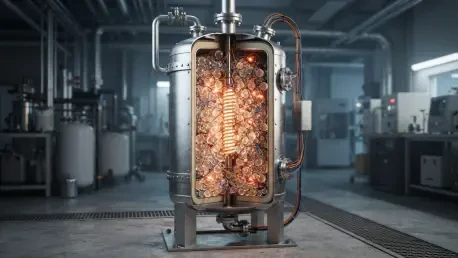
To test the feasibility of the concept, the research team developed a sophisticated laboratory-scale simulation using a large-scale sandbox designed to mimic complex geological conditions. This stainless steel cylinder stands 1.5 meters tall with a diameter of 1 meter, providing a substantial volume for monitoring thermal behavior. To ensure the accuracy of the resulting data, the entire apparatus was heavily insulated to maintain adiabatic boundary conditions, which effectively prevents external temperature fluctuations from skewing the observations. The reservoir medium consisted of high-precision glass beads ranging from 0.8 to 1.2 millimeters in diameter, chosen specifically to create a homogeneous porous medium that replicates the hydraulic and thermal properties of a fractured rock matrix. By using such a controlled material, the researchers could isolate the effects of fluid flow and heat exchange without the unpredictable interference of natural geological variations, establishing a baseline for how a “well-within-a-well” architecture performs under pressure.
The physical properties of this simulated environment were documented with meticulous detail to ensure reproducibility in future field applications. The glass beads possessed a density of 1500 kg/m³, a specific heat capacity of 800 J/(kg·K), and a thermal conductivity of 2.5 W/(m·K). With an average porosity of 0.35, the team utilized the Kozeny–Carman equation to determine a permeability of 8.92 × 10⁻¹⁰ m². This precise environment allowed for the observation of water flow as it was injected through an annular space and subsequently recovered through an inner production pipe. This configuration represents a significant departure from older designs, focusing on how a localized permeable zone can be managed to maximize contact between the working fluid and the surrounding heat source. The findings from this setup suggest that the physical arrangement of the medium is just as important as the fluid dynamics themselves, as the permeability directly dictates the efficiency of the convective heat transfer that the study sought to optimize.
Precision Measurement: Validation of the Thermal Front
Maintaining scientific integrity required a high-density sensor network to monitor the thermal front’s progression in three dimensions throughout the test period. The temperature within the sandbox was tracked at 44 specific points using calibrated PT100 thermal resistors arranged along two longitudinal lines and one transverse line. This setup allowed the researchers to capture a detailed view of how the cooling front moved through the glass bead matrix over time. By placing sensors at various radial depths and longitudinal positions, the team could identify exactly how the thermal gradient shifted as cool water was introduced into the warm environment. The fluid flow itself was measured using an electromagnetic flowmeter, ensuring that every liter of water moved through the system was accounted for in the final energy balance calculations. This level of granularity in measurement is essential for identifying the precise moment of thermal breakthrough, which is often the primary cause of failure in operational geothermal wells.
The reliability of these physical findings was further bolstered by comparing the experimental results against numerical simulations based on Darcy’s law and local thermal equilibrium. These models showed an impressive correlation with the physical tests, providing a high degree of confidence in the laboratory outcomes. Although a maximum variance of 8% was noted during the initial phase of operations, the simulated and observed temperature histories converged as the system stabilized, confirming that the laboratory model is a robust proxy for real-world dynamics. This validation process is critical because it allows engineers to use the laboratory data to refine computer models that will eventually guide the construction of full-scale geothermal sites. By proving that the experimental data aligns with established mathematical laws, the research team has created a trustworthy foundation for scaling the technology to meet industrial energy demands in various geological settings.
Fluid Dynamics: Managing the Risk of Thermal Breakthrough
One of the most critical variables investigated during the trials was the injection flow rate, which revealed a sharp trade-off between immediate energy volume and long-term system longevity. When the injection flow rate was set at 0.3 cubic meters per hour, the system maintained a stable production temperature for 50 minutes. However, doubling this flow rate to 0.6 cubic meters per hour increased the average heat flow rate from 8.9 to 22.3 kilowatts while simultaneously slashing the stable production window to a mere 25 minutes. This phenomenon highlights the danger of thermal breakthrough, where the cooled injection water reaches the production zone before the surrounding rock can adequately reheat it. The findings suggest that while higher flow rates are effective for high-intensity short-term energy needs, they may compromise the long-term viability of a well if not managed carefully. Operators must therefore balance the desire for rapid heat extraction with the natural recharge capabilities of the reservoir to avoid exhausting the resource prematurely.
The study also highlighted how the initial reservoir temperature and the temperature of the injected water dictate the total energy potential of a given site. Tests performed at 50, 60, and 70 degrees Celsius showed that higher reservoir temperatures naturally led to higher heat flow rates, peaking at 24.76 kilowatts in the hottest scenario. However, this higher thermal gradient also resulted in a more rapid decline in production quality; the 70-degree reservoir experienced a 33.43% decline in production temperature over the test hour, compared to only a 20% drop in the 50-degree reservoir. Interestingly, the researchers found that raising the temperature of the injected water could serve as a valuable control lever. While warmer injection water slightly reduced the total heat flow rate, it significantly mitigated the risk of thermal breakthrough. This creates a flexible operational strategy where the injection temperature can be adjusted to extend the operational lifespan of a geothermal site when the demand for peak power is lower.
Geometry Optimization: The Impact of Wellbore Configuration
Perhaps the most significant finding regarding the physical architecture of the system involved the axial distance between the injection and production screens. By increasing this spacing from 90 to 120 centimeters, the research team observed a dramatic improvement in overall performance and thermal stability. The wider gap allowed the fluid more time to traverse the rock matrix, which facilitated a much more thorough exchange of heat between the water and the glass beads. This structural adjustment increased the average production temperature by 4.4 degrees Celsius and boosted the heat flow rate by 2.6 kilowatts. More importantly, the total temperature decay over the test period was reduced from 31.5% to only 8.0%. This suggests that geometric optimization of the wellbore is one of the most effective ways to ensure long-term stability, proving that the physical design of the well is just as influential as the thermodynamic properties of the fluid being used.
The research provided a detailed quantification of how the cooling front migrations through the reservoir during active extraction. Data revealed that the cooling front moves downward at a velocity of 1.0 cm/min while the radial propagation moves at a slower rate of 0.75 cm/min, creating an elongated, elliptical thermal pattern within the subsurface. The most intense cooling occurred between the depths of 50 and 80 centimeters, with a depth-averaged cooling rate of 0.42 °C/min. This spatial mapping is vital for engineers when determining the placement of multiple wells within a single field to avoid thermal interference between adjacent extraction points. By understanding the specific shape and speed of the cooling front, developers can design well patterns that maximize the use of the available heat without causing localized “cold spots” that could diminish the performance of the entire field. This spatial awareness is a significant step forward in the technical planning of enhanced geothermal systems.
Strategic Implementation: Transitioning to Industrial-Scale Application
After synthesizing the data from various experimental trials, the researchers proposed an optimal configuration for the tested system that maximizes efficiency without sacrificing longevity. They determined that a specific balance, featuring a flow rate of 0.4 cubic meters per hour combined with an injection temperature of 31 degrees Celsius and a screen spacing of 120 centimeters, provided the most sustainable results. This combination allowed for high-grade heat production while preventing the rapid thermal degradation seen in more aggressive operational settings. These parameters offer a clear blueprint for maintaining steady energy output, ensuring that the reservoir’s natural thermal recharge can keep pace with extraction. Such a balanced approach is essential for moving the technology from the laboratory into the field, where economic viability depends on the ability to produce consistent energy over several decades rather than just a few years.
Ultimately, the research established a critical proof-of-concept for the Single-Well Enhanced Geothermal System by successfully overcoming the limitations of conduction-based extraction. The team demonstrated that engineered convective pathways could significantly enhance heat recovery, providing a quantitative framework that was previously missing from the geothermal industry. These findings aligned with broader efforts to diversify energy supplies and reduce carbon emissions, specifically supporting objectives to integrate more renewable sources into the grid. Although the laboratory setting used a homogeneous medium that did not account for every geological complexity, the fundamental principles of well spacing and flow management remained applicable to future field-scale pilot studies. The study concluded that with precise engineering of the reservoir and well geometry, single-well systems could become a highly viable component of the global renewable energy portfolio, offering a scalable solution for clean heat extraction.