
The transition toward a fully decarbonized electrical grid has shifted from a mere goal to an urgent operational necessity as variable energy sources become the dominant contributors to global power supply. In the current landscape of 2026, the challenge is no longer just about generating green electrons, but ensuring those electrons are available precisely when and where they are needed to maintain grid stability. This evolution requires a fundamental departure from passive generation toward a model of dispatchable clean power that can emulate the reliability and responsiveness of traditional fossil fuel plants. Envision Energy has emerged at the forefront of this movement by integrating sophisticated grid-forming technologies and long-duration storage solutions that allow renewable assets to actively support the electrical infrastructure. By focusing on the intersection of power electronics and intelligent control systems, they are bridging the gap between intermittent generation and the rigorous demands of modern residential energy consumers.
Evolution of Grid Stability and Inverter Technology
Intelligent Controls: Reliable Frequency Support
The core hurdle for modern energy infrastructure is the natural variability of renewable sources, which requires advanced grid-forming capabilities to maintain stability. Envision’s 385 kW PV string inverters are designed to act as active grid supporters rather than passive followers, providing a coordinated frequency response when paired with battery systems. This ensures that the energy supply remains steady and responsive to the fluctuating demands of the electrical grid. Unlike traditional inverters that simply follow the grid’s voltage and frequency, these new systems create their own reference signals, allowing them to restart the grid in the event of a blackout or maintain stability during sudden load shifts. This technological leap is essential for regions where renewable penetration has surpassed 50 percent, as it provides the necessary inertia that was previously supplied by the rotating masses of heavy turbines in fossil fuel plants. By stabilizing the frequency in real-time, these inverters prevent the cascading failures that occur.
Technical Optimization: Fault Localization and Recovery
Reliability is further bolstered by a distributed Maximum Power Point Tracking design that localizes potential faults to individual solar arrays, preventing widespread plant failures. By combining these advanced power electronics with millisecond-level coordination between solar modules and storage, the system achieves smooth ramp-rate control. This high level of technical integration allows clean energy plants to function with the same dependability as traditional power facilities. The granular level of monitoring and control means that if one section of a massive solar farm experiences a drop in irradiance due to cloud cover, the system can instantly compensate through adjacent storage units. This rapid-fire response prevents the flickering and voltage sags that historically plagued large-scale solar projects. By isolating faults at the source, maintenance teams can address issues without taking the entire facility offline, significantly improving the uptime and overall yield of the investment over time while reducing the total cost of ownership.
High-Performance Storage and Specialized Infrastructure
Utility-Scale Efficiency: Long-Duration Battery Systems
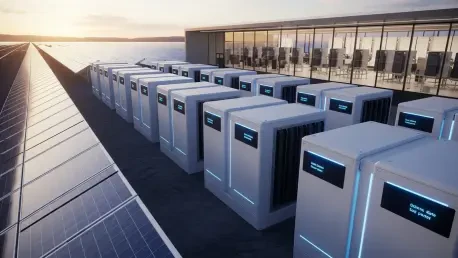
As the duration of energy storage becomes more critical for grid independence, Envision has introduced the Gen8 4.X series utility systems to meet the growing need for long-term energy shifts. These units are specifically built for long-duration applications, providing anywhere from 8 to 16 hours of storage capacity. By using in-house developed battery cells and silicon carbide power electronics, the system achieves a 91% round-trip efficiency and can handle massive overloads during transient events. The transition to silicon carbide represents a major advancement in power density and thermal management, allowing the inverters to operate with minimal cooling requirements even in extreme environments. Furthermore, the 16-hour discharge capability shifts the role of batteries from simple peak-shaving tools to legitimate base-load providers. This capability allows grid operators to rely on stored solar energy long after the sun has set, effectively bridging the gap without needing to fire up gas peaker plants.
Streamlined Power Delivery: High-Density AI Workloads
To support the rapid expansion of the AI sector, Envision developed a 2.5 MW Solid-State Transformer that converts high-voltage AC directly to 800 V DC for streamlined operation. This digital platform simplifies the power conversion process, cutting the electrical infrastructure footprint in half and allowing data center operators to maximize their hardware density. When paired with a dual-chemistry battery approach that uses both lithium and sodium-ion cells, this infrastructure lowers the cost of AI processing by more than 30% while ensuring constant system availability. The elimination of multiple conversion stages between the grid and the server rack is a game-changer for data centers that are currently struggling with the heat and space requirements of high-performance GPUs. By delivering DC power directly to the systems that use it, the SST reduces energy losses that typically occur in traditional transformer and rectifier setups for digital systems that drive the global economy.
Implementing Scalable Solutions for Grid Resilience
The integration of advanced grid-forming inverters and long-duration storage provided a clear pathway for utilities to manage the complexities of a renewable-heavy grid. These systems demonstrated that clean energy could indeed match the dispatchability of traditional power sources when supported by intelligent controls and high-efficiency hardware. The reduction in land use and the optimization of power delivery for high-demand sectors like AI significantly improved the economic outlook for large-scale energy projects. Moving forward, the focus shifted toward the mass deployment of these integrated systems across diverse geographic regions to ensure uniform grid stability. Industry leaders prioritized the standardization of solid-state transformer interfaces to allow for even faster scaling of data center infrastructure. By focusing on the intersection of digital control and physical storage, the energy sector achieved a level of reliability that once seemed unattainable through older generation methods.