
This KRW 3 billion contract demonstrates that domestically developed South Korean research is internationally competitive in the growing market for small modular reactors. As the global maritime industry witnesses a transformative shift toward zero-emission energy sources, traditional fossil fuels face increasing regulatory and environmental pressures that necessitate radical innovation. By merging the advanced engineering capabilities of the Korea Atomic Energy Research Institute with the innovative concepts of Saltfoss, a subsidiary of Seaborg Technologies, this partnership aims to redefine how ocean-going vessels and coastal communities access clean power. The collaboration focuses specifically on the development of Molten Salt Reactor technology, which utilizes a liquid fuel that inherently prevents the types of meltdowns associated with conventional solid-fuel plants. As the world demands more resilient and portable energy solutions, the synergy between Danish design and South Korean manufacturing expertise provides a robust framework for commercializing these floating power plants through 2029.
Advancing Molten Salt Reactor Designs: the Core Partnership
The technical core of this partnership centers on the Compact Molten Salt Reactor, a design that employs a liquid fluoride salt mixture as both the fuel and the coolant. Unlike traditional pressurized water reactors that require massive containment structures and high-pressure systems, the MSR operates at near-atmospheric pressure, significantly reducing the physical footprint and material costs of the unit. Saltfoss has pioneered a unique moderator approach using sodium hydroxide, which allows for a more compact core design compared to graphite-moderated systems. KAERI contributes its extensive experience in nuclear materials science and safety analysis to ensure that these designs meet the rigorous standards required for maritime deployment. This technical exchange is not merely about blueprints; it involves the creation of comprehensive safety assessment software and experimental validation protocols that will govern the operational life of the reactor from 2026 to 2030. This ensures that every component is optimized for the harsh, corrosive environments characteristic of marine operations.
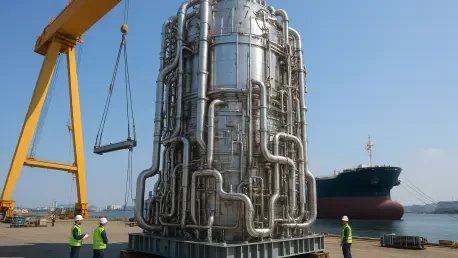
Under the terms of the newly finalized agreement, the South Korean research team will provide critical safety evaluation reports and specialized computational fluid dynamics modeling to assist Saltfoss in securing international regulatory approvals. This collaboration is particularly significant because it bridges the gap between theoretical reactor design and the industrial manufacturing capabilities that South Korea possesses in abundance. The focus remains on modularity, allowing the reactors to be built in shipyards and then transported to their final destinations, whether they are powering hydrogen production facilities or desalination plants. By utilizing existing shipyard infrastructure, the partnership can drastically reduce the time and capital expenditure typically associated with nuclear construction. The integration of Saltfoss’s innovative salt-based moderator with KAERI’s sophisticated simulation tools represents a milestone in nuclear engineering, proving that public-private partnerships across borders are essential for solving the complex thermodynamic challenges inherent in small modular reactor development.
Establishing Global Safety Standards: the Path to Deployment
One of the primary hurdles for floating nuclear technology is the creation of a standardized international regulatory framework that governs nuclear assets moving across territorial waters. To address this, the partnership is focusing on the development of safety-by-design principles, where the physical properties of the fuel salt provide inherent safety without the need for operator intervention or external power. If the reactor experiences a significant temperature spike, the expansion of the salt naturally slows the fission process, and a freeze plug can melt to drain the fuel into subcritical storage tanks. KAERI’s role in verifying these passive safety systems is essential for gaining the trust of global maritime authorities and local communities. The data generated through this research will likely form the basis for new international standards for maritime nuclear safety, facilitating smoother transitions for other companies entering the space. This proactive engagement with safety modeling helps to demystify nuclear energy and highlights its potential as a reliable, safe partner for the modern shipping industry.
The finalized agreement between KAERI and Saltfoss established a clear roadmap for the integration of modular nuclear power into the maritime sector. Stakeholders moved beyond theoretical discussions to implement rigorous engineering workflows that prioritized both safety and manufacturability. To maintain this momentum, industry leaders focused on building a robust supply chain for high-purity fluoride salts and specialized nickel-based alloys capable of withstanding long-term exposure to molten fuel. This proactive approach to material sourcing ensured that the transition from research to commercial deployment remained on schedule. Furthermore, the collaboration emphasized the importance of workforce development, as engineers were trained in the unique maintenance requirements of floating reactors. By aligning technological innovation with practical industrial capacity, the partnership provided a blueprint for future clean energy projects. The focus then shifted toward engaging with international maritime organizations to finalize the legal protocols for cross-border reactor operations, ensuring that the next generation of floating power plants operated within a secure and regulated global environment.