
Christopher Hailstone is a seasoned veteran in the energy sector, bringing decades of expertise in grid reliability, utility management, and the evolving landscape of renewable fuels. As a primary advisor on energy security, he has monitored the rapid transformation of the fuel industry as it balances traditional resource management with ambitious sustainability targets. Today, he shares his perspective on the logistical triumphs and future hurdles of the ethanol blending program, providing a deep dive into how raw material shifts and infrastructure scaling are reshaping the national energy strategy.
Maintaining a 20% blending rate requires a monthly intake of roughly 90 crore liters. What logistical adjustments have Oil Marketing Companies made to handle these volumes, and what specific steps are needed to ensure the annual requirement of 1,350 crore liters is met without supply disruptions?
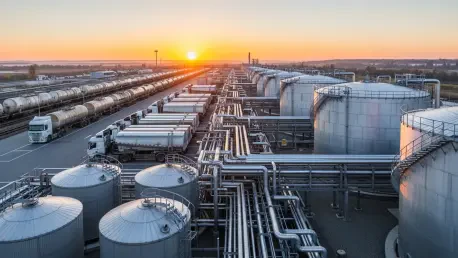
The logistical shift has been nothing short of a massive industrial overhaul, as moving 90.1 crore liters in a single month like April requires a seamless chain of transport and storage. Oil Marketing Companies have had to significantly expand their terminal capacities, ensuring that Public Sector Units can maintain high stock levels, which reached about 90.1 crore liters earlier this year. To hit that 1,350 crore liter annual target, we are looking at a constant rotation of supply where the 513.6 crore liters received in the first half of the year must be matched by even more aggressive procurement in the second half. This requires real-time monitoring of blending hubs to ensure the 542.7 crore liters already blended stay ahead of the incoming supply curve to prevent any bottlenecks at the pump.
Maize now represents over 45% of ethanol feedstock, significantly outpacing rice and sugarcane juice. How does this shift toward grain-based ethanol affect the stability of the supply chain, and what are the primary challenges in managing the storage and processing of such diverse raw materials?
Moving toward a grain-heavy model, where maize accounts for 478.9 crore liters, adds a layer of complexity because these materials have different storage requirements compared to traditional molasses. While sugarcane juice contributes a solid 165.9 crore liters, the reliance on maize and 233.3 crore liters of FCI rice means we are now deeply integrated with the seasonal cycles of the agricultural grain market. The challenge lies in the moisture control and pest management of these dry feedstocks, which are far more susceptible to spoilage than B-heavy molasses. We are essentially managing a dual-track supply chain where industrial ethanol production must now mirror the sophisticated storage infrastructure of a national food reserve.
Manufacturers recently offered over 1,700 crore liters of ethanol, but only about 1,048 crore liters were allocated. What factors contribute to this discrepancy between production offers and actual procurement, and how can the industry better align manufacturing capacity with current blending mandates?
The discrepancy between the 1,776 crore liters offered and the 1,048 crore liters allocated highlights a classic “infrastructure gap” where production speed has outpaced the current 20% blending limit. Even though manufacturers are ready to flood the market with nearly double the required volume, the OMCs are restricted by the physical volume of petrol consumed and the technical caps on blending. To bridge this, we need to look beyond the initial 1,050 crore liter tenders and find ways to absorb the excess capacity. Aligning this requires a policy shift that allows for higher stocks or perhaps a pivot toward export markets for the surplus, otherwise, we risk discouraging investment in a sector that is clearly ready to do more.
Ethanol blending has climbed from 10% to 20% in just a few years, helping reduce dependence on imported crude oil. What have been the most significant economic benefits of this rapid scale-up, and what infrastructure improvements were essential to support this transition?
The economic impact is most visible in the massive foreign exchange savings we see as we chip away at our crude oil import bill, moving from 12.06% blending just a few years ago to a steady 20% today. By blending 1,022.4 crore liters in the previous year alone, we kept a significant portion of our energy spending within our borders, directly benefiting the rural economy. To make this work, the industry had to fast-track the conversion of distilleries and enhance the precision of blending equipment at the distribution terminals. This transition also required a psychological shift for the automotive sector, proving that our infrastructure could handle the corrosive nature of higher ethanol concentrations without compromising vehicle performance.
Current ethanol production capacity has begun to exceed the 20% blending requirement, leading to calls for higher targets. What technical or regulatory barriers prevent an immediate move beyond 20%, and how would a further increase impact the domestic automotive and agriculture sectors?
The primary barrier isn’t the will to do it, but rather the “blend wall,” which is the point where the current vehicle fleet can no longer safely use higher concentrations without engine modifications. While manufacturers have successfully delivered 14.60% and then 19.24% in consecutive years, moving to 25% or 30% requires a coordinated rollout of flex-fuel vehicles. For the agricultural sector, a target increase would be a massive windfall, potentially absorbing the remainder of that 1,776 crore liter production capacity and providing a stable floor price for maize and damaged grains. However, we must proceed carefully with regulations to ensure that food security isn’t compromised as we divert more grain from the table to the fuel tank.
What is your forecast for ethanol blending?
I predict that the momentum built over the last few years, which saw blending targets met well ahead of schedule, will inevitably push us toward a 25% mandate by the end of the decade. With the current supply year already hitting the 20% mark consistently since November 2025, the pressure from underutilized production capacity will force a regulatory expansion. We will likely see a more diversified feedstock portfolio where the 1.16% share of C-heavy molasses grows alongside sophisticated waste-to-fuel technologies. Ultimately, the success of the 2025-26 cycle, with its massive 1,350 crore liter requirement, will serve as the final proof-of-concept needed to transition ethanol from a supplemental additive to a primary pillar of our national fuel strategy.