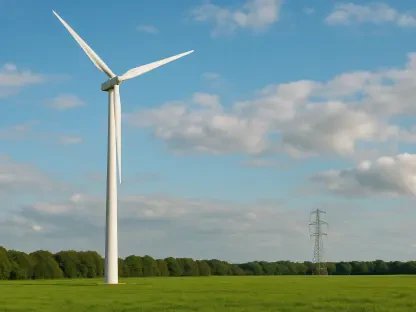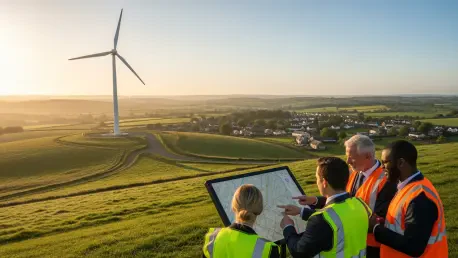

The rhythmic rotation of a wind turbine against the skyline often sparks debate about aesthetic impact, yet for many residents across the United Kingdom, these structures are beginning to represent something far more valuable than just a shift in the view. Instead of being seen as industrial intrusions, these spinning blades are increasingly viewed as engines for local prosperity. This shift occurs when the energy produced does not simply disappear into a national grid managed by a distant corporation, but instead provides the financial foundation for essential community assets.
GB Energy, a publicly owned organization headquartered in Aberdeen, is currently spearheading a campaign to establish 1,000 community-led renewable projects between 2026 and 2030. This initiative represents a radical move away from the traditional top-down energy model that has historically favored multinational utility firms. By placing the means of energy production into the hands of local residents, the government aims to democratize the power sector while meeting ambitious climate targets.
Turning the Visual Disturbance of Wind Turbines Into Tangible Local Gains
The logic behind this decentralized vision centers on the mitigation of economic leakage. In traditional commercial models, the revenue generated by wind and solar farms is extracted as profit for international shareholders, providing little direct benefit to the host region. Localized ownership ensures that surplus funds remain within the town or village, creating a circular economy where renewable assets fund everything from banking hubs to shared community workspaces.
As the energy transition accelerates, the role of GB Energy is to serve as both a catalyst and a financial backer for these grassroots efforts. Head of Local Energy Strategy, Fraser Stewart, emphasizes that the strategy is not intended to replace massive commercial developments entirely but to supplement them with more intimate, resilient projects. This dual approach acknowledges that while large firms provide scale, community projects provide the social license necessary for a green transition.
The Evolution of UK Energy: From Multinational Dominance to Localized Ownership
Historically, the UK energy sector has been dominated by a few major players who managed the vast majority of the nation’s generation capacity. This centralized structure often left local communities as passive observers or, in some cases, opponents of infrastructure developments. The pivot toward community ownership marks a significant evolution, as it allows people to move from being simple energy consumers to being collective owners of the infrastructure they live alongside.
By the year 2030, the successful implementation of this 1,000-project target could redefine the economic geography of energy in the United Kingdom. This strategy seeks to prove that local power is not a fringe interest but a viable economic driver for hundreds of thousands of people. The focus is on creating a self-sustaining ecosystem where the profit from the wind or sun directly improves the quality of life for the people in the immediate vicinity.
Lessons From Huntly and the Economic Realities of Local Power
The town of Huntly in Aberdeenshire provides a compelling proof of concept for what is possible when a community takes control of its energy future. Over a decade, a single 500kW community-owned turbine has generated approximately £1.5 million in profit. These funds were instrumental in revitalizing the town center, most notably through the restoration of a local cinema and the creation of essential services that commercial providers had abandoned.
However, the journey for Huntly was characterized by significant bureaucratic and technical challenges. It took six years from the project’s inception to secure funding and overcome the hurdles of connecting to the electrical grid. Donald Boyd of the Huntly Development Trust noted that the expense and complexity of grid access remain the most formidable barriers for small-scale groups. These lessons are now being used to streamline processes for the next generation of projects.
Balancing Ambitious Scaling With Institutional and Political Critique
Despite the optimism, the rapid expansion of GB Energy has attracted significant scrutiny from political opponents who question the organization’s efficacy. Critics, including Conservative MP Harriet Cross, have characterized the entity as an ideological project that has yet to deliver on its more ambitious job-creation promises. Concerns have been raised about the actual rate of investment and whether the entity’s role has been diluted since its high-profile launch.
The organization currently operates with a modest staff of roughly 30 permanent employees, a figure that critics point to as evidence of a slow start. However, the leadership remains confident in its scaling trajectory, with plans to expand the Aberdeen headquarters to 300 staff members. The focus is on building a robust institutional framework that can handle the sheer volume of 1,000 concurrent projects without compromising on technical oversight or financial accountability.
Practical Frameworks for Launching Self-Sustaining Community Power Projects
To reach the target of 1,000 projects, communities must adopt a strategic approach to selecting technology and sites. While large-scale commercial wind farms often face public opposition due to their size, smaller, community-owned turbines frequently enjoy higher levels of local support. By focusing on smaller footprints and localized benefits, groups can bypass some of the planning resistance that plagues larger utility-scale projects.
Strategic use of public buildings also offers a pathway toward rapid deployment without the need for extensive land acquisition. Installing solar arrays on schools, libraries, and hospitals allows communities to generate power exactly where it is needed most. This localized consumption reduces the strain on the national grid and provides public institutions with a hedge against volatile global energy prices, ensuring long-term financial stability for local services.
The transition toward a decentralized energy model represented a significant departure from the centralized grids of the past. Stakeholders prioritized the removal of technical barriers, specifically focusing on streamlining grid access for small-scale generators. Early successes served as the foundation for a more equitable policy that transformed residents into active participants in the national energy strategy. Moving forward, the focus shifted to ensuring that the revenue from these projects was reinvested into the workforce, providing training and maintenance jobs that stayed within the community. Through this evolution, the visual presence of renewable energy became inseparable from the tangible improvement of local life.