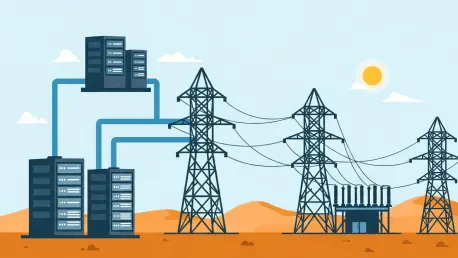

Nevada’s expansive high-desert landscape is currently transforming into a global digital nervous system, yet the sheer volume of electricity required to power this evolution has ignited a high-stakes legal confrontation between a traditional utility giant and a massive infrastructure developer. This conflict, unfolding in Washoe County’s Second Judicial District Court, represents more than a simple breach-of-contract dispute; it is a fundamental battle over the future of the state’s energy resources. As hyperscale data centers—massive facilities housing the servers that drive global cloud computing and artificial intelligence—look to settle in the Silver State, the question of who pays for the necessary power grid upgrades has become a billion-dollar point of contention.
The significance of this story lies in its potential to redefine the relationship between public utilities and private industry. If the current trajectory continues, the energy landscape of Nevada will be unrecognizable within two decades. This litigation serves as a critical bellwether for how modern society balances the rapid expansion of essential technology infrastructure with the protection of the general rate-paying public. At the heart of the matter is whether a private developer can bypass public regulatory oversight in favor of private arbitration, a move that could leave millions of residential and small-business customers vulnerable to shifting costs and reduced grid reliability.
The Looming Surge: 22 Gigawatts and the Battle for Nevada’s Grid
The current demand for electricity in Nevada is undergoing a transformation that few could have anticipated even a decade ago. Historically, data centers accounted for a modest 5% of total energy sales within the state, but updated projections indicate that this figure will skyrocket to a staggering 64% by 2046. This shift represents a fundamental realignment of the state’s economic and physical architecture. The sheer scale of this growth is difficult to comprehend, as the digital economy moves from the periphery to the very center of the power consumption model.
Currently, NV Energy is grappling with service requests totaling approximately 22 gigawatts of power. To put this into perspective, this volume is more than double the entire system’s current peak demand. The utility faces an unprecedented challenge: expanding its generation and transmission capabilities fast enough to accommodate “hyperscale” clients without compromising the service of existing users. This surge has forced a constant state of revision for the state’s power planning, as traditional models of incremental growth are being discarded in favor of radical, high-capacity infrastructure developments.
Understanding the Stakes of Hyperscale Infrastructure
The geographical center of this energy storm is located in Northern Nevada, specifically across 12,000 acres in Storey and Lyon counties. This region is rapidly becoming a global data hub, attracting the most significant players in the technology industry who require vast swaths of land and reliable cooling resources. The developer Tract has moved aggressively to secure these parcels, positioning themselves as a gatekeeper for future hyperscale capacity. However, the infrastructure required to connect these massive campuses to the grid involves far more than just laying wires; it requires a complete overhaul of the regional transmission network.
In Nevada, the Integrated Resource Plan (IRP) serves as the evolving blueprint for state energy generation and procurement. Every major project must align with this plan to ensure that the state remains on a sustainable path toward energy independence and carbon goals. The tension between rapid industrial growth and traditional utility regulation has reached a breaking point because the pace of data center development far exceeds the standard regulatory cycle. This disconnect has created a vacuum where private contractual expectations often collide with the rigid reality of public utility law and grid physics.
Regulatory Oversight Versus Private Arbitration
A central legal tug-of-war has emerged regarding how these disputes should be resolved. NV Energy is pushing for the transparency provided by the Public Utilities Commission of Nevada (PUCN), arguing that any decision involving power allocation is a matter of significant public interest. They contend that the costs and technical requirements of such massive loads must be vetted in a public forum to prevent any detrimental impact on the wider grid. In contrast, Tract has demanded that the dispute be settled through private arbitration, citing clauses in existing agreements that allow for non-public resolution of contractual disagreements.
This push for arbitration raises significant concerns about cost-shifting. NV Energy asserts that if Tract’s demands are met without proper regulatory scrutiny, existing residential and small-business customers might find themselves subsidizing the specialized infrastructure needed for industrial expansion. Furthermore, the conflict is complicated by proposals for “behind-the-meter” power solutions. To address immediate shortages, there have been suggestions of building temporary natural gas and diesel plants that bypass the main grid. NV Energy views these facilities as a dangerous attempt to skirt environmental and regulatory oversight while still relying on the stability of the public utility system.
Corporate Philosophies in Conflict: Public Good vs. Contractual Rights
The litigation highlights two deeply conflicting corporate philosophies. NV Energy has positioned itself as the defender of the public interest and rate-payer stability, arguing that its primary duty is to protect the integrity of the state’s energy supply. From the utility’s perspective, large-load customers who create massive new costs must bear those financial burdens entirely. They view Tract’s legal maneuvers as an attempt to secure preferential treatment and hidden agreements that would otherwise be rejected in a transparent public hearing before the state commission.
Tract defends its position by moving past what it describes as “inflammatory rhetoric,” focusing instead on its role as an economic engine for Nevada. The developer emphasizes that it has signed “Rule 9” agreements—standard contracts for large-scale infrastructure—and expects NV Energy to honor those commitments. Tract points to its history of successful litigation, including previous cases with companies like Switch, as evidence that they are merely seeking to hold the utility accountable to its signed obligations. They argue that their billion-dollar investment in the state entitles them to a predictable and reliable path toward power connectivity.
Strategies for Managing High-Demand Industrial Energy Requests
To navigate this complex landscape, state leaders and utility experts have focused on balancing transparency with the rapid needs of high-demand industrial customers. Aligning large-load requests with the public utility commission frameworks has emerged as a primary strategy to ensure that the public remains informed and protected. By mandating that all hyperscale projects undergo a rigorous review process, the state has sought to prevent the privatization of energy policy. This approach ensured that the long-term health of the grid was prioritized over short-term industrial gains.
Implementation of robust “Rule 9” agreements eventually provided a clearer roadmap for infrastructure cost-sharing. These agreements were designed to protect the general rate-paying population by ensuring that industrial developers paid for the specific upgrades their projects necessitated. Future-proofing the grid also involved creating new frameworks for integrating hyperscale demand without compromising financial equity across different customer classes. These measures shifted the focus toward a more collaborative and predictable environment for both utility providers and technology companies. Stakeholders recognized that the sustainable integration of data centers required a unified vision for energy equity, which ultimately provided a more stable foundation for the state’s technological future.