
The Rapid Erosion of the European Forest Landscape
The deep silence of the once-resilient European woodlands is increasingly broken by the dry crackle of dying branches and the hum of urgent machinery as the continent grapples with an unprecedented loss of its green heritage. In the years leading up to 2026, the rate of aboveground biomass loss in European forests surged by 46% compared to the historical average. This shift marks a critical turning point for ecosystems serving as a primary defense against climate change.
In Central Europe, particularly within the timber-rich regions of Germany, Poland, and the Czech Republic, the landscape is shifting from a lush carbon reservoir to a vulnerable terrain under mounting environmental pressure. The intensity of this decline suggests that traditional forest stability is no longer guaranteed. As the canopy thins, the fundamental character of these ancient landscapes undergoes a profound transformation, moving toward a state of constant flux.
Understanding the Carbon Stakes for a Warming Continent
The health of European forests is inextricably linked to international climate stability. The European Union set a target to sequester 310 million tonnes of CO2 equivalent annually by 2030, a goal relying on the carbon-absorbing capacity of standing timber. As biomass vanishes, the carbon stored in tree trunks is released back into the atmosphere, creating a feedback loop. This structural threat to environmental security challenges the survival of remaining vegetation.
Every hectare of lost timber represents a significant setback for mitigation strategies intended to curb the effects of global warming. This loss is not merely an industrial concern but a risk to the continent’s environmental security. Without the cooling influence and storage capacity of these forests, the regional climate may become increasingly volatile, further challenging the recovery of the remaining woodlands and their ability to regulate local temperatures.
Dissecting the Triple Threat: Harvest, Heat, and Habitat Loss
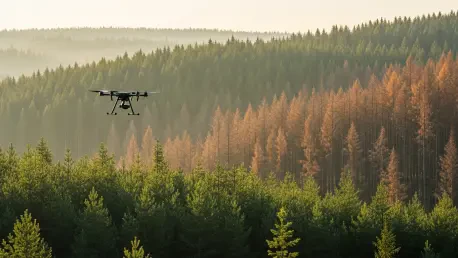
While timber harvesting remains the primary cause of biomass removal—accounting for roughly 82% of loss—the landscape of destruction is changing. Natural disturbances are now responsible for nearly a quarter of all biomass loss. The intensification of wildfires and storm events has accelerated the pace of degradation. Furthermore, bark beetle infestations thrive in forests weakened by water stress, where traditional forestry meets modern climate volatility with devastating results.
The disproportionate impact on high-stock regions in Central Europe highlights a growing disconnect between industrial demand and ecological reality. As heatwaves become more frequent, the moisture levels required to maintain tree health have plummeted, leaving vast areas brittle. This combination of factors creates a precarious environment where trees are either harvested prematurely to salvage value or lost entirely to preventable ecological collapse.
Evidence From Decades of Satellite Observation
High-resolution satellite data from 1985 to 2023 tracked these changes with startling precision. The findings highlight how drought cycles stripped trees of natural defenses, leaving them susceptible to pests that were once manageable. This data reveals that forest decline is a systemic shift in resilience that peaked recently. Imagery confirms that the speed of canopy loss has outpaced natural regeneration in key areas, proving the biological foundations are being eroded faster than they can adapt.
The research indicates that the vulnerability of these ecosystems reached a critical threshold as moisture levels dropped and temperatures climbed. Satellite records show that the rate of forest decline is not a seasonal fluctuation but a long-term trend. This evidence serves as a warning that the continent’s green infrastructure requires immediate attention. The data-driven perspective provides a clear map of where interventions are most needed to prevent a total loss of forest functionality.
Implementing a Framework for Forest Resilience and Recovery
To safeguard these ecosystems, forest management pivoted toward long-term stability rather than immediate yield. Stakeholders prioritized diversifying forest composition by integrating tree species that were better adapted to heat and drought. Utilizing advanced satellite monitoring systems allowed for the detection of early signs of pest outbreaks and moisture stress in real-time, enabling rapid intervention before entire stands were compromised.
Regional land-use policies began to balance industrial timber demands with the urgent need for carbon sequestration by adjusting harvesting schedules. These actions emphasized the retention of biomass in high-risk zones to maintain microclimates and soil health. By moving toward a model of ecological stewardship, the continent sought to rebuild the resilience of its woodlands and ensured they remained a cornerstone of climate defense for the decades ahead.