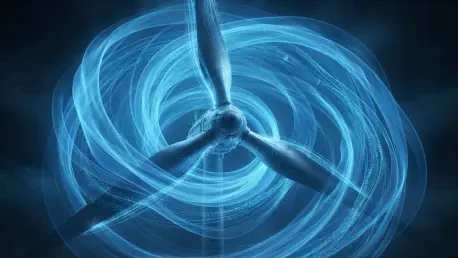

Research conducted at the FINO1 platform in the North Sea indicates that massive atmospheric eddies can engulf a 240-meter rotor, exerting synchronized forces on its components. As the wind energy sector transitions toward massive 15-megawatt units, the industry is discovering that the standard atmospheric models used for decades may be fundamentally flawed for marine environments. Historically, engineering standards like those from the International Electrotechnical Commission have relied on the Mann and Kaimal models, which were originally developed for onshore conditions characterized by high-frequency turbulence. These models assume a level of atmospheric stability that rarely exists in the open ocean, where sprawling, quasi-two-dimensional wind structures can persist for hours. By focusing primarily on rapid, chaotic gusts, designers have inadvertently overlooked the “slow gusts”—low-frequency fluctuations that occur at intervals below 0.001 Hz. These massive atmospheric events represent a hidden threat to the structural integrity of the newest generation of offshore assets.
The Discrepancy: Current Design Standards vs. Marine Reality
The core of the problem lies in the mathematical representation of wind energy across different frequency spectrums. Traditional models are highly effective at predicting the impact of high-frequency turbulence, which creates localized stress on individual turbine blades. However, these frameworks systematically underestimate the energy contained within the slow end of the spectrum. In the marine environment, wind behaves differently than it does over land due to the lack of topographical obstacles and the unique thermal interactions between the sea surface and the air. These conditions foster the creation of immense eddies that stretch horizontally for several kilometers. When a turbine with a 240-meter rotor diameter encounters these slow-moving structures, the entire machine is effectively submerged within a single coherent wind event. This shift from localized, chaotic turbulence to large-scale, synchronized pressure changes creates a mechanical load profile that modern 15-megawatt turbines were not originally designed to handle over their projected lifespans.
To better understand this phenomenon, researchers have developed a specialized 2D+3D modeling approach that combines standard turbulence data with low-frequency marine observations. By calibrating this model with real-world data from the North Sea, engineers have identified a significant increase in damage-equivalent loads on critical structural components. Specifically, the tower base and blade roots experience much higher fatigue stress than previously predicted by onshore-centric simulations. This occurs because the slow gusts possess a high degree of spatial coherence, meaning they exert a unified thrust force across the entire rotor sweep simultaneously. Unlike smaller gusts that might only strike one side of the rotor, these massive eddies push against the whole structure in unison, magnifying the bending moments at the base. Interestingly, while longitudinal forces see a marked increase, the lateral twisting moments decrease, suggesting that these large-scale structures impose a more uniform but significantly more intense rhythmic pressure on the overall system.
Operational Hazards: Floating Platforms and Dynamic Loading
Analytical data suggests that offshore turbines are most vulnerable to these atmospheric forces when operating below their rated wind speed, typically around 10.6 meters per second. At these lower velocities, the active pitch control systems of the blades are generally inactive or less responsive, as they are not yet required to shed excess wind energy to protect the generator. Consequently, the turbine cannot effectively mitigate the sudden, coherent load spikes produced by slow-moving eddies. Without the ability to adjust blade pitch in real-time to counteract these forces, the structural components must absorb the full energy of the gust. This lack of active mitigation leads to a compounding effect on fatigue life, where the cumulative stress of thousands of these unmanaged events accelerates the wear and tear on the steel and composite materials. This finding is particularly concerning for operators looking to maximize the uptime of their fleets in regions where wind speeds frequently fluctuate within this critical sub-rated range.
The transition to floating wind technology further complicates the structural risks posed by low-frequency atmospheric fluctuations. While fixed-bottom monopiles are susceptible to increased tower base fatigue, floating semi-submersible platforms exhibit an even higher sensitivity to slow gusts. These fluctuations significantly amplify the surge and pitch motions of the platform, sometimes causing displacements at low speeds that exceed those triggered by the platform’s own natural resonant frequency. Because a floating foundation is not rigidly attached to the seabed, the entire assembly moves in response to the synchronized thrust of a large eddy. This heightened motion translates directly into elevated tension levels within the mooring lines and dynamic power cables. Current standard simulations, which often ignore these sprawling marine structures, likely fail to account for the peak tension loads that these components will face in the field. As the industry moves toward deeper waters and larger floating arrays, the failure to integrate these dynamics could lead to premature mooring failures.
Risk Mitigation: Protecting the Next Generation of Assets
The recognition of these overlooked atmospheric forces prompted a critical reassessment of how global offshore wind assets were engineered and maintained. Developers prioritized the integration of advanced 2D+3D wind modeling into the early FEED stages of project development to ensure that structural margins accounted for synchronized thrust events. This shift in perspective led to the refinement of turbine control algorithms, allowing for proactive blade pitching even at sub-rated wind speeds to dampen the impact of large-scale eddies. Furthermore, the industry moved toward more robust sensor arrays on floating platforms to monitor real-time fatigue accumulation in mooring lines, providing the data necessary for predictive maintenance schedules. Engineers also focused on reinforcing the transition pieces of monopiles to better withstand the longitudinal stresses identified in the FINO1 data. Ultimately, the adoption of marine-specific standards proved essential for securing the long-term bankability of massive offshore projects.
By acknowledging the unique behavior of the ocean atmosphere, the sector successfully moved beyond the limitations of onshore models to build a more resilient energy infrastructure. Moving forward, it is recommended that offshore developers mandate high-fidelity atmospheric characterization as part of the site assessment process, specifically targeting low-frequency wind spectral energy. Additionally, the integration of lidar-assisted control systems could provide turbines with the “eyes” to see incoming slow-moving eddies several seconds before they arrive, allowing the pitch system to brace the rotor for the synchronized thrust. These technical adjustments are not merely incremental improvements but are vital safeguards for the economic viability of the global energy transition. Ensuring that the next generation of massive turbines can withstand the unseen rhythms of the sea will be the difference between reaching carbon neutrality targets and facing a premature wave of decommissioning costs for the world’s most critical renewable assets.