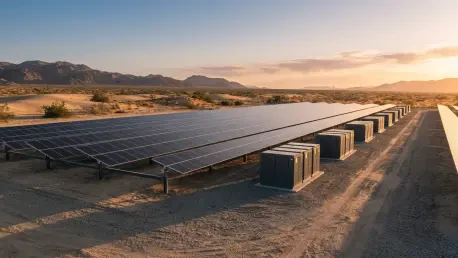

Developers are increasingly utilizing battery technology to mitigate the financial risks associated with midday price drops in high-renewable energy markets. This strategic shift represents a fundamental transformation in how utility-scale power is delivered across the American landscape. According to recent data from the U.S. Energy Information Administration, the integration of battery storage with solar facilities has surged from a negligible share a decade ago to a commanding 16% as of late 2026. This trajectory accounts for approximately 41 GW of operational capacity currently serving the national grid. With projections indicating that hybrid projects will comprise over 30% of all solar additions from 2026 to 2028, the industry is rapidly moving away from standalone generation. This evolution reflects a growing recognition that intermittency is no longer an acceptable byproduct of green energy but a challenge that requires a sophisticated and integrated technological response.
Economic Incentives: Strategies for Integrated Storage
The primary motivation behind this trend lies in the ability of operators to capture lost value through sophisticated energy arbitrage strategies. By pairing high-capacity batteries with photovoltaic arrays, developers can effectively “time-shift” their production, harvesting sunlight when the supply is abundant and spot prices are at their lowest point during the day. This stored energy is then released into the wholesale market when demand spikes in the evening, allowing facility owners to secure much higher margins than would be possible with a direct-to-grid approach. This capability transforms a solar farm from a passive generator into an active, dispatchable asset that functions similarly to a traditional natural gas plant. Beyond simple price capture, these systems provide a buffer against the negative pricing events that have become increasingly common in saturated markets. This financial resilience ensures that large-scale solar remains a viable investment even as more capacity enters the system.
In addition to maximizing revenue from energy sales, hybrid configurations offer lucrative opportunities through ancillary services that support the broader stability of the electrical grid. Operators are now leveraging co-located battery systems to provide frequency regulation and voltage support, tasks that were historically reserved for spinning reserves in conventional power stations. These services allow grid operators to maintain a delicate balance between supply and demand in real-time, preventing blackouts and equipment damage. Because batteries can respond to signal changes in milliseconds, they are far more efficient at this than mechanical turbines. This technical superiority has led to the development of new tariff structures that specifically reward the rapid response capabilities of storage-integrated plants. Consequently, the business model for solar has expanded from a one-dimensional energy provider to a multi-faceted grid service platform. This diversification of income streams makes these projects more attractive.
Regional Market Leadership: Implementation and Infrastructure Goals
Building on these operational and financial foundations, geographic data reveals a concentrated push toward hybridization in the American Southwest, where states like California, Arizona, New Mexico, and Nevada are leading the nation. In these regions, the adoption of solar-plus-storage systems is more than double the national average, driven by both favorable regulatory environments and extreme weather patterns that necessitate high reliability. Market analyses from the Solar Energy Industries Association demonstrate that massive increases in capacity in California and Texas have already exerted downward pressure on wholesale prices. Specifically, these markets have seen wholesale electricity costs drop by nearly 40% as of 2026, even as total power demand continues to rise due to electrification and industrial growth. This price compression serves as a powerful market signal, forcing developers in other regions to adopt storage just to remain competitive. The success of these Western projects serves as a blueprint.
Moving forward, the industry prioritized the development of more durable transmission networks and standardized technical protocols to accommodate the massive influx of hybrid energy facilities. Federal and state agencies took decisive steps to streamline the permitting process, ensuring that the 361 GW of capacity currently in the interconnection queue was integrated without unnecessary delays. It became clear that the integration of storage was not merely a financial strategy but a requirement for national energy security. Future initiatives focused on expanding long-duration storage technologies, such as flow batteries, to provide a safety net for extended periods of low sunlight. Additionally, grid operators refined market rules to properly compensate developers for the essential stability services these systems provided during peak demand. By treating co-located storage as a standard component of energy infrastructure, the sector successfully created a more resilient, responsive, and cost-effective power grid for every American home.