
Christopher Hailstone brings a wealth of knowledge in grid security and energy management to the table at a pivotal moment for our infrastructure. As we navigate the complex transition to a decentralized power grid, his insights into how building owners integrate storage technologies are invaluable for understanding the future of urban resilience. This discussion explores the massive surge in battery capacity, the regulatory bottlenecks currently stifling progress, and why winning over local communities is the most critical hurdle to clear for long-term sustainability.
With nearly 58 gigawatt-hours of on-site battery capacity installed just last year, how do you see this momentum shaping the resilience of our national grid over the next decade?
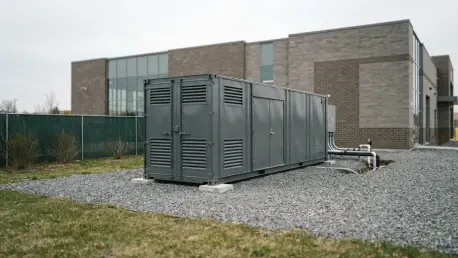
The record-breaking installation of 58 gigawatt-hours in 2025 marks a turning point where building owners stopped viewing storage as a luxury and started seeing it as a necessity. Looking ahead, we are anticipating an additional 500 gigawatt-hours of capacity to come online between 2026 and 2032, which will fundamentally change how we manage peak demand across the country. This massive influx of distributed energy resources allows for a more flexible grid that can withstand sudden disruptions while pushing us closer to our ambitious decarbonization targets. By integrating these systems directly into our real estate infrastructure, we are essentially building a decentralized safety net that protects both individual owners and the broader utility network from the volatility of energy markets.
Despite this record growth, many projects are still getting stuck in the pipeline; what are the most significant logistical hurdles that developers are facing right now?
Even when a project is a slam dunk economically, developers are hitting a wall with interconnection delays and permitting inconsistencies that vary wildly from one zip code to the next. These long and unpredictable timelines force projects to accumulate significant soft costs, including mounting engineering fees and the expensive labor required for prolonged community engagement. We see situations where shifting local requirements and a general lack of familiarity with battery technology can stall a project for years, exposing it to changing market conditions and fluctuating incentive structures. It is incredibly frustrating for stakeholders because the technology is ready for prime time, but the administrative frameworks often lag behind, creating a level of financial risk that many property owners simply cannot shoulder.
State mandates in places like New York and Illinois are ambitious, yet progress seems slow; why is there such a massive gap between these high-level goals and the actual megawatts on the ground?
New York’s mandate to procure 6 gigawatts of storage by 2030 is a bold signal, but the reality is that they have only reached about 415 megawatts, which is a mere 7% of that target. We see similar ambitious targets in Illinois at 3 gigawatts and Massachusetts at 5,000 megawatts, but the disconnect happens at the local level where zoning and land use decisions are actually made. Many smaller municipalities simply do not have the bandwidth, the budget, or the specialized knowledge to implement the regulations needed to approve these high-tech systems. When a developer shows up to permit a project, they often face a review process that is ill-equipped to handle modern storage, effectively blocking the state’s green energy mandates from the bottom up.
Fire risk is frequently cited as a top concern for local officials; how can project teams better address these safety fears to gain the trust of local zoning boards?
Safety, particularly regarding fire risk, is almost always the first thing people bring up during public hearings, and it is a concern we must take seriously to move forward. The most successful developers are those who bring fire safety teams into the educational conversation early to explain how modern battery energy storage systems are engineered with layers of protection. Massachusetts provides an excellent blueprint here with their Energy Facilities Siting Board, which offers a prescriptive path that reduces the uncertainty often found in state-level reviews. By having clear, stringent safety requirements in place from the start, we can build confidence among first responders and ensure they are fully prepared to manage any potential incidents with modern suppression techniques.
You’ve mentioned that community engagement can make or break a project; what specific strategies should developers use to turn potential opposition into support?
The secret sauce to moving a project through a tough jurisdiction is early and transparent engagement well before any formal filings are even made. This proactive approach allows developers to sit down with community members, listen to their specific fears, and adjust the project plan to reflect their input from the very beginning. Instead of coming in with a finished design that feels forced upon a neighborhood, you present an evolving plan that explains exactly how safety and emergency response systems will work. When residents feel their voices have been heard and see that the project provides local benefits like improved grid reliability during storms, they are much less likely to organize against the installation.
What is your forecast for on-site battery storage?
My forecast is that we will see a dramatic shift toward standardization across the country as the 500 gigawatt-hours projected for the next several years start to hit the ground. While we are currently struggling with low completion rates in major markets like New York, the pressure to meet 2030 mandates will force more states to adopt the prescriptive regulatory models we see working in Massachusetts today. As local boards become more educated and comfortable with the technology, the soft costs associated with delays will begin to drop, making on-site storage as common in commercial real estate as high-efficiency HVAC systems. We are moving toward a reality where every major building serves as a vital, active node in a much smarter, cleaner, and safer national energy grid.