
Directly calculating both fluid dynamics and acoustic propagation helps identify the specific aerodynamic triggers that cause wind turbines to exceed acceptable noise thresholds. This research, spearheaded by Kazuya Kusano and Sota Nagatomi, addresses the central dilemma of modern wind energy: how to harmonize the quest for maximum kilowatt-hours with the social and environmental necessity for quiet operation. As urban areas expand and the demand for decentralized power grows, vertical-axis wind turbines, particularly the straight-bladed Darrieus variants, have emerged as promising candidates for integrated energy systems in 2026. However, their complex aerodynamic behavior creates unique acoustic challenges that have historically limited their widespread adoption. By scrutinizing the relationship between fluctuating air loads and pressure radiation, the study provides a roadmap for engineering quieter, more efficient rotors that could operate closer to residential centers without causing significant disturbance to the public.
Analyzing Aerodynamic Forces and Sound Radiation
Comparing Blade Configurations and Energy Efficiency
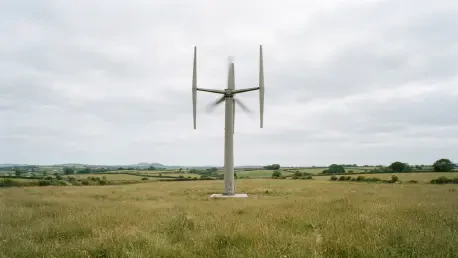
The core of the analysis centers on the relationship between unsteady aerodynamic forces and the resulting pressure radiation that reaches the human ear as noise. Unlike the more common horizontal-axis turbines that dominate large-scale wind farms, Darrieus vertical-axis models utilize blades that travel in a circular path perpendicular to the wind. This specific trajectory causes the aerodynamic loads to fluctuate significantly throughout every single rotation, creating a complex environment for both power generation and noise production. The study specifically evaluates how the number of blades—comparing a single-bladed setup to a two-bladed configuration—influences the turbine’s overall performance. This comparison allows for a detailed assessment of the power coefficient, which measures energy extraction efficiency, alongside a pressure-based radiation indicator, which serves as a metric for the potential noise generated during the turbine’s operation.
By focusing on these distinct configurations, researchers can pinpoint how mechanical changes to the rotor design impact the environmental footprint of the machine. The study highlights that the interaction between the blade and the incoming wind stream is not a steady process but a dynamic event that varies with every degree of rotation. For instance, as a blade moves from the windward to the leeward side, the pressure distribution across its surface shifts rapidly, leading to the emission of acoustic waves. By isolating these moments of high radiation, engineers can begin to rethink blade geometry or rotational speeds to minimize the disturbance. The objective is to determine whether a higher blade count, which typically offers smoother torque and better self-starting capabilities, introduces an unacceptable level of acoustic overhead. This data is essential for designers who must balance the mechanical stability of a multi-bladed system against the potentially quieter profile of a simplified rotor.
Timing of Peak Acoustic Radiation Phases
One of the most groundbreaking discoveries of this research is the precise identification of when a turbine is loudest during its rotational cycle. Conventional wisdom in the industry has long suggested that a turbine generates the most noise at the same moment it is producing the most power—essentially when the wind force on the blades is at its maximum. However, the simulations by Kusano and Nagatomi revealed a different and more complex reality. They found that the primary peaks in acoustic radiation do not align with peak power generation; instead, they occur during phases where the aerodynamic force undergoes the most rapid temporal changes. This means that the “jerkiness” of the load, or how quickly the force increases or decreases, is a much more significant driver of noise than the total magnitude of the force itself. This insight shifts the focus of noise reduction from simply reducing the load to smoothing out the transitions that occur as the blade spins.
Specifically, the loudest radiation was observed during the upstream sweep of the rotor when operating at a tip-speed ratio of 4.5. This is the portion of the rotation where the blade moves across the front of the turbine relative to the incoming wind direction. During this brief window, the power coefficient and the force acting on the blade transition violently, creating a spike in the pressure-based radiation indicator. The study establishes that the rate of change in these forces acts as the primary catalyst for sound emission. For engineers, this phase-resolved connection is a game-changer, as it suggests that smoothing out the aerodynamic loading during the upstream phase could lead to significantly quieter turbine designs. By modifying the pitch of the blade or its structural curvature specifically for this part of the cycle, it may be possible to dampen the acoustic peaks without losing a significant amount of the total energy captured from the wind over a full rotation.
Validating Models and Future Engineering Steps
To ensure the research findings were grounded in physical reality, the researchers compared their simulation’s wake predictions against established experimental data. The hybrid lattice Boltzmann method with overset grids demonstrated superior accuracy in predicting mean streamwise wake velocities when compared to older, more traditional simulation methods. This validation provided a strong foundation for the study, though the team remained objective by noting that a well-predicted wake does not automatically guarantee that all acoustic results are perfect. However, the high degree of correlation between the simulated flow patterns and real-world observations suggested that the model effectively captured the underlying physics of the turbine’s operation. This level of accuracy was essential for building trust in simulation-based design, allowing engineers to rely on these digital models to predict how future turbine prototypes might behave in various wind conditions.
Moving forward, the results of this analysis provided a conceptual roadmap for the next generation of wind energy technology by emphasizing that noise is a product of rapid force fluctuations. Engineering teams should now prioritize the development of active or passive load-smoothing technologies, such as trailing-edge flaps or variable-pitch control, to mitigate the acoustic spikes identified during the upstream sweep. While the study operated within certain technical constraints, such as ignoring tip noise and focusing on pressure indicators, it successfully proved that aerodynamic transients were the primary culprits of acoustic pollution. Future designs must incorporate these insights to create turbines that are not only powerful but also socially acceptable for integration into residential landscapes. By focusing on the temporal rate of force change rather than just total output, the industry took a significant step toward a quieter, more sustainable energy future that balances efficiency with environmental harmony.