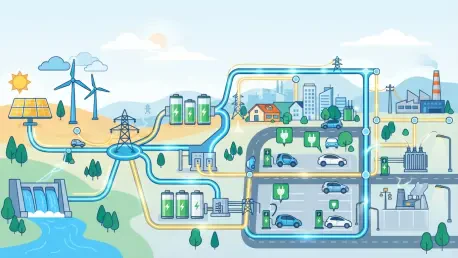

Achieving a highly efficient smart distribution system depends on the seamless integration of machine learning with mathematical optimization frameworks. As the energy transition matures throughout 2026 and into 2028, the industry has realized that traditional deterministic models are no longer sufficient for managing the volatility introduced by residential solar arrays, commercial battery storage, and the rapid expansion of electric vehicle charging hubs. These variables have transformed the grid from a predictable, top-down system into a complex, multi-directional network. Traditional management systems often fail because they operate in functional silos, treating demand forecasting, asset health, and economic dispatch as disconnected tasks. This fragmentation leads to significant operational risks, especially when renewable supply fluctuates without warning. Consequently, there is an urgent need for a unified architecture that harmonizes real-time data ingestion with high-stakes optimization to ensure stability.
Structural Evolution of Modern Distribution Networks
Data Integration: Probabilistic Forecasting Models
The proposed hierarchical framework addresses these challenges by implementing a specialized data layer that focuses on high-resolution acquisition and the cleaning of heterogeneous signals from smart meters and phasor units. This rigorous preprocessing is essential for the second phase, which utilizes advanced machine learning techniques to perform probabilistic forecasting. Unlike legacy systems that provide a single, often inaccurate point estimate for energy demand, this probabilistic approach generates a range of potential outcomes. By quantifying uncertainty directly within the forecast, the system allows grid operators to visualize the probability of various load scenarios before they occur. This shift from deterministic to stochastic modeling provides a more realistic representation of the randomness associated with wind and solar power production during the current operational year. This predictive accuracy is the cornerstone of a system capable of adapting to rapid environmental changes.
Scheduling Logic: Uncertainty-Aware Optimization Engines
Building upon the forecasting layer, the framework employs an uncertainty-aware optimization engine to balance supply and demand in real time across the distribution network. This component ensures that resource allocation decisions remain resilient even when actual renewable output deviates from projections. By integrating physical constraints such as voltage stability limits and battery cycle life, the framework optimizes the dispatch of distributed energy resources without compromising long-term infrastructure health. Furthermore, a dedicated resilience layer provides critical protection through intelligent fault detection and automated redispatch mechanisms. When a localized failure or line surge is detected, the system utilizes autonomous logic to reconfigure the network topology. This rapid response capability minimizes downtime and prevents localized disturbances from cascading into widespread outages, representing a major advancement over the manual intervention strategies used in previous decades.
Enhancing Operational Resilience and Standardization
Validation Methods: Standardized Solver Benchmarking
A significant contribution of this work is the development of a standardized testbed for solver benchmarking, which addresses the lack of consistency in evaluating grid optimization algorithms. This platform allows researchers and engineers to compare the performance of various mathematical solvers, such as Gurobi and CPLEX, under identical operational conditions and network stressors. By providing a common ground for assessment, the framework enables the identification of the most efficient computational methods for solving the complex mixed-integer linear programming problems inherent in modern power management. This level of standardization is vital for ensuring that selected algorithms can operate within the strict latency requirements of real-time distribution systems. Benchmarking results indicated that this integrated approach significantly reduces computational overhead compared to non-hierarchical models, which is essential as grid devices continue to proliferate through 2027.
Strategic Evolution: Implementation and Future System Resilience
The implementation of this integrated hierarchical model established a definitive roadmap for utility providers seeking to modernize their infrastructure between 2026 and 2029. The study successfully validated that merging probabilistic machine learning with robust optimization enhanced both decision-making precision and overall grid reliability. Analysts concluded that stakeholders needed to prioritize the deployment of edge computing hardware capable of processing these logic sequences locally, thereby reducing the dependency on centralized data processing. Investment in cross-functional data pipelines proved to be a critical factor in the successful execution of autonomous redispatch functions. Further findings suggested that industry leaders had to focus on improving the interoperability between hardware vendors to ensure these frameworks remained effective across diverse regional grids. This transition toward self-healing, data-driven systems provided a scalable solution to the unpredictability of modern energy consumption.