
The current lack of direct communication between Washington and Tehran has left mediators struggling to bridge a gap that threatens global economic stability. This diplomatic silence has allowed the Strait of Hormuz to become the centerpiece of a dangerous geopolitical game where any miscalculation could trigger a worldwide energy crisis. As the Iranian government faces a tightening net of international sanctions, its officials have issued an uncompromising ultimatum: if their ability to export crude oil is completely blocked, they will ensure that no other regional nation can utilize the waterway for energy shipments. This approach of extreme brinkmanship explicitly ties Iran’s national economic survival to the integrity of the global energy supply chain. By positioning the strait as a primary point of leverage, Tehran is attempting to force the international community to choose between maintaining Iranian oil flows or facing a total collapse of maritime trade in the Persian Gulf region.
Brinkmanship and Strategic Leverage
Iranian Defense Tactics and Regional Threats
Iranian leadership has adopted an increasingly defiant posture, with high-ranking officials asserting that any move to stifle their petroleum sales will result in the total disruption of all regional energy flows. Parliamentary Speaker Mohammad Bagher Ghalibaf recently broadened these warnings during a session in Tehran, suggesting that if Iran’s internal security is compromised by foreign pressure, energy infrastructure throughout the Gulf could be classified as legitimate military targets. This shift in rhetoric indicates that the Islamic Republic no longer views the conflict as a localized maritime dispute but as a comprehensive struggle for regional survival. By framing the Strait of Hormuz and neighboring oil facilities as defensive assets, Tehran aims to project strength to its domestic audience while sending a clear signal to Washington that military or economic duress will not yield the expected concessions but will instead invite a heavy and widespread retaliation.
In several public addresses, Ghalibaf claimed that the era of American military intimidation in the Middle East has effectively concluded, promising that any perceived acts of bullying will be met with a swift and painful response. This defiant narrative is echoed by the top brass of the Revolutionary Guards, who have been conducting high-profile naval drills to showcase their capability to interdict commercial traffic. These maneuvers are designed to prove that the nation’s security is fundamentally inseparable from the operational freedom of its maritime borders. By emphasizing their tactical readiness, Iranian commanders are attempting to devalue the presence of the U.S. Fifth Fleet, arguing that conventional naval superiority cannot prevent the localized disruption of shipping lanes. This strategic messaging serves to reinforce the idea that Iran is prepared to pay a significant price to defend its economic interests, regardless of the technological or military disparity.
The Hardline Stance of the United States
On the American side, the administration under President Donald Trump has maintained an uncompromising position, characterized by a refusal to provide sanctions relief or access to frozen assets in exchange for temporary pauses in tensions. Washington’s current strategy remains focused on a multifaceted maximum pressure approach intended to prevent nuclear proliferation and curb Iran’s regional military influence. From the perspective of the White House, any Iranian overtures for negotiation are not seen as genuine diplomatic interests but rather as signs of desperation under the weight of a failing economy. This perception has led to a rigid policy where military readiness is prioritized over diplomatic flexibility, further entrenching the deadlock. Trump has utilized various public platforms to dismiss reports of back-channel deals, insisting that any future agreement must address not only the nuclear file but also the development of ballistic missiles and support of regional proxies.
The American strategic objective continues to prioritize a change in the fundamental behavior of the Iranian leadership, often suggesting that only internal political shifts will lead to long-term regional stability. To this end, the U.S. has intensified its monitoring of Iranian oil tankers and has worked closely with regional allies to bolster the defenses of critical energy hubs. This policy of containment is designed to squeeze the financial lifelines of the Revolutionary Guards, yet it also increases the likelihood of a direct kinetic confrontation at sea. Despite the mounting risks, the administration has signaled that it will not retreat from its current course, believing that the costs of a nuclear-armed or resurgent Iran far outweigh the short-term economic volatility caused by the maritime standoff. This uncompromising stance has left little room for mediators from Europe or the Gulf to find a viable middle ground that satisfies the security requirements of both major powers.
Maritime Security and Global Market Impacts
Challenges to Maritime Authority and Navigation
Revolutionary Guards spokesperson Hossein Mohebbi has openly challenged recent claims that Iranian influence over the Strait of Hormuz has been neutralized by international naval presence. He asserted that the passage of a few commercial vessels under the cover of darkness or with heavy escort does not constitute an open strait, maintaining that Tehran still dictates the ultimate terms of navigation through the waterway. Iranian officials have accused the American president of providing a dishonest account of the dispute, arguing that the conflict is less about nuclear weapons and more about suppressing Iran’s legitimate regional stature. Meanwhile, international mediators have found their efforts hampered by a lack of trust; while Tehran insists on the removal of coercion before talks can begin, Washington views such demands as unacceptable preconditions. Proposed frameworks, such as a countdown to reopen the strait alongside a ceasefire, have been rejected as the crisis continues to escalate.
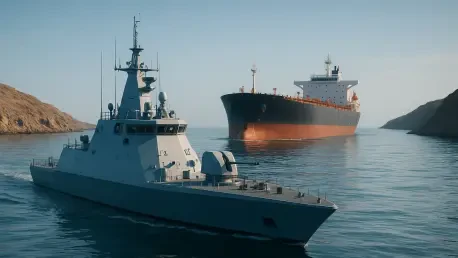
The logistical reality on the water remains precarious, with shipping data from analysts suggesting that traffic through the strait has become highly irregular. Although some energy flows are attempting to resume, current volumes are estimated to be at roughly half of their pre-war levels, creating a massive shortfall in the global market. To mitigate the risk of seizure or attack, many commercial vessels have resorted to going dark by disabling their Automatic Identification Systems, a tactic that complicates the ability of international observers to monitor the true volume of oil moving through the region. This lack of transparency has turned the Persian Gulf into a gray zone where identifying the origin and destination of cargo becomes nearly impossible. Such maritime obfuscation not only increases the risk of accidental collisions but also provides cover for the very activities that sanctions were designed to prevent, leading to a breakdown in the international maritime order.
Economic Consequences and Future Strategic Mitigation
The persistent threat of a complete blockade has kept global oil markets in a state of high volatility, with futures for Brent crude and West Texas Intermediate rising sharply as traders react to every new rhetorical escalation. This economic instability is not confined to the Persian Gulf; the conflict has expanded to include the Houthi movement in Yemen, which has increasingly targeted interests in the Red Sea. These proxy actions have forced major producers like Saudi Arabia to reroute a significant portion of their exports back through the Strait of Hormuz, ironically increasing their exposure to the very Iranian leverage they sought to avoid. This complex web of military and logistical challenges has demonstrated that the global energy infrastructure is more interconnected and vulnerable than previously understood. Even as oil-producing nations attempt to stabilize their output, they remain deeply susceptible to the security dynamics unfolding between the two primary antagonists.
Future stability necessitated a fundamental shift toward diversifying energy transit routes and strengthening international maritime law. Experts concluded that relying solely on the Strait of Hormuz was a strategic error that required the accelerated construction of overland pipelines to the Gulf of Oman and the Red Sea. Global stakeholders determined that the most effective next steps involved creating a unified maritime security framework that operated independently of bilateral political disputes. Furthermore, the crisis illustrated the necessity of a permanent, direct communication channel between the defense ministries of the involved nations to prevent accidental escalation. Actionable solutions were identified in the form of multilateral energy sharing agreements and the development of high-capacity alternative energy grids that could bypass regional chokepoints during times of conflict. By addressing these structural vulnerabilities, the international community aimed to decouple the global economy.