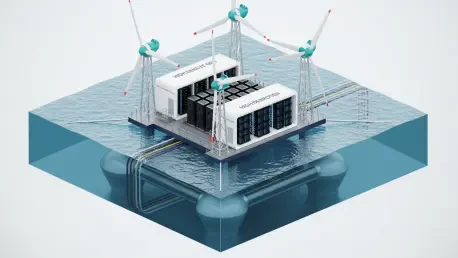

The unrelenting expansion of artificial intelligence models has pushed terrestrial power grids to their absolute breaking point, forcing hyperscalers to scout radical new territories for energy-intensive infrastructure. As land prices in traditional data hub corridors like Northern Virginia or Dublin continue to skyrocket, the logic of pivoting to the vast, untapped surfaces of the world’s oceans has moved from a theoretical concept to a strategic necessity. Floating wind turbines offer a unique solution because they can be stationed in deep waters where wind speeds are consistently high and more predictable than their onshore counterparts. This geographic shift addresses the dual crises of space scarcity and power density. By co-locating server clusters directly onto floating foundations or submerged pods tethered to these turbines, developers bypass the typical inefficiencies of long-distance transmission. This nascent architecture represents a convergence of marine engineering and high-performance computing that could redefine the global digital backbone.
Infrastructure Synergies: Thermal Efficiency and Grid Independence
Heat dissipation remains the primary operational hurdle for modern artificial intelligence hardware, as high-density GPU racks generate thermal loads that traditional air-cooled facilities struggle to manage without excessive water consumption. Placing data centers in an offshore environment provides an immediate and nearly infinite heat sink through the surrounding seawater, which significantly reduces the Power Usage Effectiveness ratio toward the theoretical ideal of 1.0. Advanced liquid-to-liquid heat exchangers integrated into the floating platforms allow for closed-loop cooling systems that protect sensitive electronics from the corrosive marine atmosphere while utilizing the ambient temperature of the ocean. This thermal efficiency is particularly critical for the newest generation of chips, which require liquid cooling at the chassis level to maintain peak performance during massive training runs. The structural stability provided by semi-submersible foundations ensures that vibration-sensitive components remain operational even in heavy swells.
Beyond the immediate cooling advantages, the direct integration of power generation and consumption eliminates much of the hardware required for terrestrial grid connection. In traditional setups, renewable energy must be converted to high-voltage direct current for long-distance transport, incurring significant resistive losses before being stepped back down for server use. By contrast, a floating wind farm configured as a microgrid can deliver power directly to onboard or adjacent server modules, minimizing the need for extensive cabling and transformers. This localized power cycle increases the overall reliability of the data center, insulating it from the rolling blackouts or frequency instabilities that have plagued land-based grids during extreme weather events. Furthermore, the modular nature of floating wind platforms allows for a scalable infrastructure model. As AI demands increase, additional turbine-server units are towed into position and networked via subsea fiber-optic cables, creating a decentralized and highly resilient mesh of offshore processing power.
Economic Frameworks: Strategic Autonomy and Scalable Solutions
Moving data infrastructure into international or territorial waters presents a complex but lucrative shift in the economic landscape of the technology sector. While the initial capital expenditure for marine-grade hardware is higher than for standard warehouse builds, the long-term operational savings from zero-cost cooling and lower-cost maritime leases offset these costs. Governments have begun to recognize the potential of specific blue data zones, offering streamlined permitting processes for developers who combine renewable energy production with digital infrastructure. These zones reduce the typical multi-year lead times associated with securing land-use rights and environmental impact assessments on the mainland. This regulatory evolution encouraged a new class of investment, where energy companies and cloud providers formed joint ventures to share the costs of offshore platforms. As of 2026, the cost per megawatt for floating wind reached parity with fixed-bottom alternatives, making the financial case for combined projects increasingly robust for institutional investors.
The successful pilot programs established the technical groundwork for a broader rollout of deep-sea computational nodes across the Atlantic and Pacific basins. Industry leaders shifted their focus toward standardizing the mechanical interfaces between turbine foundations and server modules to ensure interoperability across different vendors. This standardization simplified the maintenance cycles, as specialized service vessels were able to swap out modular server containers without disrupting the turbine’s power generation. Engineering teams also perfected the use of automated underwater vehicles to monitor subsea cabling and structural integrity, reducing the necessity for human divers in hazardous environments. Decision-makers in the technology sector prioritized the development of more robust subsea fiber interconnects to ensure that these remote clusters remained synchronized with terrestrial networks. The industry eventually moved toward a fully integrated oceanic cloud, where the energy of the wind and the cooling of the sea were harnessed to sustain the digital intelligence of the modern world.