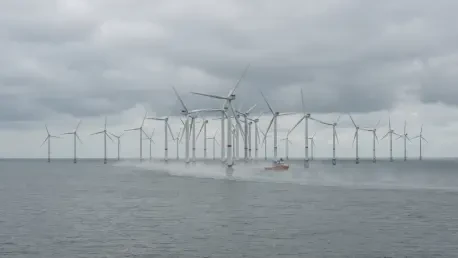

Stable atmospheric conditions, where warmer air sits atop cooler air, effectively suppress the vertical mixing required to re-energize the wind flow behind massive offshore turbine arrays. As the global energy sector accelerates its pivot toward expansive offshore wind deployment, understanding how momentum extraction from upwind arrays influences downwind resources has become a pivotal challenge for grid operators and developers. The current research, led by Elizabeth J. McCabe and a team of atmospheric scientists, provides a comprehensive investigation into the mechanisms that dictate the persistence and dissipation of these wakes within the German Bight of the North Sea. By using a sophisticated combination of high-resolution aircraft observations, stationary meteorological towers, and advanced numerical modeling, the study reveals that atmospheric stability is the primary driver of wake propagation. This research proves that wind speed deficits can extend beyond fifty kilometers, a distance far exceeding traditional expectations. These findings suggest that the industry must move beyond simplified engineering models and embrace a deeper understanding of the marine boundary layer’s thermodynamic structure to ensure the long-term viability of massive wind energy clusters.
Comparing Terrestrial And Marine Wind Dynamics
The behavior of wind turbine wakes differs significantly between land-based installations and those located in marine environments, primarily due to differences in surface roughness and thermal turbulence. On land, the presence of vegetation, buildings, and complex terrain creates significant friction, which generates mechanical mixing. Additionally, solar heating of the ground leads to convective plumes that naturally “heal” the wind speed deficit by mixing high-momentum air from the upper atmosphere back down to the turbine level. In sharp contrast, the relatively smooth surface of the open ocean offers very little mechanical friction. This lack of resistance means there is less natural turbulence to break up the wake created by a large turbine array. Consequently, the energy extracted by the rotors is not replaced as quickly as it would be over a terrestrial landscape, allowing the wake to maintain its structure and velocity deficit for much longer periods as it travels across the water.
Furthermore, traditional industrial engineering models, such as TurbOPark or DAWM-EV, often rely on simplistic assumptions that fail to fully integrate the complex thermodynamic stability classes frequently encountered at sea. These models often project a premature recovery of wind speeds, leading to a consistent underestimation of flow deficits at distances of forty to fifty kilometers downwind. This discrepancy creates a significant risk for developers who may overestimate the energy yield of downwind lease areas. The research highlights the necessity of shifting toward mesoscale modeling that accounts for vertical temperature gradients. By properly integrating these thermodynamic factors, operators can better predict how the atmosphere will behave under various conditions, ensuring that energy production forecasts align more closely with the physical reality of the North Sea’s unique climate.
Collecting Empirical Data From The North Sea
To build a reliable empirical foundation for this study, the research team used data from the WInd PArk Far Field (WIPAFF) campaign, which deployed a specialized Dornier DO 128 research aircraft. Over the course of more than forty flight missions, this aircraft performed detailed transects across the German Bight, sampling flow vectors, air temperature, pressure, and humidity at a frequency of one hundred hertz. These high-frequency measurements provided a high-resolution look at the atmospheric structure, which was later averaged to fifteen-second intervals to allow for direct comparison with numerical model grids. The flight paths were strategically designed to capture snapshots of the wake at turbine hub heights—typically between 95 and 120 meters—as well as at altitudes above the rotor plane. This allowed the scientists to observe how the wake expanded vertically and horizontally as it moved away from major clusters like Amrumbank West and Gode Wind.
In addition to the mobile aircraft data, the FINO3 research platform provided a crucial stationary perspective on the local microclimate of the North Sea. This meteorological tower offered continuous data from multiple elevations, enabling the researchers to track how the atmosphere evolved over long periods and how it responded to the installation of nearby turbine arrays. By applying power law formulations to the observations gathered at FINO3, the team derived wind shear exponents that ensured vertical consistency across the boundary layer. This dual approach, combining the spatial breadth of aircraft missions with the temporal depth of stationary tower data, created a robust validation set for the numerical simulations. The integration of these disparate data sources allowed for a more nuanced understanding of how turbines interact with the marine atmosphere under varying seasonal and daily weather patterns.
How Modern Models Predict Wake Recovery
The study utilized the Weather Research and Forecasting (WRF) model, a state-of-the-art system for atmospheric simulation, coupled with the Fitch Wind Farm Parameterization. This specific scheme represents wind turbines as a source of drag that extracts kinetic energy from the wind while simultaneously adding turbulent kinetic energy (TKE) generated by the rotating blades. A critical technical adjustment identified in the research involved reducing the added TKE to exactly one-quarter of its standard formulation. Previous industrial applications had shown that the original Fitch formulation often overestimated the rate of wake recovery, leading to inaccurate predictions of wind speed restoration. By applying this correction, the researchers were able to match the observed long-range deficits more accurately, proving that the model could successfully simulate the “momentum sink” effect created by massive offshore arrays.
One of the persistent challenges in mesoscale modeling is the “temporal phase shift,” where a simulation might accurately predict a specific weather pattern but fail to align it perfectly with the real-world clock. To overcome this hurdle, the researchers developed a strategy that compared “virtual flights” within a five-hour simulation window against the actual data recorded by the research aircraft. By shifting the model’s output in time to find the best correlation with the physical measurements, the team significantly improved the accuracy of their validation process. This synchronization demonstrated that while advanced models are highly capable, they require precise calibration and temporal alignment to be truly effective in site-specific energy assessments. This methodology provides a blueprint for future studies seeking to validate simulation results against high-speed mobile observational data.
Categorizing The Impact Of Thermal Stratification
The core discovery of the study identifies three primary atmospheric regimes—stable, neutral, and unstable—that serve as the ultimate gatekeepers of wake behavior. In stable conditions, which occur when warmer air masses move over cooler water, vertical motion is effectively suppressed. This creates a “lid” on the lower atmosphere that prevents high-momentum air from mixing downward to replenish the wind speed behind the turbines. Under these specific circumstances, velocity deficits were observed to remain intact for distances exceeding fifty kilometers. Conversely, unstable conditions occur when the sea surface is warmer than the air above, triggering buoyant plumes that stimulate intense vertical mixing. In these cases, the wake erodes quite rapidly, and the wind speed recovers within a much shorter distance, often before reaching the next cluster of turbines.
A particularly striking revelation from the data was the decoupling of wake length from ambient wind speed. While one might intuitively expect higher wind speeds to push a wake further, the research found that even at moderate speeds, a stable atmosphere will maintain a wake for vast distances because mechanical mixing is insufficient to overcome thermal stratification. The researchers identified the bulk Richardson number as the most dependable metric for classifying these offshore environments and predicting wake persistence. By focusing on how temperature changes with height rather than just wind velocity, the study explains why certain weather patterns lead to significant energy losses in neighboring wind farms. This finding shifts the focus of offshore planning from purely aerodynamic considerations to a more holistic meteorological approach.
Addressing Challenges In Modern Predictive Modeling
Despite the high accuracy achieved by the WRF model, the study pointed out several persistent challenges that still face the industry, such as the “cold bias” where simulations consistently predict temperatures slightly cooler than those observed. Furthermore, minor wind direction offsets proved to be a significant hurdle; an error of just a few degrees in the model’s predicted wind direction can shift the entire wake corridor several kilometers to the north or south. For developers managing high-density lease areas, these directional biases are problematic because they can lead to incorrect assumptions about whether a wake from an upwind project will impact a downwind array or pass through the gaps between them. This “spatial uncertainty” remains a critical area where current mesoscale models require further refinement to support real-time grid management.
Another vital discovery involved the “capping inversion height,” which is the altitude where a layer of very stable air prevents any further vertical mixing. During stable events in the North Sea, the aircraft data revealed that this inversion often sits as low as 60 meters above the sea surface. Because this height falls directly within the rotor sweep zone of modern, large-scale turbines, it effectively traps the wake at the hub height, preventing it from expanding upward and dissipating. This phenomenon explains the extreme propagation distances recorded during the study and highlights a significant climatological risk for the offshore industry. As turbines continue to grow in height and rotor diameter, they are increasingly likely to interact with these shallow boundary layers, making the understanding of capping inversions essential for future site selection and layout optimization.
Strategic Advancements: The Path Forward For Offshore Development
The findings derived from the North Sea observations established a new benchmark for how offshore wind resources should be evaluated. The research confirmed that long-range wakes are a physical reality that can measurably impact the economic viability of downwind projects located dozens of kilometers away. By proving that the Fitch parameterization, when correctly tuned, can capture these effects, the study provided a validated path for developers to improve their energy yield predictions. The identification of the Businger-Hicks bulk Richardson number as the superior metric for stability classification allowed for more precise modeling of the marine boundary layer. This transition toward integrated meteorological-wind farm simulations represents a necessary evolution for the industry as it moves into more crowded waters where the “downwind resource” is no longer a guaranteed constant.
The researchers concluded that future offshore wind planning must prioritize the thermodynamic state of the atmosphere as much as the local wind resource. Strategic next steps for the industry include the adoption of high-resolution mesoscale modeling in the early stages of lease area development to account for inter-farm interference during stable atmospheric periods. The study emphasized that as the density of offshore wind farms increases, the collective “shadow” cast by these arrays will have regional implications for wind availability. By moving beyond simplified engineering assumptions and embracing the complexities of thermal stratification, stakeholders can better mitigate financial risks and optimize the layout of future clusters. This scientific roadmap ensures that the transition to renewable energy remains robust, even as the marine environment presents increasingly complex operational challenges for the global energy grid.