
Standardized diagnostic tools must evolve to distinguish between chemical precursors and actual soot as the aviation industry adopts fuels with lower aromatic content. The transition of the global aviation sector toward sustainable energy sources represents one of the most significant technical challenges in modern engineering. While the primary driver for this shift is the reduction of net carbon emissions, the secondary benefit—reducing particulate air pollution and contrail formation—is equally vital for minimizing the environmental footprint of commercial flight. Central to this endeavor is the study of soot formation, a complex combustion byproduct that varies significantly depending on the chemical composition of the fuel. A recent investigation provides a rigorous comparative analysis of soot formation dynamics in turbulent spray flames, contrasting conventional Jet A-1 kerosene with a synthetic paraffinic surrogate, Isopar-M. To achieve a scientifically rigorous comparison, researchers established a controlled laboratory environment designed to mimic the turbulent conditions of an aircraft engine’s combustion chamber. This investigation used advanced optical measurements to prove that the path to cleaner skies relies not just on new fuel chemistry, but on the ability to detect and quantify increasingly microscopic particulates that traditional sensors might overlook during high-altitude operation.
Part 1: Establishing the Experimental Combustion Environment
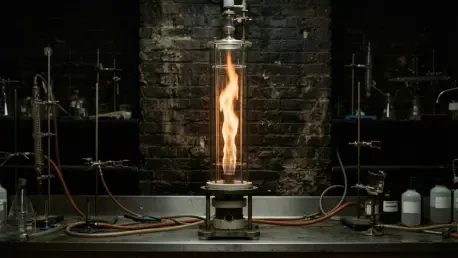
To facilitate a meaningful comparison between conventional and alternative fuels, the research team utilized a direct-injection, high-efficiency nebulizer with a 150-micrometer internal-diameter capillary. This precision instrument ensured that the fuel delivery remained consistent across all test cycles, allowing for a focused analysis of how chemistry affects combustion. The experimental operating parameters were meticulously synchronized to ensure that any observed differences in soot output were attributable to fuel chemistry rather than mechanical variance or flow fluctuations. Both fuels were fed at a constant rate of 100 grams per hour and stabilized within a 60-millimeter diameter polycarbonate chimney by a co-flowing air stream of 1500 grams per hour. This setup allowed the researchers to observe “lifted” flames, which stabilized approximately six millimeters above the nebulizer tip. By maintaining such strict control over the physical environment, the team could isolate the impact of aromatic hydrocarbons on the formation of carbonaceous particulates. The resulting data provides a foundational understanding of how synthetic fuels behave in turbulent environments that simulate the high-stress conditions found in modern jet turbines.
Despite the similarities in flow rates and hardware, the physical properties of the fuels necessitated careful consideration during the initial atomization and vaporization stages. Standard Jet A-1, a fossil-derived kerosene, features a complex mixture of hydrocarbons including significant aromatic content, whereas Isopar-M consists primarily of branched alkanes with less than 1% aromatic presence. This chemical disparity is crucial because aromatics are well-known precursors to soot formation. During the experiments, Jet A-1 exhibited a density of 800 kg/m³ and a viscosity of 1.3 mPa·s, while Isopar-M was slightly less dense at 780 kg/m³ but more viscous at 2.1 mPa·s. These differences influenced the initial spray formation, which was visually captured as a dark, non-luminous region extending 75 millimeters above the burner tip in both flames. The higher viscosity of the alternative fuel slightly altered the droplet size distribution, yet the overall flame stability remained comparable. This stability ensured that the subsequent laser-based diagnostics could accurately probe the reaction zones without interference from erratic flame movements or unburned fuel pockets that might skew the comparative results.
Thermal Characteristics: Mapping Flame Heat Distribution
Thermal profiles acquired via S-type thermocouples revealed that while both flames reached peak temperatures of approximately 1800 Kelvin, the spatial distribution of this heat differed significantly between the two fuel types. The Isopar-M flame reached its thermal peak much earlier in the combustion process, specifically around 80 millimeters in height. In contrast, the Jet A-1 flame showed a more gradual, monotonic increase in temperature across the intermediate regions of the flame. This earlier thermal peak in the alternative fuel likely contributes to the rapid oxidation of soot precursors, effectively preventing the growth of larger, more complex carbon particles before they can agglomerate. The spatial variation in temperature serves as a primary indicator of how fuel chemistry alters the timeline of soot development. By accelerating the heat release, paraffinic fuels seem to create an environment where the chemical building blocks of soot are consumed by oxygen more efficiently. This phenomenon suggests that engines designed for sustainable aviation fuels might benefit from adjusted combustion liner cooling and fuel injection timing to optimize the thermal benefits of these cleaner-burning chemical structures.
The research also employed multispectral imaging and hydroxyl radical chemiluminescence to map the reaction zones where fuel and oxidizer meet. Hydroxyl emission, a marker for the primary reaction zone, was concentrated in the lower region between 6 and 35 millimeters for both fuels. However, as the combustion progressed downstream, the visual signatures diverged sharply. The Jet A-1 flame exhibited a vibrant orange emission peaking between 125 and 180 millimeters, a characteristic sign of high soot concentrations radiating heat. In contrast, the Isopar-M flame produced a much dimmer, diffuse yellow glow that peaked higher up, between 150 and 230 millimeters. This visual evidence supports the theory of a “nucleation-dominated” process in alternative fuels, where particles are oxidized or dispersed before they can grow into the large aggregates that cause visible smoke and contrail seeds. The shift in visual intensity underscores the massive reduction in black carbon emissions that can be achieved simply by removing aromatic compounds from the fuel stream, even when combustion occurs under turbulent, high-heat conditions typical of commercial aviation.
Part 2: Probing Nanoscale Soot With Lasers
The core of the study’s diagnostic power lay in the use of laser-induced incandescence to heat soot particles and analyze their resulting light emission. By using a pulsed neodymium-doped yttrium aluminum garnet laser at 532 nanometers, the researchers could instantaneously heat soot particles to several thousand degrees. Time-resolved measurements were then used to determine the size of primary soot particles by observing how they transferred heat to the surrounding gas. The results showed a stark contrast in particle maturation: Jet A-1 produced significant particle growth and agglomeration, with thermal decay times indicating the presence of relatively large, dense carbon structures. On the other hand, Isopar-M exhibited decay times restricted to a narrow band, suggesting that the particles never grew beyond an ultrafine nucleation stage. These findings indicate that in the Isopar-M flame, soot particles remain significantly smaller than 20 nanometers in diameter throughout the entire combustion process. This is a critical distinction, as smaller particles have different atmospheric residency times and different impacts on human respiratory health and the formation of persistent ice crystals in the upper atmosphere.
Planar imaging provided a two-dimensional snapshot of the soot distribution, revealing that the Jet A-1 flame produced incandescence intensities roughly three times greater than those of its synthetic counterpart. More importantly, the imaging highlighted a high degree of turbulence and intermittency within the flame structure. The soot was not a steady, uniform cloud but rather a series of highly transient, jagged filaments tossed by turbulent vortices. In instantaneous frames, the peak intensity of soot in the conventional kerosene was sometimes six times higher than that of the alternative fuel, illustrating the volatile and concentrated nature of carbon formation in traditional jet fuels. This turbulence-driven intermittency is essential for engineers to understand, as it means that peak soot concentrations can be much higher than average measurements suggest. The ability to visualize these filaments in real-time allows for a better understanding of how localized rich-burn zones contribute to the overall emission profile of the engine. By reducing the overall intensity and frequency of these soot filaments, alternative fuels like Isopar-M provide a much more forgiving combustion profile that resists the formation of heavy particulate matter even under erratic airflow conditions.
Spectral Contamination: Distinguishing Precursors From Soot
By examining the light across a wide spectral range, the research team sought to calculate soot volume fractions through spectrally resolved diagnostics. While Jet A-1 produced a clear, blackbody-like spectrum that allowed for straightforward calculation of particle concentration, the Isopar-M spectrum was heavily distorted. This distortion was caused by laser-induced fluorescence from gas-phase polycyclic aromatic hydrocarbons, which are the chemical precursors to soot. These precursors absorbed the laser energy and emitted light that masked the true incandescence of the tiny soot particles. This spectral contamination highlights a significant challenge for the next generation of aircraft sensors: as fuels become cleaner, the “noise” from chemical precursors can easily be mistaken for the signal of actual soot particles. Standard optical filters and detection methods that worked for traditional kerosene are proving insufficient for paraffinic fuels. This finding emphasizes that the development of alternative fuels must be accompanied by the development of more specialized optical sensors capable of filtering out fluorescence to provide an accurate reading of the increasingly lower soot loads being produced in modern combustion chambers.
Beyond just measuring the quantity of soot, the researchers performed an extensive morphological analysis by processing 35,000 individual soot filaments extracted from the planar images. Using a custom image-processing pipeline involving binarization and contour detection, they analyzed parameters like perimeter, surface area, and emission density. The statistical analysis confirmed that Jet A-1 filaments were not only more numerous but also much larger and more structurally mature. Specifically, the 95th percentile of filament surface area in the Jet A-1 flame was 2.6 times greater than that of Isopar-M. This indicates that the soot in conventional fuel is more compact and graphitized, containing more carbon mass per unit of volume than the wispy, fragmented soot produced by the synthetic paraffinic fuel. This structural maturity is directly linked to the presence of aromatics, which provide the building blocks for the carbon lattice. By moving toward synthetic fuels, the aviation industry is essentially shifting the morphology of its emissions toward less stable, more easily oxidized structures that are less likely to persist in the environment or contribute to the darkening of snow and ice through particulate deposition.
Quantitative Findings: The Challenge of Low Concentrations
For Jet A-1, the researchers successfully mapped the soot volume fraction, identifying a narrow central core where concentration peaked at approximately three parts per million. Above 180 millimeters, the soot concentration dropped sharply as turbulent mixing with air promoted rapid oxidation, essentially “burning off” the remaining carbon before it could exit the chimney. However, the Isopar-M flame presented significant challenges because the soot particles were so small and the precursor fluorescence was so relatively strong. When researchers attempted to fit the spectral data for Isopar-M to standard radiation laws, the fluorescence bias resulted in physically impossible temperature readings of up to 5000 Kelvin. This error is a critical contribution to the field of combustion diagnostics, proving that current tools have reached their functional limit when applied to high-purity paraffinic fuels. The low soot loads of these alternative fuels are nearing the detection limits of traditional laser-induced incandescence technology, requiring higher laser fluences or more complex multi-wavelength detection strategies to overcome the interference from chemical precursors.
The transition to Isopar-M and similar synthetic paraffinic kerosenes effectively shifts the emission profile of aircraft from large soot aggregates to ultrafine particles and gas-phase precursors. While this is a net positive for reducing contrail formation and particulate matter, it requires a significant shift in how engineers monitor and verify combustion efficiency. The study demonstrated that Isopar-M produced three times less incandescence than Jet A-1, but the difficulty in measuring this reduced load means that new certification standards must be established. Future diagnostic systems will likely need to incorporate specialized narrow-band filters and advanced signal-processing algorithms to isolate the thermal signatures of sub-20-nanometer particles. As the industry moves toward 100% sustainable aviation fuel, the ability to accurately quantify these trace emissions will be essential for verifying the environmental benefits claimed by fuel producers and engine manufacturers alike. This research establishes a clear baseline for these efforts, showing that while the fuels are getting cleaner, the science of measuring that cleanliness is becoming exponentially more complex.
Strategic Outlook: Advancing Future Emission Standards
The comparative study of Jet A-1 and Isopar-M provided a definitive look at why alternative aviation fuels are superior from an environmental perspective. The research successfully identified that the soot-reduction potential of paraffinic fuels is rooted in a nucleation-dominated process that prevents the growth of large, lung-penetrating aggregates. By proving that synthetic surrogates produce significantly smaller primary particles and lower total soot loads, the investigation supported the continued adoption of these fuels as a viable path toward sustainable flight. The results showed that the transition to alternative energy sources is not just about carbon neutrality, but about a fundamental change in the physical nature of aerospace emissions. Moving forward, the industry must focus on scaling these fuels while ensuring that the combustion systems are optimized to handle their unique viscosity and thermal profiles. This will require a collaborative effort between fuel chemists and engine designers to ensure that the hardware can fully leverage the cleaner-burning properties of branched alkanes without sacrificing performance or safety.
In the years following this research, the primary focus for aviation engineers shifted toward refining the optical tools used in both laboratory and on-wing diagnostic systems. The discovery that chemical precursors could produce “spectral contamination” led to a new generation of multi-wavelength sensors that can distinguish between gas-phase molecules and solid particulates with high precision. These advancements have allowed for more accurate monitoring of engine health and emission compliance, ensuring that the benefits of alternative fuels are fully realized. Furthermore, the morphological data gathered from the thousands of analyzed filaments provided a roadmap for simulating soot formation in computational fluid dynamics models, allowing for faster and cheaper development of next-generation combustors. Ultimately, the investigation proved that the path to a cleaner aviation sector is paved with increasingly precise measurements. By identifying the limitations of current diagnostic techniques, researchers have enabled the development of the more sensitive tools required to verify the environmental performance of the global fleet as it moves toward a more sustainable future.