
In the evolving landscape of global energy, Christopher Hailstone stands as a pivotal figure in the transition toward sustainable utility infrastructure. With a career spanning decades in energy management and grid reliability, his expertise has been instrumental in bridging the gap between raw renewable resources and the complex demands of modern electricity and gas delivery. As the bio-energy sector moves from the fringes to the center of national security strategies, his insights provide a roadmap for integrating decentralized production into the heavy-duty demands of industrial and city-wide networks.
The following discussion explores the strategic implementation of a 100-ton-per-day bio-gas cluster in Telangana, the technical nuances of synchronizing bio-fuels with existing utility grids, and the profound economic impact of converting agricultural waste into high-value energy.
Moving toward a 100-ton-per-day capacity using a cluster of ten smaller units represents a specific scaling strategy. How does this modular approach minimize operational risks compared to a single mega-plant, and what specific logistics are required to manage diverse inputs like paddy straw and poultry waste across multiple sites?
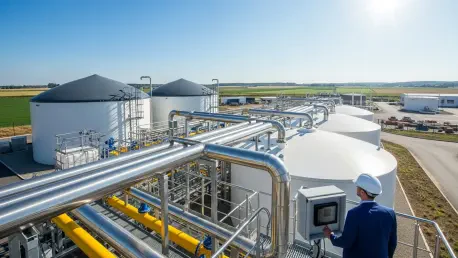
Adopting a modular approach is essentially an insurance policy against the systemic failures that often plague massive, centralized facilities. By distributing the 100-ton-per-day target across ten individual 10-ton units, we ensure that a mechanical breakdown or a localized supply chain disruption at one site doesn’t halt the entire operation. From a logistical standpoint, managing diverse inputs like paddy straw, cattle dung, and poultry waste requires a highly coordinated local network to prevent high transportation costs from eating into the margins. We are setting up these units in strategic hubs, such as the Narmetta Industrial Area, to minimize the distance between the farm gate and the processing unit. This decentralized model allows us to tailor the pretreatment process of each unit to the specific organic stream available in that immediate vicinity, ensuring maximum efficiency in gas yield.
Connecting bio-gas production directly into existing City Gas Distribution networks is a primary goal for regional energy security. What technical hurdles exist when synchronizing domestically produced fuel with utility infrastructure, and how do long-term offtake agreements with major energy providers influence the financial stability of these projects?
The primary technical challenge lies in achieving precise gas quality synchronization; the compressed bio-gas must match the calorific value and purity levels of the natural gas already flowing through the City Gas Distribution (CGD) pipelines. We utilize advanced scrubbing and compression technologies to ensure the fuel is seamless for both industrial and mobility applications in regions like Hyderabad. Financially, the project’s backbone is formed by structured offtake agreements with major entities like GAIL and Bhagyanagar Gas Limited (BGL). These contracts provide a guaranteed buyer for our output, which turns a high-capex investment of INR 700 crore into a bankable, low-risk venture for our stakeholders. This demand assurance is what allows us to confidently plan a multi-year rollout, knowing that every cubic meter of gas produced is already sold into the domestic market.
Converting agricultural residues into clean fuel addresses both energy needs and environmental issues like stubble burning. Could you walk us through the chemical conversion process for various organic streams, and what metrics are used to measure the reduction in greenhouse gas emissions when replacing traditional fossil fuels?
The transformation begins with anaerobic digestion, where microorganisms break down the complex organic matter in paddy straw and poultry waste in the absence of oxygen to produce raw biogas. This raw gas is then refined to remove carbon dioxide and hydrogen sulfide, resulting in a high-methane compressed bio-gas that is chemically equivalent to fossil-derived natural gas. We measure our environmental success through carbon intensity metrics, specifically tracking the displacement of imported fossil fuels and the prevention of methane release from decomposing waste. By capturing the methane that would have otherwise escaped from open cattle dung heaps or been released during stubble burning, we significantly lower the carbon footprint of the local agricultural sector. It is a sensory shift as much as a chemical one, turning the smoke-filled air of harvest season into a clean, pressurized fuel source.
The industry is shifting from voluntary adoption to a mandatory five-percent blending framework by the end of the decade. How will this policy shift accelerate private investment in the bio-energy sector, and what steps should local governments take to ensure the supply chain can meet these rising targets?
The shift to a mandatory blending framework—starting at 1% and rising to 5% by 2028–29—acts as a massive catalyst for private capital because it creates a permanent, non-negotiable demand. This regulatory certainty encourages investors to fund ambitious projects like our three-phase rollout, knowing the market cannot disappear. To support this, local governments must streamline the “waste-to-energy” supply chain by facilitating better collection infrastructure and providing clear land-use permits for industrial clusters. The government’s support in Telangana has already been vital, but continuing to integrate these plants into schemes like GOBARdhan will be essential to reach the national goal of 15,000 tons per day of production capacity. This policy evolution essentially transitions bio-gas from a niche green initiative into a core component of the national energy portfolio.
Large-scale bio-fuel investments are often cited as catalysts for the rural economy. Beyond the initial capital injection, how do these facilities create sustained income for local farmers, and what role does the circular economy play in transforming waste management from a cost into a revenue stream?
These facilities fundamentally change the financial landscape for a farmer by turning “waste” into a second harvest. Instead of spending money to clear fields or manage manure, farmers now have a reliable marketplace where they can sell paddy straw and cattle dung, providing them with a steady, supplemental income stream. This is the circular economy in action: the agricultural residue goes into our plant, and the nutrient-rich digestate produced as a byproduct can often go back to the fields as organic fertilizer. We are seeing an investment of INR 210 crore in the first phase alone, and much of that value circulates locally through employment and raw material procurement. It transforms the rural economy from a passive producer of raw goods into an active participant in the high-tech energy sector.
Developing bio-energy infrastructure in phases requires significant coordination between investors and government officials. What are the primary milestones for completing a multi-year, multi-plant rollout, and how do you ensure that the technology used in the first phase remains efficient as the entire cluster reaches completion?
Our rollout is meticulously scheduled into three phases—Phase 1 with three plants, followed by another three in Phase 2, and concluding with four in Phase 3 by 2030. Each phase acts as a learning milestone, allowing us to refine our construction timelines and optimize the integration with the CGD network based on real-time performance data. To ensure long-term efficiency, we utilize a modular technology architecture that allows for “plug-and-play” upgrades. This means that as we break ground on the final four plants in 2028, we can retroactively apply any software or filtration improvements to the original Narmetta units. Maintaining this technological continuity is critical for ensuring that the entire 100 TPD cluster operates as a single, cohesive, and high-performing utility asset.
What is your forecast for the bio-energy sector?
I foresee a decade of rapid industrialization where bio-gas plants become as common as traditional power substations across the rural-urban fringe. We are moving toward an era of “energy independence at the district level,” where regional clusters will insulate local economies from the volatility of global oil and gas prices. As the 5% blending mandate takes hold, I expect to see a surge in specialized logistics companies dedicated solely to organic waste management, further professionalizing the supply chain. Ultimately, bio-energy will no longer be viewed as an alternative; it will be the primary driver of India’s transition to a self-reliant, low-carbon economy, proving that environmental stewardship and industrial growth are not just compatible, but inseparable.