
Christopher Hailstone joins us today as a seasoned authority on environmental resource management and grid stability, bringing a unique perspective to the intersection of energy and sustainable land use. With a career dedicated to understanding how fragile ecosystems can be bolstered through innovative technology, he has become a leading voice in the push for climate-resilient agriculture. In this discussion, we explore the transformative potential of biochar within the steep, terraced landscapes of Northeast India. We delve into how converting agricultural waste into a soil amendment can simultaneously combat erosion, improve water security during unpredictable dry spells, and provide a low-cost pathway for small-scale farmers to secure their livelihoods against a backdrop of rising global temperatures.
Hill farming often deals with rapid rainwater runoff and nutrient loss on steep slopes. How does biochar physically alter the soil structure to mitigate these issues, and what specific improvements in moisture retention have you observed in terraced landscapes?
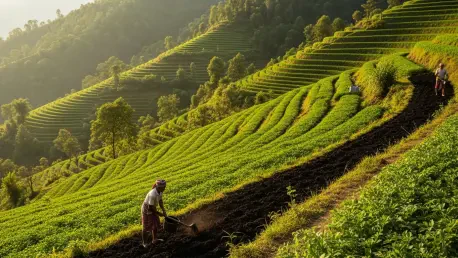
The physical transformation of the soil begins with biochar’s incredibly porous, honeycombed structure, which essentially turns the earth into a high-capacity sponge. In the steep, fragile hill regions of Nagaland, where gravity and heavy rains usually strip the land of its vitality, these carbon-rich particles lock into the soil matrix to anchor nutrients that would otherwise be washed away. You can almost feel the difference in the soil’s tilth; it becomes more resilient and less prone to the devastating erosion that plagues traditional slope farming. By stabilizing the soil in these terraced landscapes, we see a significant reduction in the need for constant irrigation because the biochar holds onto every drop of rainwater with remarkable tenacity. This structural change is a game-changer for farmers who have spent generations watching their most fertile topsoil disappear down the mountainside after a single heavy storm.
Crop residue burning is a common environmental challenge, yet these materials can be converted into carbon-rich biochar. What is the step-by-step process for small-scale farmers to produce this material affordably, and how does this transition impact their long-term operational costs?
The beauty of this transition lies in its simplicity: farmers take the very agricultural waste that they used to burn—creating thick, choking smoke—and subject it to a controlled, low-oxygen heating process. This localized production allows marginal farmers to create a high-value soil amendment right on their own land without needing expensive industrial equipment. By repurposing crop residues, they effectively eliminate the cost of waste disposal while simultaneously slashing their expenditures on chemical fertilizers and supplemental water. Over the long term, this creates a closed-loop system where the farm provides its own “medicine” for the soil, leading to a much more stable and predictable balance sheet. It is an empowering shift from a cycle of pollution and expense to one of carbon sequestration and financial self-sufficiency.
Rising temperatures and irregular rainfall patterns are putting significant pressure on farm productivity. How does integrating biochar into the soil help crops survive extended dry periods, and what metrics are used to measure the resulting improvements in fertility and yield?
As temperatures climb and the rains become more erratic, biochar acts as a critical buffer that protects the roots of the crop from the searing heat and thirst of a dry spell. It improves the overall soil health by fostering a habitat for beneficial microbes, which in turn boosts crop resilience and helps plants thrive even when the weather is unforgiving. To track these improvements, researchers look closely at long-term carbon storage levels in the soil and the specific volume of water retained over weeks rather than days. We also monitor actual crop yield per hectare, where the evidence often shows more robust harvests in biochar-treated plots compared to traditional ones. The emotional relief for a farmer seeing a green, thriving field in the middle of a drought is perhaps the most profound metric of all, proving that the land can still provide despite a changing climate.
Moving from research to field application involves pilot projects in local villages and horticulture areas. What are the primary obstacles farmers face when adopting these methods, and how can government agencies better support the training infrastructure required for widespread use?
The jump from a controlled university study to a muddy, working terrace farm is often hindered by a lack of hands-on technical knowledge and the initial hesitation to change age-old traditions. Many small-scale farmers are understandably cautious about altering their methods when their survival depends on every single harvest, making the success of local pilot projects absolutely vital. Government agencies can bridge this gap by funding robust training programs and creating demonstration centers where farmers can see the tangible results of biochar application for themselves. By collaborating with institutions like Nagaland University, the government can help standardize affordable production techniques and ensure that the “low-cost” promise of biochar actually reaches the most isolated horticulture areas. It requires a concerted effort to move this from a scientific paper into a practical, everyday tool for the thousands of families working the hills.
What is your forecast for biochar use in hill farming?
I predict that biochar will soon become the cornerstone of climate-resilient agriculture in high-altitude regions, evolving from an experimental additive to a standard practice for sustainable soil management. Within the next decade, we will likely see a massive reduction in crop residue burning as farmers recognize the immense value hidden in their waste, turning environmental hazards into a foundation for food security. As the technology for small-scale production becomes more refined and government-backed training scales up, biochar will play a pivotal role in stabilizing the agricultural economies of places like Northeast India. Ultimately, this isn’t just about better soil; it’s about a global shift toward “carbon farming” where the land becomes a powerful tool for long-term carbon storage while simultaneously feeding a growing population under increasingly difficult environmental conditions.