
The arrival of prismatic battery cells at the Louisville Assembly Plant marks a pivotal shift toward reducing production costs for mass-market electric vehicles. This initial shipment originates from the BlueOval Battery Park in Marshall, Michigan, where the automaker has officially transitioned from a vehicle assembler into a direct producer of energy components. The significance of this move lies in the choice of lithium iron phosphate chemistry, a technology that prioritizes affordability and durability over the density of nickel-cobalt-manganese alternatives. These specific cells are destined for prototypes of the “Fathom,” an upcoming electric pickup truck engineered on the Universal Electric Vehicle Platform. By localizing the supply chain, the organization aims to insulate itself from logistics volatility while capturing federal incentives for domestic manufacturing. This milestone serves as a proof of concept for a broader strategy to democratize electric mobility for the average consumer throughout the country.
Strategic Advantages of LFP Chemistry
The transition toward LFP chemistry represents a calculated departure from the expensive raw materials that have historically driven up the price of battery packs. By eliminating nickel and cobalt, the production process becomes more sustainable and less reliant on high-cost mining operations often plagued by supply constraints. Beyond the economic benefits, LFP batteries are recognized for their robust thermal stability and cycle life, which means they can be charged to one hundred percent frequently without the degradation typical of other chemistries. This durability makes them ideal for work-focused vehicles like the Fathom, where high-use scenarios and bidirectional power functions are essential requirements. Owners can utilize the truck as a mobile power source for job sites or home backup without fearing significant battery health loss. Furthermore, the prismatic form factor allows for better space utilization within the chassis, offering a more compact storage solution for the fleet.
Innovation in cell design has allowed these prismatic units to perform double duty as both energy storage and structural elements within the vehicle architecture. This “cell-to-chassis” approach significantly reduces the number of individual components required for the assembly, which in turn lowers the overall weight of the truck. By integrating the batteries directly into the frame, engineers have simplified the manufacturing process and improved the rigidity of the platform. This structural efficiency translates to better handling and safety performance for the end user while simultaneously decreasing the energy consumption needed to move the vehicle. The move away from complex modular housing allows for a more streamlined production line at the assembly plant, ensuring that the cost savings achieved at the cell level are maintained through the final vehicle rollout. Such technical advancements are critical for reaching price parity between internal combustion engines and electric alternatives.
Operational Integration and Future Scaling
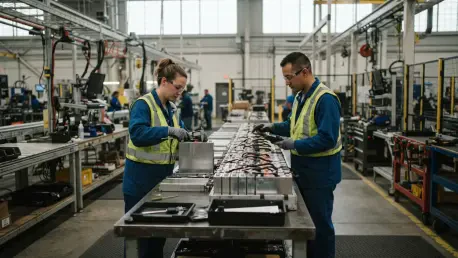
The Michigan facility serves as a primary example of how a domestic manufacturer can leverage global expertise to accelerate industrial output. While the automaker owns and operates the BlueOval Battery Park, the core manufacturing technology is licensed from Contemporary Amperex Technology Co. Limited, an international leader in battery innovation. This partnership enables a rapid scaling of production, with the factory currently reaching speeds of forty cells per minute. To ensure that this high-volume output does not compromise safety or performance, the plant utilizes advanced automated inspection systems. These systems employ high-resolution image-recognition technology to scan every cell for microscopic flaws, targeting defect rates measured in parts per billion. This level of precision is necessary when producing the massive quantities required for a flagship electric pickup truck program. By blending foreign technical knowledge with American industrial labor, the facility has become a cornerstone of the regional economy.
The successful dispatch of the first domestic LFP cells established a template for achieving energy independence in the automotive sector. Stakeholders recognized that the move toward structural prismatic cells provided the leverage to compete with global manufacturers on both price and performance. Looking forward, the industry should prioritize the development of closed-loop recycling systems to recover these materials, ensuring that the domestic battery cycle remains sustainable. Companies that followed this lead by investing in localized technology effectively mitigated the risks of global supply chain disruptions. The integration of standardized cell formats across various vehicle platforms simplified the transition for repair networks, which became a vital factor in consumer adoption. By focusing on chemistry and quality control during the production ramp-up from 2026 to 2028, the manufacturer secured a position at the forefront of the electric transition and paved the way for broader infrastructure projects.