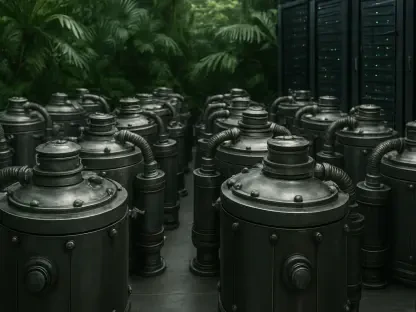

The relentless pursuit of computational power has reached a critical juncture where the sheer heat generated by high-density microprocessors threatens to melt the very progress the semiconductor industry has fought for decades to maintain. As transistors shrink toward their physical limits, the thermal energy density concentrated on a single chip has surged beyond the capacity of traditional air-cooling methods. This fundamental physical constraint has birthed a new generation of thermal management centered on copper cold plates. By integrating advanced liquid-to-chip interfaces, engineers are now moving toward a future where the cooling system is as sophisticated as the silicon it protects. The current shift is not merely an incremental update; it is a vital transition required to prevent a total energy crisis within the global digital infrastructure.
The Evolution of Direct-to-Chip Thermal Management
Historically, server rooms relied on massive air-conditioning units to push chilled air through perforated floor tiles and into metal heat sinks. However, air is an incredibly poor conductor of heat, possessing a low volumetric heat capacity that makes it inefficient for modern workloads. As rack densities climb toward 100 kilowatts and beyond, the industry is pivoting toward liquid-based thermal solutions. These systems utilize the superior heat-carrying capacity of water or specialized fluids to pull energy directly from the source. The transition represents a shift from “cooling the room” to “cooling the chip,” a philosophy that dramatically reduces the energy wasted on moving vast quantities of air.
The core principle of cold plate technology lies in the direct contact between a high-conductivity material and the processor. Heat is absorbed through a metal interface and then transported away by a circulating fluid. This direct-to-chip approach addresses the “thermal bottleneck” that has historically limited the clock speeds and reliability of high-performance computing. In the context of global sustainability, this evolution is critical. Data centers currently consume a significant portion of the world’s electricity, and a substantial fraction of that power is dedicated solely to mechanical cooling. By refining the efficiency of fluid transport, the industry can significantly lower its environmental footprint while maintaining growth.
Engineering Foundations and Technical Components
Material Selection: The Superiority of Pure Copper
While aluminum alloys and stainless steel are common in industrial manufacturing due to their lower costs and ease of fabrication, they pale in comparison to pure copper regarding thermal conductivity. Copper provides a thermal transfer rate of approximately 400 W/mK, nearly double that of the best aluminum alloys. This disparity means that copper can move heat away from a hotspot much faster, preventing localized thermal throttling in the silicon. However, the use of high-purity copper presents significant fabrication challenges. Its high melting point and extreme reflectivity make it an elusive target for traditional laser-based 3D printing, often resulting in structural defects or poor material density.
Design Innovation: Topology Optimization Algorithms
Traditional cold plates typically utilize uniform, straight-channel fin geometries because they are easy to manufacture with standard milling tools. Nevertheless, these simple structures are rarely the most efficient for heat exchange. Modern engineering has embraced topology optimization, a computational method where physics-based algorithms determine the ideal internal structure. These algorithms iteratively adjust the geometry to maximize surface area contact and heat conduction while simultaneously minimizing fluid resistance. The resulting structures often appear organic or irregular, specifically designed to disrupt the fluid boundary layer and ensure a constant state of high-energy exchange between the metal and the coolant.
Fabrication Breakthrough: Electrochemical Additive Manufacturing (ECAM)
To realize these complex, algorithmically derived designs, a move away from heat-based manufacturing is necessary. Electrochemical Additive Manufacturing, or ECAM, builds copper structures at the micro-scale through a room-temperature plating process. By depositing metal atom by atom, ECAM avoids the oxidation and structural stresses associated with welding or laser melting. This precision allows for the creation of features as small as 30 micrometers, a scale that is impossible to achieve with traditional milling. This level of detail enables the production of the jagged, high-surface-area fins required to achieve the performance targets set by topology optimization software.
Recent Advancements and Emerging Industry Trends
The integration of artificial intelligence into the design phase is now allowing for real-time adjustments to internal geometries based on specific chip power maps. This means a cold plate can be customized to have denser fin structures exactly where the processor’s hottest cores are located. This “bespoke cooling” trend is gaining traction as hyperscalers look for every possible efficiency gain. Furthermore, there is a growing movement toward “sustainable-by-design” infrastructure. Corporations are no longer viewing cooling as a utility but as a core component of their carbon neutrality strategies, leading to increased investment in liquid-cooling hardware that can be recycled or repurposed.
Real-World Applications and Sector Deployment
In hyperscale data centers, the implementation of liquid-cooled server racks has moved from a niche experiment to a standard requirement for next-generation AI clusters. These facilities use copper cold plates to manage the massive thermal output of modern GPUs, allowing for tighter server packing and lower operational costs. Beyond the server room, electric vehicle infrastructure is benefiting from similar advancements. High-efficiency cold plates are being deployed to regulate the temperature of battery packs and power inverters. This thermal regulation is essential for achieving the ultra-fast charging speeds that consumers now expect, as it prevents the battery from overheating during high-voltage transfers.
The aerospace and defense sectors are also utilizing these precision heat exchangers for avionics and high-altitude electronics. In these environments, weight and volume are at a premium, making the high efficiency-to-size ratio of copper cold plates highly attractive. Additionally, renewable energy systems, such as solar and wind power installations, rely on these plates to enhance the reliability of power converters. By maintaining stable temperatures in harsh outdoor environments, the technology ensures that the transition to clean energy is supported by durable and efficient hardware capable of long-term service.
Technical Challenges and Market Obstacles
Despite the clear performance advantages, the transition from air to liquid cooling involves significant initial capital expenditure. Building a liquid-cooled data center requires specialized plumbing, coolant distribution units, and leak-detection systems that are not present in traditional facilities. Scaling electrochemical additive manufacturing for mass production also remains a hurdle. While the process is highly precise, it is currently slower than traditional die-casting, which can create supply chain bottlenecks. There is also a lack of standardized interfaces across different hardware vendors, which can lead to vendor lock-in and complicate the maintenance of mixed-server environments.
Future Outlook and Technological Trajectory
The next phase of development will likely involve “smart” cold plates equipped with integrated sensors. These sensors will monitor thermal gradients and fluid pressure in real-time, allowing the system to adjust flow rates dynamically based on the computational load. This would move cooling from a static system to an active, responsive one. Furthermore, this technology will play a vital role in the longevity of Moore’s Law. By providing a superior thermal ceiling, copper cold plates allow designers to push power densities higher without the risk of immediate thermal failure. In the long term, these systems will be the foundational architecture for the cooling stages of quantum computers and future supercomputers.
Final Assessment of Copper Cold Plate Technology
The synergy of high-purity copper, topology optimization, and electrochemical additive manufacturing has successfully redefined the boundaries of thermal management. The performance gains are substantial, with a recorded 32% increase in cooling efficacy and a 68% reduction in the pressure drop compared to traditional designs. This means that systems can run cooler while requiring significantly less power to circulate the necessary fluids. The technology proved its worth by demonstrating that it is possible to decouple the growth of the digital economy from the exponential rise in energy consumption.
The shift toward this sophisticated cooling paradigm was ultimately a response to the physical limitations of legacy air-based systems. By utilizing ECAM to overcome the fabrication difficulties of pure copper, engineers created a tool that allows for unprecedented control over heat transfer. This advancement provided a clear path for data centers to scale their operations sustainably while meeting the rigorous demands of modern artificial intelligence and high-performance computing. The adoption of these copper-based solutions was the necessary step to align industrial progress with global environmental responsibilities. All evidence suggested that the era of air cooling has ended, and the age of liquid-metal thermal management has officially begun.