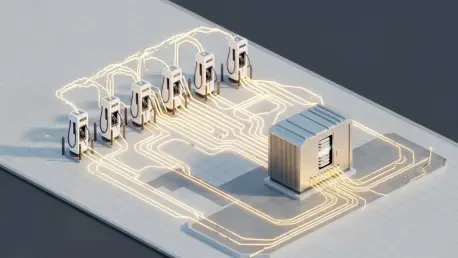

The global race to electrify transportation has encountered a formidable obstacle in the form of an aging electrical grid that was never designed to handle the instantaneous surge of ultra-rapid charging stations. As the expansion of ultra-rapid charging networks accelerates, market leaders like InstaVolt have transitioned toward a more resilient model by integrating Battery Energy Storage Systems into their core infrastructure. This technological shift serves as a critical bridge, allowing high-capacity charging to flourish even where traditional grid connections remain stagnant or prohibitively expensive. The interplay between private charging operators and grid providers has become a defining factor in meeting government-mandated decarbonization goals, with decentralized energy solutions emerging as the primary tool for bypassing the limitations of centralized power distribution.
Market Dynamics and the Shift Toward Distributed Energy Resources
Technological Evolution and Evolving Consumer Demand for Ultra-Rapid Charging
Technological advancements have allowed on-site battery storage to effectively decouple charging speed from the immediate capacity of the local grid. This evolution is vital because driver expectations have shifted entirely toward speed and reliability; a charging station that cannot deliver its advertised power during peak hours is increasingly viewed as a failure of infrastructure. By utilizing battery buffers, operators can maintain high performance regardless of the underlying utility constraints, ensuring that every vehicle receives a consistent and rapid charge.
The rise of the “Superhub” model further exemplifies this trend by integrating large-scale storage with renewable sources like on-site solar arrays. These hubs provide a dependable power source in rural and highway locations where the existing power lines are often insufficient for multiple high-draw chargers. As consumer behavior continues to prioritize uptime and geographical accessibility, the adoption of decentralized power management has become the only viable path for expanding the network into previously underserved regions.
Growth Projections and the Economic Impact of On-Site Storage
The economic viability of battery-supported charging is no longer theoretical, as demonstrated by the operational success of the Winchester model. This strategy involves purchasing off-peak energy at lower rates, storing it, and then reselling it during peak hours when grid prices and demand are at their highest. Data shows that this form of energy arbitrage allows operators to offer more competitive pricing to drivers while simultaneously protecting their own profit margins from the volatility of the energy market.
Performance metrics from integrated sites show a measurable increase in both energy delivery and hardware utilization. For instance, installations at key transit points have reported energy delivery increases of over 30 percent per session once battery capacity was added to support the hardware. These gains prove that BESS integration is not merely a temporary fix for grid delays but a long-term standard for national infrastructure that maximizes the efficiency of every kilowatt-hour delivered.
Overcoming Structural Hurdles and Systemic Grid Constraints
Navigating the complexities of the modern energy landscape requires strategies to circumvent exorbitant network demand charges and chronic delays in high-capacity grid connections. In many regions, waiting for a traditional utility upgrade can stall a project for several years, creating a bottleneck that threatens the pace of electric vehicle adoption. By adopting a mindset of disciplined infrastructure thinking, operators use batteries to augment smaller, existing connections, allowing sites to go live in a fraction of the time required for a full grid overhaul.
Localized energy augmentation also addresses the geographic limitations of the current power grid, particularly in remote areas where the cost of running new high-voltage lines is prohibitive. This approach allows for the scaling of existing sites where high demand has already outpaced the available power supply. Instead of waiting for a central authority to modernize the wires, private companies are building their own micro-scale reliability, ensuring that the charging network grows at the speed of market demand rather than at the speed of utility bureaucracy.
Navigating the Regulatory Landscape and Energy Security Standards
National infrastructure mandates and planning permissions play a significant role in determining the speed of charging station deployment. Governments are increasingly recognizing that localized storage can act as a shock absorber for the national grid, providing stabilization services during times of peak stress. Regulatory shifts are now incentivizing private investment in BESS because these systems reduce the overall burden on public utility upgrades, shifting the financial responsibility of modernization from the taxpayer to the private infrastructure developer.
Compliance with evolving energy security standards is also driving the integration of on-site renewables with storage systems. Environmental standards have become stricter, pushing operators to prove that the energy used for transportation is as clean as possible. By storing solar power generated on-site, charging stations can operate with a higher degree of energy independence, fulfilling both regulatory requirements and the broader goal of creating a sustainable, low-carbon transport network that is resilient against external energy shocks.
The Future of Localized Energy Management and Grid Independence
The industry is moving toward a reality where fully autonomous charging sites, powered by a sophisticated blend of hybrid solar and battery systems, become the norm. Emerging disruptors in energy management software are already optimizing storage cycles based on real-time grid pricing and weather forecasts, ensuring that batteries are always prepared for high-traffic periods. This transition from a centralized grid reliance to a resilient, distributed network of energy-smart hubs represents the next phase of the energy transition.
As global economic conditions stabilize and innovations in battery chemistry continue to lower deployment costs, the barrier to entry for BESS will continue to fall. The focus will likely shift toward maximizing the intelligence of these systems, allowing them to interact with the grid as active participants rather than passive consumers. This independence will be the hallmark of the next generation of charging infrastructure, where the location of a high-speed charger is determined by driver needs rather than the proximity of a high-voltage substation.
Assessing the Long-Term Viability of Battery-Integrated Charging
The strategic implementation of battery energy storage systems successfully mitigated the systemic energy scarcity that once threatened to derail the electric vehicle sector. Stakeholders who prioritized proactive infrastructure investments found that decoupling charging speed from immediate grid capacity was the only way to ensure network reliability and long-term cost-effectiveness. This approach proved that localized solutions could solve national-scale problems more efficiently than waiting for a centralized modernization of the entire power grid.
The industry moved toward a model where BESS acted as the primary catalyst for the widespread adoption of sustainable electric transportation. By focusing on energy autonomy and operational efficiency, developers created a blueprint for a resilient network that functioned independently of the pace of utility upgrades. This evolution shifted the narrative from a grid crisis to a landscape of opportunity, establishing a new standard for how energy is managed, stored, and delivered to a mobile society.