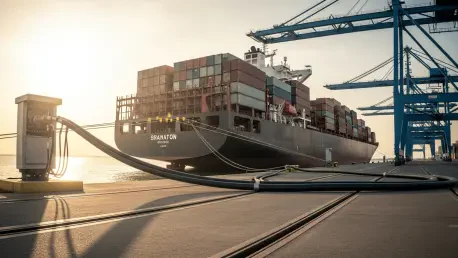

The thick plumes of black smoke traditionally rising from container ships docked at major global ports are becoming a relic of a less regulated maritime past as port authorities implement strict zero-emission mandates. This transformation stems from the realization that vessels at berth contribute significantly to localized air pollution, often exceeding the total emissions of thousands of passenger cars in surrounding urban areas. For decades, the decision to plug into the local electrical grid, known as cold ironing or shore power, remained a voluntary measure adopted by environmentally conscious shipowners or ports seeking to reduce noise. However, the landscape has fundamentally changed due to a convergence of international climate targets and health-focused legislation that leaves little room for individual preference. As maritime hubs transition into green corridors, the ability to turn off auxiliary engines and draw power from land-based sources has evolved from a prestigious environmental accolade into a non-negotiable prerequisite for conducting trade in the modern global economy.
Navigating the New Regulatory Landscape
The enforcement of the FuelEU Maritime regulation has established a clear trajectory for the decarbonization of the shipping industry by mandating specific emission reductions for energy used on board ships. Starting in 2026, the requirements focus on the gradual reduction of greenhouse gas intensity, with specific clauses targeting the use of on-shore power supply for containerships and passenger vessels while at berth. This legislative framework creates a standardized expectation across the European Union, ensuring that any vessel wishing to utilize major European ports must be equipped to handle land-based electrical connections. Beyond the European borders, the International Maritime Organization has intensified its revised strategy to reach net-zero emissions, influencing port state control measures worldwide. These regulations do not merely suggest improvements; they impose significant financial penalties for non-compliance, effectively turning the environmental cost of idling into a direct operational expense that must be managed.
While European standards provide a continental framework, the stringent mandates implemented by the California Air Resources Board serve as a primary catalyst for shore power adoption in North Pacific trade routes. These requirements dictate that a vast majority of container, refrigerated, and cruise vessels must utilize shore power to mitigate the health risks associated with particulate matter and nitrogen oxides in densely populated coastal regions. This local enforcement has triggered a global ripple effect, as shipping lines operating on trans-Pacific routes must invest in standardized equipment to maintain access to critical gateways like the Port of Los Angeles and the Port of Long Beach. Consequently, the maritime industry is witnessing a shift where compliance with regional laws dictates the global design standards of newbuilds. This regulatory pressure is further reinforced by green port incentives that provide discounted wharfage fees, creating a dual-pronged approach of punitive measures and rewards.
Strategic Integration and Future Infrastructure
Integrating massive cargo ships into a city’s electrical grid presents a monumental engineering challenge that requires substantial upgrades to existing utility infrastructure and substation capacity. A single large cruise ship can demand upwards of 15 to 20 megawatts of electricity, a load equivalent to that of a small town, which necessitates sophisticated frequency converters and high-voltage transformers to match the ship’s internal requirements. To meet these demands, ports are increasingly partnering with regional energy providers to ensure that the power drawn from the grid is not only sufficient but also sourced from renewable energy to truly achieve zero-emission goals. This transition requires a holistic view of the energy ecosystem, where the port acts as a dynamic node in the regional grid. The synchronization of ship-to-shore systems involves complex protective relaying and automated control systems to prevent power surges or outages, ensuring that the transition occurs seamlessly without disrupting onboard operations.
The maritime sector successfully navigated the transition from voluntary participation to mandatory compliance by prioritizing robust infrastructure investment and cross-industry collaboration. Stakeholders who acted decisively identified the necessary technological upgrades early, which allowed them to integrate shore power capabilities without disrupting their primary logistics schedules. Port authorities and utility providers coordinated their efforts to ensure grid stability while providing the high-voltage capacity required for modern maritime operations. Regulatory bodies provided the clear frameworks needed to standardize equipment, which simplified the procurement process for global shipping lines. These collective actions reduced localized air pollution and established a new benchmark for sustainable port operations across the globe. By treating compliance as a strategic imperative, the industry secured its operational future within an increasingly carbon-constrained world. The focus remained on developing resilient energy networks.