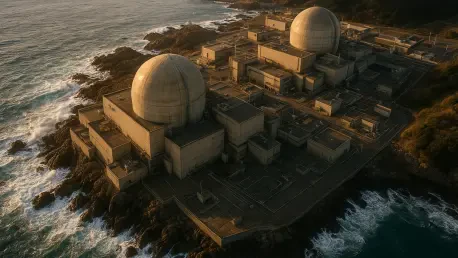

The Nuclear Safety and Security Commission faces pressure to implement more aggressive auditing of the climate models used to predict the long-term viability of reactor cooling sites. As the global environment shifts, the Korea Hydro & Nuclear Power (KHNP) company is grappling with the thermal integrity of its massive nuclear fleet. These reactors rely on stable local seawater temperatures to dissipate waste heat during standard power generation and, more critically, to provide emergency cooling during unforeseen accidents. Every facility is built to a specific design seawater temperature limit, which serves as a regulatory boundary for safety. If the incoming cooling water exceeds these thresholds, the system’s efficiency can no longer be guaranteed under existing safety standards. Recent environmental data indicates that the surrounding ocean is warming at a pace that quickly erodes these protective margins, forcing a national reevaluation of energy security and operational protocols.
Immediate Thermal Risks and Infrastructure Vulnerability
Monitoring: Narrowing Safety Margins at Critical Sites
A comprehensive legislative audit recently brought to light a significant vulnerability in South Korea’s energy grid, noting that eight major nuclear reactors are operating dangerously close to their thermal design limits. These units, which include Hanul Units 1, 3, and 4, alongside Hanbit Units 1, 3, 4, 5, and 6, are now functioning within a narrow 2 °C (3.6 °F) buffer of their maximum allowable intake temperatures. This proximity creates a precarious situation during peak summer months when atmospheric heat transfers directly to the coastal waters. When these margins shrink, the operational flexibility of the plant diminishes, leaving engineers with very little room for error. The thermal load of the reactor must be carefully balanced against the cooling capacity of the ocean, but as the heat sink itself warms, the fundamental physics of the cooling process become less efficient and more difficult to manage under strict regulatory safety mandates.
Forecasting: The Volatile Nature of Climate Models
Beyond the immediate temperature readings, the most alarming discovery from recent technical reports is the precipitous decline in the projected margin period for various facilities. This metric represents the estimated time remaining before ambient seawater temperatures are expected to consistently exceed the plant’s design limits. In a startling shift, the projected safety margin for Hanul Units 3 and 4 plummeted from 28 years to just 13 years within a single assessment cycle. This massive discrepancy suggests that fifteen years of expected safety vanished virtually overnight due to revised environmental data and more accurate modeling techniques. This volatility highlights a disconnect between historical climate projections and the current reality of rapid oceanic warming. If these projections continue to be revised downward at such a rate, the time available for making structural modifications to the plants will be far shorter than previously anticipated.
Addressing Procedural Flaws and Future Reforms
Policy: The Limitations of the Ten-Year Upgrade Rule
The current strategy employed by KHNP has faced heavy criticism for being overly reactive rather than preventative, particularly regarding the ten-year rule for facility upgrades. Under this policy, the agency only initiates significant infrastructure modifications, such as reinforcing cooling systems or expanding heat exchangers, once a reactor’s margin falls below a ten-year threshold. Critics argue that this timeline is dangerously inadequate because it fails to account for the non-linear nature of climate change. As seen in recent data, a margin can drop by more than a decade in a single year, which could theoretically leave a plant in a state of non-compliance before an upgrade plan is even finalized. This rigid adherence to a static timeframe ignores the reality that environmental conditions are changing faster than the bureaucratic and engineering processes required to address them, creating a significant gap in the national safety architecture.
Resilience: Proactive Systems for Enhanced Facility Safety
In addition to technical upgrades, the Nuclear Safety and Security Commission was tasked with taking a more aggressive role in auditing the data models used by plant operators. This involved verifying that all climate projections accounted for the most severe possible scenarios, including sustained heatwaves that could elevate seawater temperatures for weeks at a time. Authorities moved to prioritize physical infrastructure resilience, such as deep-sea intake pipes or secondary cooling loops, over simply adjusting safety paperwork to reflect higher allowable limits. By investing in these long-term physical solutions, the industry sought to decouple plant safety from fluctuating environmental conditions. The focus transitioned toward creating a self-sustaining safety culture that anticipated environmental shifts rather than just reacting to them. These proactive steps were essential for maintaining public trust and ensuring that nuclear power remained a viable component of the carbon-neutral transition.