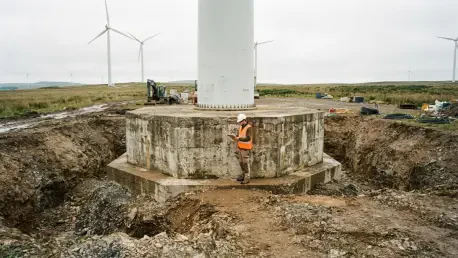

The global landscape of renewable energy has reached a pivotal juncture where the first generation of industrial wind power assets is nearing the end of its intended operational lifespan, forcing a radical rethink of infrastructure longevity. As of 2026, many of the pioneering turbines installed during the early expansion phase of the industry have reached a point of diminishing returns. These aging machines, once the vanguard of the green revolution, now represent a significant opportunity for repowering—a process that involves replacing older, low-capacity units with modern, high-efficiency turbines. However, this transition is not merely a matter of swapping out mechanical components; it presents a profound structural engineering dilemma centered on the massive concrete foundations buried beneath the earth.
The current industry landscape is defined by a drive for greater energy density and improved capacity factors. While early-generation wind farms typically utilized turbines with capacities under 1 megawatt, the modern standard has shifted toward units capable of generating 7.5 megawatts or more. This technological leap necessitates a rigorous evaluation of existing site infrastructure. Developers are now faced with a choice between the costly, environmentally disruptive process of full demolition and the innovative prospect of upcycling legacy foundations to support these much larger loads. The logistical complexity of navigating existing grid connections and land-use permits makes the reuse of established sites highly desirable, provided the structural integrity of the foundations can be guaranteed for another operational cycle.
Navigating this transition requires a deep understanding of the historical context of wind site development. The foundations laid fifteen to twenty years ago were designed for a different era of mechanical stress and aerodynamic force. Transitioning these sites into the late 2020s involves more than just structural reinforcement; it requires a holistic approach to asset management that balances economic viability with environmental stewardship. As the industry moves forward from 2026, the focus has shifted toward maximizing the value of every ton of concrete already poured, turning what was once considered a liability into a strategic asset for the next generation of wind energy production.
The Evolution of Wind Energy Infrastructure and Repowering Needs
The trajectory of wind turbine engineering has been characterized by a relentless increase in scale, with rotor diameters and hub heights expanding to capture more consistent, higher-velocity winds. In the early 2000s, an 850-kilowatt turbine was considered a substantial piece of industrial machinery, supported by octagonal spread foundations that were perfectly adequate for the overturning moments of that period. Fast forward to the present day in 2026, and the industry is routinely deploying turbines that are nearly ten times more powerful. These modern giants exert vastly superior dynamic loads, creating a structural mismatch that legacy foundations were never intended to resolve without significant modification.
This evolution has created a massive inventory of “legacy” infrastructure that is approaching a crossroads. Traditional repowering strategies often defaulted to a complete site clearing, which involved the energy-intensive demolition of reinforced concrete bases. However, the environmental and economic costs of such a strategy are increasingly difficult to justify in a market that prioritizes sustainability and capital efficiency. The need to modernize is further accelerated by the expiration of early power purchase agreements and the availability of superior turbine technology that can thrive in the exact locations where the first wind farms were established. Consequently, the industry is witnessing a shift in focus from greenfield development to the complex art of site optimization.
Integrating modern mega turbines into established layouts is not just an engineering hurdle but a strategic necessity for the 2026 to 2030 period. Existing sites often possess the best wind resources and the most mature transmission infrastructure, making them too valuable to abandon. The challenge lies in bridging the gap between the structural capacity of the past and the aerodynamic demands of the present. This has spurred a wave of innovation in foundation assessment and reinforcement techniques, as engineers work to determine how much life is left in the concrete and how it can be bolstered to meet the rigorous safety standards required for the high-capacity machines of today.
Emerging Trends and Market Dynamics in Wind Site Modernization
Innovative Retrofitting Technologies and Underpinning Strategies
The industry is currently witnessing a departure from traditional “demolish-and-replace” mindsets in favor of sophisticated underpinning strategies that treat legacy concrete as a foundational asset. This trend centers on the creation of “composite” foundation systems, where the existing octagonal or circular base is integrated with a new, larger substructure. By mechanically coupling the old and new components, engineers can create a footprint capable of resisting the massive overturning moments associated with 7.5-megawatt turbines. A critical element of this strategy involves the reuse of the embedded steel foundation ring, which serves as the primary anchor point for the new tower assembly.
Material science advancements are playing a vital role in the success of these retrofits, particularly in the development of high-strength grouts and specialized rebar systems that ensure a monolithic bond between concrete layers of different ages. Rather than viewing the legacy base as a primary load-bearing element, modern underpinning designs often treat the old concrete as a stabilizing dead-weight counterweight. This conservative approach allows the new substructure to handle the primary stresses while the existing mass contributes to the overall stability of the system. This shift toward “infrastructure upcycling” is gaining traction as a more sustainable alternative to the carbon-intensive process of pouring entirely new foundations from scratch.
Projections for the Global Wind Repowering Market
The economic outlook for the wind repowering sector is increasingly bullish, with projections indicating a surge in project activity across Europe, North America, and Asia between 2026 and 2030. Market data suggests that foundation reuse can reduce the volume of required earthwork by over 40 percent and concrete consumption by approximately 7 to 10 percent compared to new construction. These savings are significant when scaled across a project with dozens of turbine locations. Developers are recognizing that reducing the environmental footprint of repowering not only lowers costs but also streamlines the permitting process, as modernizing an existing footprint is often viewed more favorably by regulatory bodies than expanding into new territory.
As the global fleet continues to age, the market for specialized engineering services focused on foundation upcycling is expected to expand. This growth is driven by the need to meet aggressive renewable energy targets while managing the finite resources of the construction sector. In the coming years, the ability to leverage existing infrastructure will be a key differentiator for successful developers. By optimizing the use of legacy assets, the industry can achieve a faster turnaround for repowering projects, ensuring that the transition to higher-capacity turbines contributes to a more efficient and circular energy economy.
Technical and Environmental Challenges of Foundation Reuse
The primary technical obstacle to foundation reuse is the massive disparity in load demands between different generations of turbine technology. A legacy foundation designed for a sub-megawatt unit is fundamentally unsuited to the overturning moments of a modern 7.5-megawatt nacelle, which can be several orders of magnitude higher. If subjected to these modern forces without modification, an old foundation would likely experience catastrophic failure modes, such as excessive tower inclination or the complete detachment of the base from the underlying subgrade. These risks are exacerbated by the fact that concrete, while durable, can develop internal micro-cracks or undergo chemical degradation over decades of exposure to harsh environmental conditions.
Environmental factors also complicate the reuse process, as the interface between the old concrete and the surrounding soil must be carefully managed. Excavating around an existing foundation to perform an underpinning retrofit requires precision to avoid disturbing the bearing capacity of the original subgrade. Furthermore, ensuring a perfect structural bond between the old and new concrete is a significant engineering challenge. Differences in the modulus of elasticity and thermal expansion rates between aged concrete and fresh pours can lead to stress concentrations at the interface, potentially compromising the integrity of the composite system. Overcoming these hurdles necessitates the use of high-fidelity sensors and non-destructive testing to verify the health of the legacy core before any reinforcement begins.
The environmental impact of the repowering process itself is a growing concern for stakeholders. While reusing a foundation is inherently more sustainable than building a new one, the retrofitting process still involves significant industrial activity. Managing the waste generated from surface roughening and rebar welding, as well as the carbon emissions associated with the transportation of new materials, requires a comprehensive environmental management plan. However, when compared to the massive volume of solid waste generated by the complete demolition of forty or fifty large concrete bases, the underpinning approach remains the clear winner in terms of lifecycle sustainability and minimal site disturbance.
Regulatory Standards and Structural Compliance Frameworks
Repowering projects in 2026 are governed by a stringent set of national and international engineering codes that leave little room for error. Compliance with standards such as China’s NB/T 10311-2019 or the relevant Eurocodes requires a rigorous proof of stability under both normal operational conditions and extreme weather events. These regulations mandate that any reinforced or repurposed foundation must maintain high safety factors against overturning, sliding, and subgrade failure. For instance, the “separation area”—the portion of the foundation base that may lift off the ground during an extreme 50-year storm—must typically remain below a specific percentage to ensure the turbine does not become unstable during high-wind events.
Navigating these regulatory frameworks requires a data-driven approach to structural verification. Engineers must perform comprehensive subgrade bearing capacity tests to ensure the soil can handle the increased weight of the composite foundation and the larger turbine. This often involves borehole sampling and plate load tests at existing sites to account for any changes in soil compaction or moisture content over the preceding decades. Furthermore, regulatory bodies often require a detailed analysis of the “load-sharing” dynamics within the composite structure, demanding proof that the new underpinning components can safely transfer the massive moments from the tower into the ground without overstressing the legacy core.
Beyond the purely mechanical requirements, compliance also involves meeting modern seismic and environmental vibration standards that may not have existed when the original foundations were poured. As standards evolve, the barrier for entry for foundation reuse becomes higher, necessitating the use of more sophisticated analytical tools. Securing permits for a repowering project in 2026 depends on the ability to demonstrate that the upgraded infrastructure is not just a patch-up job, but a fully compliant, modern engineering solution that meets or exceeds the safety margins of a brand-new installation. This regulatory rigor ensures that the transition to higher-capacity wind energy does not come at the expense of public safety or operational reliability.
Future Directions in Sustainable Wind Engineering
The future of wind engineering is increasingly defined by the application of circular economy principles to heavy infrastructure. Innovations in numerical simulation, such as the use of high-fidelity finite element analysis, are allowing engineers to model the behavior of complex composite foundations with unprecedented accuracy. These simulations enable the optimization of foundation geometry, moving away from simple octagonal shapes toward circular underpinning designs that minimize stress concentrations. By using hundreds of thousands of nodes to simulate the interaction between steel, concrete, and soil, researchers can identify the exact points where reinforcement is most needed, allowing for a more efficient use of materials.
Another promising direction is the integration of real-time structural health monitoring into the foundations of repowered sites. Fiber-optic sensors and accelerometers can be embedded within the new concrete pours to provide a continuous stream of data on the foundation’s performance throughout its second life. This “smart foundation” approach allows operators to detect potential issues, such as moisture ingress or rebar corrosion, long before they manifest as structural threats. As global economic conditions and environmental regulations continue to tighten, the ability to extend the life of existing assets through these high-tech interventions will be essential for maintaining a competitive edge in the renewable energy market.
Sustainable engineering is also looking toward the development of even more advanced “hybrid” foundation types that could incorporate recycled materials or carbon-sequestering concrete. The goal for the period beyond 2026 is to reach a point where the repowering of a wind farm results in a net-zero or even carbon-negative infrastructure footprint. By combining the reuse of legacy foundations with the latest in material science and digital modeling, the wind industry is setting a benchmark for how other sectors might handle the modernization of aging industrial assets. This commitment to innovation ensures that the wind farms of the future are built on the solid, sustainable foundations of the past.
Summary of Structural Viability and Industry Recommendations
The investigation into the feasibility of foundation upcycling provided conclusive evidence that legacy concrete bases were successfully repurposed to support modern 7.5-megawatt turbines. Through the application of advanced underpinning techniques, researchers demonstrated that the structural disparity between older foundations and modern load requirements was effectively bridged. The analysis of core samples from decade-old sites revealed that the original concrete often maintained or even exceeded its design strength, providing a sound material basis for reinforcement. The composite system, which integrated the old base as a stabilizing weight while utilizing new circular substructures for primary load-bearing, satisfied all safety requirements for overturning and subgrade pressure.
Economic and environmental metrics further validated the shift toward underpinning as a preferred repowering strategy. The reduction in earthwork and concrete consumption compared to total demolition scenarios confirmed that this approach was both cost-effective and ecologically responsible. Field tests and numerical models consistently showed that circular underpinning geometries offered superior stress distribution, reducing the risk of cracking at the interface between the old and new materials. These findings supported the broader industry conclusion that the “demolish-and-replace” model was no longer the only viable path forward for aging wind farms.
Moving forward, it was recommended that stakeholders in the renewable energy sector prioritize comprehensive material testing and site-specific numerical modeling as standard components of the repowering process. The adoption of the circular underpinning method was encouraged as a means to maximize the value of existing infrastructure while minimizing the carbon footprint of site upgrades. It was also suggested that future projects incorporate real-time monitoring systems to track the long-term interaction between legacy and modern structural components. By leveraging these engineering insights, the industry took a significant step toward a more sustainable and circular approach to high-capacity wind energy production.