
The World Bank’s Groundswell report warns that Bangladesh could see as many as 13.3 million internal climate migrants by the year 2050 as environmental conditions worsen. This massive demographic shift is already visible today, as the nation navigates its position at a precarious geographic crossroads where low-lying coastal plains meet the volatile confluence of major river systems and the Bay of Bengal. This unique positioning makes the nation a global epicenter for environmental displacement, but the movement of people is rarely a simple reaction to a single event. Instead, the current migration trend is increasingly characterized by a “quiet” and incremental process rather than just sudden, headline-grabbing catastrophes. For millions of coastal residents, the difficult decision to leave home is the cumulative result of a slow-motion erosion of their livelihoods, where environmental decay and economic survival have become inextricably linked through years of rising water and failing crops.
The Interplay: Sudden Disasters and Slow-Onset Stressors
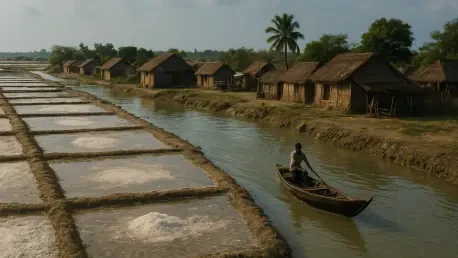
While violent cyclones and tidal surges cause immediate devastation that attracts international attention, slow-onset stressors are often more insidious in their long-term impact on the region. Rising soil and river salinity are quietly dismantling the agricultural foundations of the coast, poisoning the freshwater needed for drinking and irrigation. As fields turn barren and traditional farming becomes a mathematical impossibility, the economic fabric of these communities unravels over months and years rather than days. Research indicates that salinity alone could drive hundreds of thousands of people from their homes annually, forcing a transition from rural self-sufficiency to the deep uncertainty of urban life. This transition is not merely a choice but a forced adaptation to an environment that no longer supports the basic requirements of human life, transforming once-vibrant agrarian zones into stagnant salt flats where only the most resilient or the most desperate remain to witness the final decay.
The drivers of migration are complex and frequently defy simple environmental logic, revealing a stark gap between those who can afford to leave and those who cannot. In a striking paradox, some vulnerable coastal cities continue to attract new residents because they offer immediate job opportunities that outweigh the long-term climate risks in the minds of the impoverished. Conversely, the most endangered populations are often “trapped” in high-risk zones, lacking the financial resources or social networks necessary to relocate. For these families, migration is an expensive endeavor requiring upfront capital, meaning those facing the highest physical risks are often the least capable of escaping them. This economic barrier creates a cycle of vulnerability where the poorest residents are forced to withstand repeated disasters, depleting their meager savings with each event and further reducing their chances of ever finding safety elsewhere, effectively tethering them to a landscape that is slowly disappearing.
Urban Integration: The Struggle for Stability and the Left Behind
For most climate migrants, the journey ends within national borders, often in the overcrowded blocks of Dhaka. However, trading a flooded farm for an urban slum rarely offers a total escape from hardship; arrivals frequently encounter a lack of stable housing and healthcare. This rural-to-urban pipeline is fundamentally altering the social fabric, yet those who depart leave behind an equally dire situation. As the working-age population exits the coast, the regions they leave behind face a growing demographic crisis where only the elderly and impoverished remain. This exodus leaves the remaining infrastructure to crumble, as there are fewer individuals to maintain sea walls or manage local resources. Consequently, the burden of the encroaching sea falls most heavily on those least equipped to push back against it, creating a landscape of hollowed-out villages. This shift ensures that the most vulnerable are forced to navigate increasing hazards with a diminishing community support system.
The scale of internal displacement documented through late 2025 necessitated a fundamental shift in how the government and international partners approached climate resilience. Instead of focusing solely on reactive disaster relief, policymakers began integrating climate migration into long-term urban planning and national development strategies. The transition involved developing climate-resilient cities to decentralize the pressure on Dhaka and provide newcomers with actual economic stability. Authorities recognized that providing vocational training and social safety nets was as critical as building physical sea walls. Stakeholders emphasized that the future of the nation depended on whether these institutions could prepare for this massive demographic shift by ensuring that receiving cities provided genuine stability. By prioritizing localized adaptation and sustainable growth, the narrative moved toward a model where migration became a managed choice rather than a desperate flight for survival in a rapidly changing world.