
Christopher Hailstone is a distinguished authority in utility management and grid security, possessing years of experience navigating the complexities of large-scale renewable energy integration. As our resident expert on regulatory governance, he has spent much of his career advising on how to stabilize electricity delivery while transitioning to a decentralized, consumer-driven power model. In this discussion, he explores the critical intersection of policy and physical safety, examining the recent surge in residential battery installations and the regulatory gaps that could jeopardize the green energy transition. By analyzing everything from the technical definitions set by federal departments to the granular safety statistics of solar schemes, he provides a sobering yet necessary look at the infrastructure powering our modern homes.
When we consider the density of high-wattage assets like battery stacks and electric vehicles in modern garages, how quickly can a minor electrical fault escalate into a catastrophic event for a homeowner?
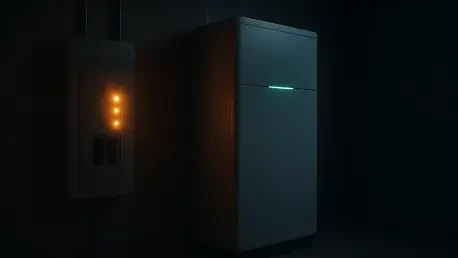
The escalation from a simple electrical fault to a full-scale structural fire happens with terrifying speed, often leaving residents with only seconds to react. In a recent incident in Adelaide, a fault completely unrelated to the home’s renewable hardware ignited a fire that produced flames reaching a meter high in just moments. The homeowner reported hearing an audible popping noise before discovering the blaze, which was dangerously close to both a battery stack and an electric vehicle. If those high-wattage assets had caught fire, the thermal runaway would have likely incinerated the entire house. This highlights why even top-tier equipment requires an extra layer of protection, such as garage-specific smoke detectors, to mitigate the risks inherent in high-current environments.
There is currently a significant debate regarding whether a federal department or an independent body should lead technical regulations; what are the risks of having the DCCEEW set these definitions instead of an autonomous regulator?
The decision to let the Department of Climate Change, Energy, the Environment and Water (DCCEEW) set technical definitions has caused a stir among industry advocates who were hoping for a more independent oversight body. The primary concern is one of accountability; it is much harder for stakeholders to challenge or hold a federal government department responsible for its internal methods compared to a transparent, independent regulator. We have seen states like Victoria express anxiety over this for over a year, fearing that poor federal management could lead to incidents where the states unfairly take the blame. Without an independent body like the Clean Energy Regulator at the helm of technical standards, we risk a fragmented system where policy priorities might inadvertently overlook the practical, on-the-ground safety requirements that experts demand.
While government officials often highlight a low percentage of formal complaints, do these statistics accurately reflect the safety and performance of the millions of systems currently being deployed?
The raw data can be quite deceptive when you look at the sheer scale of the Small-scale Renewable Energy Scheme. Minister Chris Bowen recently noted that there were only 315 complaints out of 800,000 installations over the past year, which represents a tiny 0.04% margin. However, these figures only represent formal complaints and investigations, such as the 17 matters referred for formal investigation, which is just 0.002% of the total. What these numbers don’t show are the hundreds of thousands of systems that may be poorly configured or sub-optimally installed but haven’t yet reached a breaking point. We are talking about a massive volume of hardware—over 530,000 home battery installations—where a lack of rigorous, universal inspection could be hiding a much larger systemic risk.
With the workmanship in the industry ranging from expert configurations to dangerously poor installs, how can policy be restructured to ensure that high-quality products aren’t compromised by lackluster installation standards?
The current policy environment has been described by some as a “ready, fire, aim” approach, where the rush to subsidize and install equipment has outpaced the development of a robust safety net. For instance, some battery subsidies reached as high as $18,000, yet the programs often failed to mandate a simple $300 independent inspection to verify the work. Victoria provides a much better model, where licensed electrical inspectors examine every single system and the state conducts its own audits on 2.5% of installations. To protect consumers, we must move away from sporadic, voluntary checks and toward a mandatory national inspection framework. If we continue to allow a spectrum where “cheap” installs bypass quality controls, we are essentially gambling with the long-term reliability of our residential energy infrastructure.
What is your forecast for the evolution of consumer energy resource regulations over the next few years?
I anticipate a sharp pivot toward more stringent, “Victoria-style” auditing across all states as the federal government realizes that the current hands-off approach is unsustainable. As we continue to integrate more than 800,000 new systems annually, the pressure on the grid and the potential for high-profile accidents will force the DCCEEW to adopt much tighter technical definitions. We will likely see the introduction of mandatory digital monitoring for all subsidized battery stacks, allowing regulators to spot configuration errors before they lead to physical faults. Ultimately, the “ready, fire, aim” era will end, replaced by a much more disciplined regulatory environment that treats residential garages like the mini-power plants they have actually become.