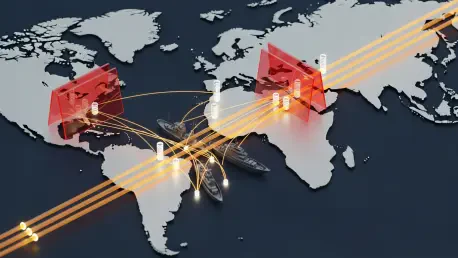

The persistent humming of industrial machinery across the globe is sounding increasingly strained as the shadow of a triple-digit oil barrel looms over every major economy. This tension reflects a market grappling with the sudden evaporation of stability in the Middle East, where the line between diplomacy and discord has blurred significantly.
The $1 Billion Weekly Toll: Why Global Energy Markets Are Bracing for the “Cliff”
The global economy is currently staring down a $1 billion weekly price tag for a military solution that no one wants to pay. Since late February, West Texas Intermediate and Brent crude have surged by more than 45%, driven by a geopolitical standoff that has effectively turned the world’s most critical energy artery into a parking lot. With oil prices stubbornly perched above the $100 mark, the reality of a “no war, no oil” scenario is no longer a theoretical risk but the new market floor.
This economic pressure stems from a fundamental break in the geopolitical machinery. The Strait of Hormuz, which facilitates nearly a fifth of the world’s liquid energy, has transformed from a conduit of prosperity into a tactical barrier. As supply lines tighten, the resulting price floor reflects a market that has priced in the permanency of regional conflict.
The “No War, No Oil” Scenario: How Diplomatic Stalemate Reshaped Global Trade
The current price hike is the direct result of a total breakdown in communication between Washington and Tehran. Following the dismissal of an Iranian counteroffer characterized by the U.S. administration as “garbage,” diplomatic relations hit a terminal stalemate. This friction led to the strategic closure of the Strait of Hormuz, a vital passage for energy shipments.
Without this passage, the market lost its primary pressure valve, creating a supply-side shock that has fundamentally decoupled oil prices from traditional demand metrics. Traders no longer look at inventories alone; they analyze the feasibility of keeping sea lanes open under the threat of ballistic escalation.
Projecting the Plateau: Why Crude Prices Face a Multi-Year Horizon Above $90
Market analysts are increasingly convinced that the current price volatility is not a short-term spike but the beginning of a prolonged era of high energy costs. Even if the Strait of Hormuz reopens by early June, the ripple effects are expected to prevent market normalization until at least 2027. Currently, the U.S. administration has pivoted its immediate diplomatic focus toward trade negotiations with China.
This shift suggests that unless China can be used as leverage to bring Tehran back to the table, prices will likely fluctuate between $90 and $100 for the foreseeable future. Domestic policy has prioritized broader trade stability, which inadvertently leaves the energy crisis to simmer on a back burner.
Industry Forensics: Expert Perspectives on the Impending Energy “Cliff”
Leading voices in both the energy sector and military strategy suggest that the market is rapidly approaching an irreversible “cliff.” Amos Hochstein and Saudi Aramco CEO Amin Nasser have both warned that the global supply chain is ill-equipped for a multi-year disruption. On the tactical side, former NATO Commander James Stavridis notes that while reopening the Strait by force is a viable military option, the resource commitment would be massive.
Such an intervention would involve a heavy toll on naval and ground assets, potentially exceeding the current economic losses. The consensus among these experts is clear: without a rapid diplomatic pivot, the economic damage will likely become systemic, forcing a total re-evaluation of global logistics and energy sourcing.
Strategic Leverage: A Framework for Navigating the Intersection of Trade and Tensions
To navigate this volatility, stakeholders adopted a three-part strategic framework that balanced military, diplomatic, and economic pressures. It became necessary to assess the cost-benefit ratio of military intervention against the $1 billion weekly operating cost of the crisis. Companies started focusing on the “China Pivot,” analyzing how U.S.-China trade talks could provide the necessary secondary leverage to influence Iranian policy.
Finally, businesses planned for a “High-Cost Horizon,” developing energy resilience strategies that accounted for sustained $90+ oil prices. This transition prioritized local energy production and reduced dependence on high-risk corridors. By shifting away from vulnerable supply chains, the global market sought to insulate itself from future geopolitical shocks.