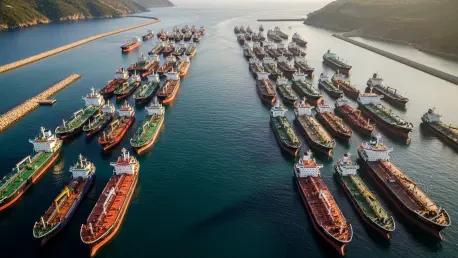

The jagged coastline of the Bab el-Mandeb Strait, a narrow strip of water barely wider than the distance between Manhattan and Staten Island, now serves as the precarious thread upon which the entire global energy market currently dangles. This eighteen-mile bottleneck has transformed from a routine transit point into a desperate escape valve for crude oil escaping regional volatility. As military friction reaches a critical breaking point, the international community watches the Red Sea with bated breath, knowing that any disruption here could send shockwaves through every corner of the global economy.
Recent escalations in the Middle East have placed an unprecedented burden on this maritime chokepoint. With the Strait of Hormuz increasingly compromised by direct Iranian threats, the Bab el-Mandeb stands as the final relief valve for the world’s oil supply. The Trump administration faces a formidable challenge as it seeks to prevent a total market collapse while navigating the complex web of regional hostilities that threaten to close this vital passage permanently.
The Eighteen-Mile Bottleneck: Holding the Global Economy Hostage
The strategic importance of the Bab el-Mandeb cannot be overstated, as it currently dictates the rhythm of the global energy trade. As the primary gateway for tankers moving between the Indian Ocean and the Mediterranean, its stability is the only factor preventing a massive spike in fuel costs. Unlike broader oceanic routes, this narrow passage offers little room for maneuver, making it an ideal target for those looking to exert maximum economic pressure with minimal military expenditure.
For the administration in Washington, the stakes involve more than just domestic gas prices; they involve the preservation of the post-war maritime order. If the Bab el-Mandeb is closed, the resulting supply shock would likely dwarf previous energy crises. This reality has forced a recalibration of naval priorities, as military planners acknowledge that the security of this eighteen-mile stretch is now synonymous with the security of the global financial system itself.
From Hormuz to Bab el-Mandeb: The Shift in Global Trade Vulnerability
The strategic pivot from the Persian Gulf toward the Red Sea represents a fundamental shift in how the West views energy security. For decades, the Strait of Hormuz was considered the world’s most dangerous flashpoint, but Iranian aggression has effectively pushed the center of gravity westward. Today, the Red Sea is no longer a mere transit route; it is the vital lifeline for the industrialized world, carrying the very fuel that powers modern civilization.
Asian economies, particularly those of Japan and South Korea, are especially vulnerable to this shift in maritime risk. These nations rely on a steady flow of crude that now bypasses traditional routes in favor of the Red Sea corridor. A total blockade would sever this connection, leaving these major economies without their primary energy source and forcing them to seek alternatives in an already depleted global market.
Proxy Warfare: The Fragility of Saudi Arabia’s East-West Pipeline
Saudi Arabia’s attempt to bypass Iranian threats by utilizing its East-West Pipeline has led to a dramatic surge in oil exports through the Bab el-Mandeb, rising from 3.9 million to 7.2 million barrels per day. This redirection was intended to offer a safer alternative to the Strait of Hormuz, yet it has inadvertently created a new, concentrated target for regional adversaries. The pipeline’s success in maintaining global supply levels now depends entirely on the continued accessibility of the southern Red Sea.
The Iranian Revolutionary Guard utilizes local proxies, specifically the Houthi militants, to exert asymmetrical pressure on this trade route. There is no need for a full-scale naval war when a few targeted strikes on specific tankers can effectively freeze international shipping. By using these localized forces, Tehran can project power and disrupt global trade while maintaining a level of plausible deniability that complicates the international response.
Market Forecasts: The Consensus on a Looming Energy Supply Vacuum
Commodity analysts and energy experts share a grim perspective on the potential closure of the “Gate of Tears.” They view any disruption as a catastrophic escalation that would create a massive supply vacuum that cannot be easily filled by other producers. The market’s sensitivity is already evident; recent spikes in crude prices serve as a clear warning of the volatility that would follow a confirmed blockade of the strait.
Security concerns regarding the viability of ceasefires in neighboring regions further complicate the outlook for maritime safety. Despite diplomatic efforts, the underlying tensions between regional powers remain unresolved, casting a shadow over the long-term safety of commercial shipping. This lack of a definitive resolution means that shipping companies must continue to navigate these waters with extreme caution, often paying exorbitant insurance premiums that eventually trickle down to consumers.
Strategic Frameworks: Mitigating the Risk of a Total Maritime Blockade
The international community recognized that traditional naval patrols were no longer sufficient to counter the evolving threats in the Red Sea. Consequently, policymakers worked to establish multi-national security protocols specifically designed to protect both the East-West Pipeline and the narrow waters of the Bab el-Mandeb. These frameworks aimed to create a unified front against asymmetric warfare, ensuring that the free flow of energy remained decoupled from the ideological conflicts of the region.
Military planners also deployed specific deterrents aimed at neutralizing drone and missile threats before they could reach commercial lanes. By fostering an environment where commercial shipping could operate with confidence, these strategic efforts sought to stabilize the energy market during a period of extreme geopolitical tension. Ultimately, the focus shifted toward building a more resilient infrastructure that could withstand the pressures of proxy warfare while maintaining the vital connection between Middle Eastern oil and the global economy.