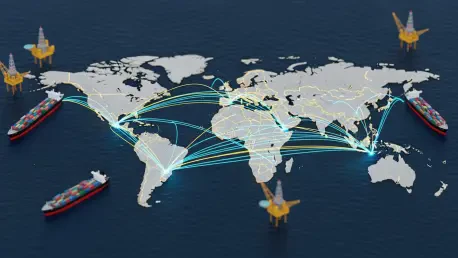

The massive energy trade corridors that once funneled oil and gas exclusively from the Middle East to South Asia are undergoing a radical transformation as the United States emerges as a dominant supplier. By May 2026, a milestone once thought impossible became reality: India imported nearly double the amount of liquefied petroleum gas from the United States than it did from all its traditional Middle Eastern suppliers combined. This pivot represents more than a temporary fix; it signals a fundamental restructuring of how the world’s fastest-growing economy powers its homes and industries. As the Strait of Hormuz faces unprecedented blockades, the survival of India’s energy security is being rewritten by American shale producers.
A Tectonic Shift in Global Energy Flow
The current geopolitical landscape has forced a dramatic realignment of energy logistics, moving away from proximity-based sourcing toward a model focused on political stability. India, historically reliant on the Persian Gulf, has begun to embrace the American shale revolution as a primary source of industrial fuel. This transition is not merely a logistical change but a strategic statement on the importance of diversifying supply routes to avoid regional volatility.
Moreover, the shift toward American energy has allowed India to strengthen its diplomatic ties with Washington while simultaneously hedging against the unpredictability of Middle Eastern conflicts. This “friend-shoring” of vital resources creates a more resilient economic foundation, ensuring that domestic growth remains decoupled from the localized crises that often plague the Strait of Hormuz.
The Fragility of the Hormuz Chokepoint and the 2026 Crisis
The historical reliance on the Gulf region left India vulnerable to a single point of failure—the Strait of Hormuz—which traditionally handled 60% of India’s LNG and almost the entirety of its LPG imports. When hostilities broke out in early 2026, the immediate threat to domestic stability forced New Delhi to look across the Atlantic to avoid a total energy collapse. This transition highlights a broader trend where supply chain resilience is becoming more valuable than geographic proximity.
Regional instability involving major powers has turned the Persian Gulf into a high-risk zone for maritime insurance and logistical planning. Consequently, the reliability of American ports, far removed from the volatile theaters of the Middle East, has become a cornerstone of Indian strategic planning. This shift ensures that the wheels of industry keep turning despite the geopolitical tremors in traditional supply zones.
Quantifying the American Energy Surge: LPG and LNG by the Numbers
The data from mid-2026 reveals a dramatic transformation in trade volume, with American LPG shipments reaching 630,000 tonnes, dwarfing the 380,000 tonnes coming from the Gulf. Simultaneously, US LNG exports to India skyrocketed to 900,000 tonnes, a threefold increase that now covers over 40% of the nation’s total gas requirements. This surge demonstrates the logistical capability of the US to meet large-scale demand on short notice.
This shift is supported by Washington’s massive expansion of shale infrastructure, allowing the US to leverage its natural resources to cement a strategic partnership that reduces India’s trade surplus. The scaling of these operations indicates that the American energy industry has successfully pivoted to fulfill the role of a global stabilizer during times of extreme market volatility.
The Economic Burden of Security: Expert Insights on Costs and Currency
While the US offers a reliable alternative, industry analysts point out that this security comes with a heavy price tag due to significantly higher freight costs compared to the short voyage from the Gulf. This rising energy bill has put downward pressure on the Indian currency, creating a complex balancing act for policymakers. The fiscal deficit remains a concern as the government tries to buffer the public from global price shocks.
Experts emphasize that because LPG is a critical cooking fuel for hundreds of millions of Indian citizens, maintaining a steady supply is a non-negotiable political priority. The social cost of a fuel shortage would far outweigh the temporary financial pain caused by high-priced shipments traveling across two oceans. This necessitated a careful calibration of national budgets to accommodate the new energy reality.
Frameworks for a Sustainable India-US Energy Corridor
To successfully integrate the US as a primary energy pillar, Indian leadership sought a multi-pronged strategy that went beyond emergency procurement. This included the pursuit of long-term fixed-price contracts to hedge against the volatility of Atlantic shipping costs and investing in domestic port infrastructure capable of handling larger American tankers. By modernizing these facilities, the nation decreased unloading times and improved the efficiency of the entire supply chain.
Furthermore, by framing these imports as a tool to balance bilateral trade, New Delhi ensured that its energy transition served both its economic interests and its long-term geopolitical standing. Policymakers also recognized the importance of diversifying the energy mix to include more sustainable sources, reducing the absolute dependence on any single fossil fuel provider. This comprehensive approach solidified a partnership that effectively shielded the domestic economy from external geopolitical shocks.