
The U.S. Prohibiting Russian Uranium Imports Act of 2024 serves as a legislative catalyst, forcing utilities to diversify their supply chains away from geostrategically risky Russian enrichment services. This shift represents more than a simple procurement change; it is the fundamental dismantling of a decades-old commercial orthodoxy that prioritized low-cost efficiency over national energy security. For years, the global nuclear fuel market operated under the assumption that state-controlled entities could remain reliable, non-political suppliers of enrichment and conversion services regardless of the geopolitical climate. However, the weaponization of energy exports in recent years has shattered this illusion, prompting a rapid reorientation toward allied interdependence. The focus is now squarely on the “front end” of the fuel cycle—the industrial sequence of mining, conversion, and enrichment. By orchestrating a coordinated strategy among the United States, Canada, France, Japan, and the United Kingdom, these nations are building a resilient architecture capable of supporting a massive surge in nuclear energy demand. This transition is further accelerated by a global commitment to triple nuclear capacity by 2050, a goal that requires a dramatic expansion of fuel supply chains that are entirely free from foreign interference and coercion.
Strategic Drivers and Supply Chain Realities
Geopolitical Pressures: The Global Energy Pivot
The current surge in nuclear energy demand is a structural necessity driven by the explosive growth of high-intensity technology sectors and the urgent need for carbon-neutral baseload power. Hyperscale data centers, fueled by the rapid advancement of artificial intelligence and large-scale cloud computing, require staggering amounts of firm electricity that weather-dependent renewables cannot consistently provide. This has led to a landmark shift where major technology firms are now bypassing traditional energy markets to enter into long-term power purchase agreements directly with nuclear operators. These multi-decade commitments provide the financial certainty needed to restart dormant reactors and extend the life of existing fleets. However, this demand surge arrives at a time when the global supply of enriched uranium remains heavily influenced by state-owned Russian enterprises. Controlling a massive portion of the world’s enrichment capacity, these entities have historically used their market dominance to suppress Western competition through aggressive pricing. The shift toward allied-sourced fuel is therefore a race against time to build sufficient domestic capacity before the reliance on geostrategically risky suppliers leads to a critical bottleneck that could stall the energy transition.
The challenge of rebuilding Western capacity is complicated by the need to avoid nationalistic duplication, which would lead to technical fragmentation and unsustainable costs. Instead of each nation attempting to build a fully self-sufficient fuel cycle, the focus has shifted toward a “single allied market” where resources and expertise are pooled. For example, while the United States focuses on advanced enrichment technologies, Canada and Australia remain the primary anchors for uranium mining and sourcing. A significant complication persists regarding Kazakhstan, which supplies over 40 percent of the world’s mined uranium but historically relies on transit routes through Russia. Establishing “westward” logistics, such as the Trans-Caspian International Transport Route, has become a top-tier policy objective to ensure that Kazakh uranium can reach Western conversion facilities without Russian interference. This logistical diversification is essential because mining itself is not the primary constraint; rather, the ability to transport and process that ore within a secure allied framework determines the long-term viability of the entire nuclear sector in a world of fractured global trade.
Identifying Bottlenecks: From Conversion to Enrichment
The conversion stage—the process of turning uranium ore concentrate into uranium hexafluoride gas—is currently one of the tightest links in the entire nuclear fuel supply chain. The Western footprint for conversion is limited to a few critical facilities, such as the Orano plant in France, the Cameco facility in Canada, and the recently restarted ConverDyn plant in the United States. This capacity is barely sufficient to meet existing demand, leaving the market highly vulnerable to even minor operational disruptions. An unplanned outage at any of these sites could cause immediate global shortages and price spikes, as there is currently very little spare capacity to absorb such shocks. As utilities move to phase out Russian-sourced material entirely, the expansion and high availability of these Western conversion plants have become essential for maintaining the operational continuity of the reactor fleet. The industry is now seeing renewed investment in these facilities, but the lead times for expanding chemical processing plants are long, requiring immediate and sustained capital commitments to keep pace with the projected growth of the nuclear sector.
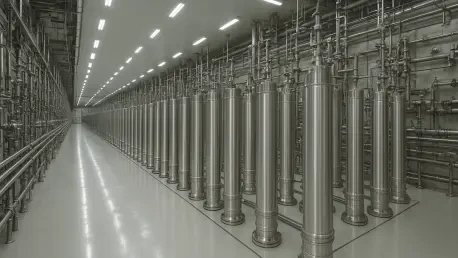
Enrichment remains the most visible and technically demanding bottleneck in the front-end fuel cycle, particularly as the industry moves toward next-generation reactor designs. While traditional large-scale reactors use Low-Enriched Uranium, many Small Modular Reactors require High-Assay Low-Enriched Uranium, which has a higher concentration of the isotope U-235. Currently, American facilities have successfully produced the first commercial-scale quantities of this fuel in 70 years, but the total output remains small compared to what will be required by the end of the decade. Despite a $5.6 billion mobilization of investment by the allied nations, demand-side projections suggest that even more capacity is needed to support both the existing fleet and the coming wave of advanced reactors. Fabrication, the final stage where fuel is shaped into ceramic pellets and loaded into rods, is relatively stable in terms of raw capacity but faces significant “qualification” hurdles. Switching a reactor from Russian-designed fuel to Western alternatives requires multiyear lead times for licensing and core management, necessitating a harmonized approach to regulatory standards across different allied jurisdictions.
Innovation and the Architecture of Cooperation
Advanced Technology: The Laser Enrichment Edge
A critical element in the strategic framework for energy independence is the role of technological innovation, specifically laser-based enrichment technology. Projected to reach significant technology readiness by late 2025, laser enrichment offers a potential paradigm shift in how the West produces nuclear fuel. Unlike traditional centrifuge cascades, which require massive industrial footprints and significant energy input, laser enrichment uses precisely tuned light to separate isotopes with much higher efficiency. Estimates suggest a 30 to 50 percent reduction in energy consumption compared to existing methods, providing a structural cost advantage that traditional state-backed monopolies cannot easily replicate. This technology is particularly well-suited for the production of specialized fuels like HALEU, as it can be scaled more modularly to match the incremental demand from new reactor deployments. By pioneering these advanced methods, the United States and its partners can leapfrog older technologies and establish a dominant market position based on technical superiority rather than just raw volume.
Beyond the enrichment process itself, the industry must address the “missing link” of deconversion and metallization to fully realize the benefits of advanced reactor designs. Most next-generation reactors require HALEU to be processed into specific metal or nitride forms, a capability that currently exists largely at the national laboratory or pilot-project scale. Without industrial-scale investment in this transition point, the Western lead in advanced reactor design will be undermined by a lack of deliverable fuel in the necessary physical formats. Establishing this industrial capacity is a prerequisite for the deployment of any next-generation nuclear technology that aims to provide carbon-free heat for industrial processes or flexible power for the grid. Allied cooperation is essential here, as the specialized facilities needed for metallization are expensive and require highly skilled labor. A shared approach where different nations host specific parts of the advanced fuel processing chain would allow for the concentration of expertise and the reduction of overall capital risk, ensuring that the technology matures in time to meet climate deadlines.
Market Harmonization: The Reference Plant Doctrine
To achieve a truly resilient fuel cycle, allied nations are adopting the “reference plant doctrine” to overcome the historical pitfalls of nuclear construction and manufacturing. In the past, many projects suffered from the “localization imperative,” where every country insisted on developing its own unique national designs and supply chains from the ground up. This approach led to technical fragmentation, massive cost overruns, and prolonged schedules. By contrast, the reference plant doctrine argues for repeating a stable, proven design using the same experienced engineering and construction teams across different countries. By utilizing international teams for the initial units of any new program, nations can significantly reduce the risk of first-of-a-kind engineering failures. This strategy allows countries to only gradually increase domestic content in subsequent units once the base technology has been successfully established and de-risked. This method ensures that the allied fuel cycle is built on a foundation of reliability and repeatable success rather than isolated and risky experiments.
The success of this cooperative architecture also depends on predictable trade policies and the removal of unilateral barriers that create market volatility. Investors are hesitant to commit the billions of dollars required for enrichment or conversion facilities if they fear that sudden shifts in trade relations could cut off their access to customers. Therefore, it is vital that the allied capitals remain stable partners, ensuring that the nuclear sector is insulated from broader trade tensions that might exist in other industries. This stability is the key to attracting the private capital needed to fund the massive expansions required over the next decade. By pooling demand from multiple utilities across different countries, the allied nations can provide the “demand certainty” that private investors require. This collective approach turns individual national energy requirements into a unified market signal that drives industrial growth and ensures a steady supply of fuel for both current and future reactors, creating a virtuous cycle of investment and deployment.
A Roadmap for Long-Term Allied Security
Formalizing Governance: The Role of a Secretariat
The transition from high-level political declarations to a functioning industrial alliance requires a formal governance structure that can manage the complexities of a multi-national fuel cycle. The establishment of a dedicated secretariat for the allied nations is a vital step in this process. This body would be responsible for long-term capacity planning, ensuring that the expansion of conversion and enrichment facilities matches the projected growth of the reactor fleet. By coordinating these investments at an international level, the alliance can avoid both shortages and oversupply, which would lead to price instability. Furthermore, the secretariat plays a crucial role in harmonizing fuel-qualification standards. Currently, the regulatory process for approving new fuel types is often redundant and time-consuming, as each country requires its own separate testing and certification. A shared framework for data and safety testing would accelerate the deployment of new fuels and allow vendors to serve a broader market with a single, high-quality product line.
Coordinating financing instruments across borders is another essential function of a formal allied secretariat. Tools such as the U.S. Inflation Reduction Act, along with various European and Japanese nuclear investment funds, provide powerful incentives for infrastructure development, but they must be aligned to be most effective. If these funds are used to compete for the same pool of private capital or to support overlapping projects, their impact is diminished. Instead, a coordinated financing strategy would allow the allied nations to support a diverse portfolio of projects, covering everything from traditional mining to advanced deconversion. This alignment ensures that Western vendors can offer comprehensive “fuel and finance” packages that are competitive with the state-backed offerings of rival nations. By providing a one-stop-shop for both the construction of reactors and the guaranteed supply of fuel, the alliance can effectively support new entrant nations that are looking to add nuclear energy to their grids for the first time.
Financial Architecture: De-risking Nuclear Infrastructure
Strategic resilience in the nuclear sector also requires a new approach to risk management, specifically through the implementation of the “two-source” rule for all critical utilities. This policy ensures that every nuclear operator has access to at least two independent allied sources for both conversion and enrichment services, preventing any single facility failure from compromising national energy security. To support this, the alliance is moving toward the creation of sovereign or pooled inventories of enriched uranium. These physical reserves act as a buffer against short-term supply disruptions and provide the market with the confidence that fuel will always be available, even during periods of geopolitical tension or technical challenges. By prioritizing this type of shared infrastructure, the allied nations are creating a safety net that protects the entire nuclear ecosystem. This collaborative model of security is far more effective and less costly than any single nation attempting to build redundant systems entirely on its own.
The allied nations successfully finalized the integrated roadmap that defined the next decade of nuclear fuel development. By the time the formal secretariat became fully operational, the synchronized investment from the partner countries had already begun to stabilize the conversion and enrichment markets. The alliance moved past the initial phase of reactive policy and established a proactive industrial base that proved capable of competing with state-controlled entities on both price and reliability. This success was built on the realization that energy security in the modern era is inseparable from allied interdependence. By harmonizing regulatory standards and pooling financial resources, the member nations demonstrated that a democratic and transparent supply chain could meet the massive energy demands of the future. The resulting infrastructure provided a blueprint for how high-tech industrial sectors can be secured against geopolitical volatility, ensuring that nuclear power remained a cornerstone of global carbon-neutral energy strategies.