
The vast expanse of the Taiwan Strait has historically been characterized by a shifting, featureless sandy seafloor that offered little sanctuary for the diverse marine life found in tropical waters. This stark environmental reality changed dramatically with the development of the Formosa Wind Farm off the coast of Miaoli County, where 69 massive offshore turbines now stand as sentinels of sustainable energy. What began as a purely industrial endeavor to harness the wind has unexpectedly triggered a remarkable ecological transformation, turning a once-barren biological desert into a bustling underwater metropolis. These towering structures of steel and stone have effectively bypassed the natural limitations of the sandy seabed, providing the hard substrates necessary for complex life to flourish. By creating a sprawling network of artificial reefs, the project demonstrates how renewable energy infrastructure can provide significant environmental benefits beyond carbon reduction.
Structural Evolution: Turning Steel into Marine Habitats
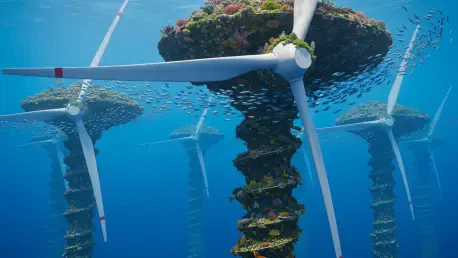
The primary driver behind this sudden biological boom is the introduction of massive hard surfaces into a traditionally soft-bottom marine environment. When engineers secured the steel turbine foundations and reinforced them with extensive boulder piles to prevent erosion, they unintentionally designed a perfect vertical habitat for reef-dwelling organisms. Unlike the flat and shifting sands that previously defined the area, these steel pilings and rock armor mimic the complexity of natural underwater cliffs and rocky outcrops. These structures offer permanent stability in an environment that was once constantly changing due to strong tidal currents and seasonal storms. The sheer physical presence of these foundations has altered local water movement, creating micro-eddies that help trap nutrients and larvae, further encouraging the settlement of diverse marine species. This physical anchoring provides the necessary foundation for a complex ecosystem to build itself from the ground up.
Beyond the large-scale impact of the foundations themselves, the fine details of the turbine structures play a critical role in fostering biodiversity within the wind farm. Small architectural features such as exposed bolts, flanges, and cable protection systems provide essential hiding spots and attachment points for a variety of smaller inhabitants. These nooks and crannies create a multi-dimensional environment that offers protection from larger predators, serving as a nursery ground for juvenile fish and invertebrates. As organisms settle into these smaller spaces, they further modify the environment by adding their own biological structures, such as the calcium carbonate shells of mollusks or the soft branching forms of sponges. This layered complexity ensures that every inch of the man-made structure is utilized by the local fauna. The transformation of these sterile machines into essential real estate for the ocean’s inhabitants highlights the potential for industrial objects to serve as productive elements within a natural system.
Ecological Progression: The Natural Colonization Process
The colonization of the Formosa Wind Farm followed a remarkably rapid and predictable sequence of biological stages, proving how quickly nature can adapt to new opportunities. Almost immediately after the construction phase concluded, pioneer species such as barnacles, anemones, and sponges began to latch onto the submerged steel legs of the turbines. These hardy organisms are the first to arrive, taking advantage of the empty space to establish a foothold and begin filtering nutrients from the surrounding seawater. Their growth creates a textured surface that is far more attractive to subsequent waves of life than bare steel alone. As these primary colonizers covered the foundations, they created a living skin that softened the industrial edges of the structures. This initial biological layer provided the necessary grip and shelter for secondary species, setting the stage for a much more complex and diverse community to develop over the following months and years.
As the initial layers of growth became established, the wind farm’s ecosystem began to support a much more sophisticated food chain that extended far beyond simple filter-feeders. The presence of dense colonies of barnacles and sponges attracted smaller mobile creatures like shrimp, crabs, and nudibranchs, which found both food and shelter within the newfound growth. This influx of small prey naturally drew in larger predatory species, signaling the maturation of the artificial reef system into a fully functioning community. By 2026, the area has seen a steady increase in the presence of high-value fish such as snappers and groupers, which now patrol the turbine foundations in search of food. The stability of this food supply ensures that these larger animals can remain in the area year-round rather than just passing through. This transition from a series of isolated steel poles to a vibrant, self-sustaining biological hub underscores the power of these structures to revitalize marine productivity.
Scientific Validation: Measuring the Living Island Effect
This environmental transformation is not merely anecdotal but is supported by extensive scientific data collected through systematic surveys conducted from 2026 to 2030. Researchers utilized advanced underwater imaging and biological sampling to compare the biodiversity around the turbine foundations with that of traditional artificial reefs and the surrounding sandy areas. The most significant finding from these studies was the identification of 86 distinct species of reef fish that had taken up residence within 50 meters of the turbines. Crucially, none of these species were found in the vast, sandy stretches that comprise the rest of the Taiwan Strait, nor were they present in historical records for this specific region. The turbines have effectively created living islands in the sea, serving as localized sanctuaries where biodiversity can flourish in total isolation. This research provides a clear quantitative baseline that proves the effectiveness of wind farms as massive, high-performance artificial reefs.
The high density of life found around these structures has addressed a long-standing debate in marine biology regarding whether artificial reefs simply attract fish or actually produce new populations. The data from the Taiwan Strait strongly supports the production hypothesis, suggesting that these turbines are actively increasing the total biomass of the region. Because the species recorded had no prior habitat in this part of the strait, it is clear that the wind farm allowed these populations to take root and grow in a location where survival was previously impossible. By providing a home in a formerly inhospitable area, the turbines have expanded the range and total numbers of many marine species, rather than just pulling them away from existing natural reefs. This evidence is vital for environmental planners who seek to justify the construction of offshore infrastructure as a net positive for the ocean. The success of this project confirms that well-placed offshore assets can act as powerful engines for regional biological growth.
Strategic Legacy: Future Steps for Nature-Inclusive Design
The success of the Formosa project highlights the immense potential for nature-inclusive design in the next generation of offshore energy developments. As the demand for clean energy grows, engineers and marine biologists are increasingly collaborating to ensure that turbine foundations are optimized for ecological benefits from the very beginning. This approach recognizes that the ocean does not distinguish between a man-made machine and a natural rock formation, provided the physical properties are conducive to life. Future projects can incorporate specific surface textures, artificial crevices, and varied rock sizes to cater to specific local species that may be under threat. By integrating these biological requirements into the initial engineering phase, developers can maximize the environmental return on investment. This shift in perspective moves beyond mere mitigation of damage and toward an active restoration of marine environments, proving that industrial progress and ecological health are not mutually exclusive.
The transformation of the Formosa Wind Farm into a thriving marine sanctuary provided a clear roadmap for the future of global offshore energy initiatives. By demonstrating that renewable energy infrastructure could double as a vital ecological asset, the project shifted the conversation from environmental impact to environmental opportunity. Stakeholders recognized that the strategic placement of these structures could revitalize degraded marine zones while simultaneously meeting carbon reduction goals. This realization prompted the adoption of more holistic planning frameworks that prioritized both technological efficiency and biological productivity in new coastal developments. As these integrated designs became the standard for the industry, the relationship between human technology and the natural world evolved into one of mutual benefit. Ultimately, the lessons learned from the Taiwan Strait empowered a new era of coastal management where industrial expansion served as a direct catalyst for the restoration and protection of global marine biodiversity.