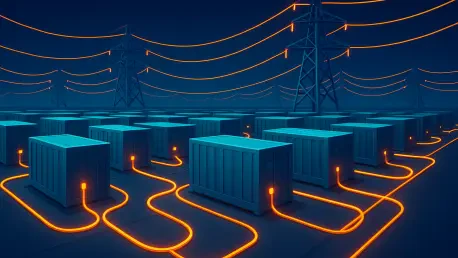

Saudi Arabia has positioned itself as the dominant force in the regional market, currently hosting 11 utility-scale projects that contribute 4.9 GW of power capacity. This substantial foundation serves as a cornerstone for the Middle East and North Africa region’s broader energy transformation, which is currently transitioning from small-scale pilot ventures into a period of massive, industrial-grade implementation. As of 2026, the strategic integration of utility-scale battery energy storage systems (BESS) has become a central priority for regional planners aiming to balance the growing influx of renewable energy sources. Current projections suggest that the cumulative storage capacity will reach a staggering 43 gigawatts by 2030, marking a nearly eightfold expansion from the capacity observed earlier this year. This aggressive trajectory is underpinned by a projected compound annual growth rate of 64% starting from 2025, signaling that the region is no longer just experimenting with storage but is instead making it the backbone of its modernized grid infrastructure to ensure long-term stability and decarbonization.
Market Leadership and Regional Expansion
The Dominance of the Saudi Arabian Powerhouse
The Kingdom’s market leadership is not merely a result of geographic scale but is driven by a highly sophisticated and bankable regulatory framework. The Saudi Power Procurement Company has played a pivotal role in this development by launching the Independent Storage Provider program, which provides the financial and legal certainty required to attract massive global capital. Currently, this framework is overseeing the deployment of approximately 20 gigawatt-hours of capacity across ten specialized standalone sites, with additional procurement rounds scheduled to ensure the momentum continues through the end of the decade. This organized effort has made the Saudi market the primary destination for developers seeking large-scale, low-risk opportunities.
Moreover, the concentration of 11 utility-scale projects within Saudi borders represents nearly 90% of the region’s current power capacity, illustrating the Kingdom’s role as the primary engine for battery adoption. This centralized approach has allowed for rapid technological standardization, which in turn reduces construction times and operational costs. By leveraging large-scale auctions and clear grid-integration requirements, the Kingdom has established a blueprint that effectively minimizes investor risk while maximizing the efficiency of the national power network as it integrates higher levels of solar energy. These projects are now vital for maintaining the balance between high-noon solar production and the evening demand peaks that define the regional energy profile.
Emerging Players and Diversifying Projects
While Saudi Arabia maintains a significant lead, nations such as Egypt, Türkiye, Kuwait, and Oman are making substantial strides in their own battery storage deployments. Türkiye and Egypt, in particular, are focusing on a dual-strategy that combines large-scale grid storage with the development of domestic manufacturing capabilities. These nations recognize that creating a local supply chain is essential for protecting their energy security against global market fluctuations. In Oman and Kuwait, the focus has shifted toward competitive procurement models that aim to integrate storage into their burgeoning wind and solar portfolios, ensuring that renewable output remains consistent even during peak demand periods.
In contrast, the United Arab Emirates has taken a more measured but technologically advanced approach, focusing on high-specification grid-forming solutions that provide essential ancillary services. Although its project pipeline may appear smaller compared to the aggressive expansion seen in Saudi Arabia, the UAE’s existing assets are among the most advanced in the region. This collective regional effort signifies a broad movement toward modernizing the Middle Eastern grid through a diverse range of storage solutions tailored to local needs. As these varied projects move toward completion between late 2026 and 2027, the regional synergy between different markets is expected to create a more resilient and flexible energy landscape that can support both industrial growth and environmental goals.
Economic Viability and Strategic Challenges
Competitive Costs and Regulatory Frameworks
The economic attractiveness of battery storage in the region has reached a tipping point, largely due to the falling Levelized Cost of Storage. In the Gulf region, standalone battery systems are now achieving costs of roughly $74 per megawatt-hour, making them increasingly competitive with traditional gas-fired generation. When these systems are paired with the region’s record-low solar prices, the resulting firmed energy becomes a reliable and dispatchable resource that can be deployed at any time of day. This economic shift is fundamentally changing how regional utilities plan their future capacity, moving storage from an optional grid-balancing tool to a core infrastructure requirement for all new power projects.
However, the transition is not without its regulatory hurdles, as the maturity of legal frameworks varies significantly across different borders. Saudi Arabia is currently categorized as a Tier I market due to its established grid codes and transparent procurement processes, whereas other nations often still operate on a project-by-project negotiation basis. This regulatory lag can sometimes hinder the adoption of advanced technologies like long-duration storage or grid-forming inverters. To fully realize the 43 GW goal by 2030, regional governments must accelerate the development of standardized grid connection rules and safety protocols that can keep pace with the rapid evolution of battery technology and the increasing demands of a decarbonized power sector.
Supply Chain Resilience and Local Production
A significant strategic concern for the MENA region is its heavy reliance on international battery cell manufacturers, with China currently providing the technology for every operational gigawatt-hour in the area. This near-total dependency on a single market exposes regional projects to potential supply shocks, geopolitical tensions, and price volatility. Industry analysts have pointed out that over 80% of the world’s battery manufacturing is concentrated in a few key global players, which creates a bottleneck that could slow down the region’s ambitious energy goals. To mitigate these risks, there is a growing emphasis on building regional self-sufficiency through the creation of domestic manufacturing hubs and recycling facilities.
The journey toward achieving the 43 GW storage milestone was defined by a transition from ambitious planning to disciplined, large-scale execution. Regional leaders recognized that the success of the energy transition depended on the maturation of human capital and local infrastructure. Throughout early 2026, governments successfully moved to standardize their grid codes and established transparent market mechanisms that encouraged long-term capital commitments from institutional investors. Future efforts should now focus on the lifecycle management of these massive battery fleets and the implementation of advanced data analytics for grid optimization. By prioritizing local manufacturing and regulatory clarity, the MENA region effectively transformed a significant technological challenge into a durable economic opportunity for the coming decades.