
Resolution 684 of 2018 established the national regulatory framework required to manage the integrated control and potential utilization of invasive species like gorse. In the high-altitude paramos of Colombia, Ulex europaeus has transitioned from a tool for erosion control into a pervasive ecological menace that threatens the stability of vital watersheds. The Universidad de los Andes has spearheaded a transition in environmental management by investigating the transformation of this woody shrub into high-density biomass pellets. By leveraging mechanical engineering to address a biological crisis, the project aims to create a sustainable value chain that offsets the immense costs of landscape restoration. This initiative is not merely about clearing land but about redefining an invasive species as a renewable energy source that can meet industrial thermal demands while protecting local biodiversity. As the project progresses from 2026 to 2028, it represents a significant milestone in the intersection of renewable energy and ecological conservation through engineering.
Environmental Impact and Management Challenges
Ecological Threats: The Seed Bank Crisis
Gorse represents a unique challenge among invasive species due to its aggressive growth patterns and its capacity to fundamentally alter the environments it colonizes. The plant creates dense, thorny thickets that block sunlight and physically exclude native vegetation, leading to a drastic reduction in local biodiversity. Beyond physical displacement, gorse modifies soil chemistry by fixing nitrogen at levels that are toxic to many native high-Andean plants, effectively preventing natural regeneration even after the primary infestation is cleared. Perhaps the most daunting aspect of its biology is the persistent seed bank it leaves behind. Seeds from gorse can remain dormant and viable in the soil for up to seven decades, requiring constant vigilance and long-term monitoring from environmental authorities. Furthermore, the high oil content within its branches increases the frequency and intensity of wildfires, which poses a severe risk to both human infrastructure and the fragile paramo ecosystems.
Removal Logistics: From Waste to Resource
Current management efforts spearheaded by regional environmental corporations like the CAR have focused on large-scale manual and mechanical removal across thousands of hectares. In the vital watersheds of the Bogotá and Suarez rivers, teams extract approximately one ton of gorse material weekly to prevent the further degradation of water-producing landscapes. Historically, this biomass was categorized as hazardous waste because of its potential to spread, necessitating expensive transport to specialized incineration facilities. This old model provided no secondary benefits and placed a significant financial burden on the state’s environmental budget. The new paradigm introduced by the Universidad de los Andes seeks to eliminate these costs by processing the material on-site or at nearby facilities to create a marketable fuel product. By transitioning from a model of disposal to one of resource recovery, the project turns an ecological liability into an economic asset, providing a financial incentive for the sustained removal of gorse.
Technological Innovation and Energy Potential
Mechanical Processing: Shredding and Pelletization
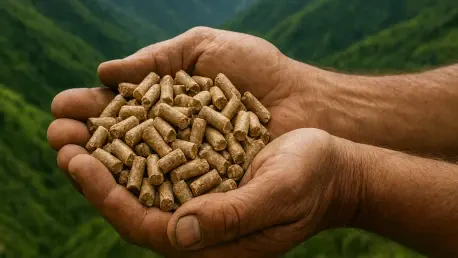
The engineering core of this project involves a multi-stage mechanical transformation designed to convert raw, irregularly shaped shrubbery into a uniform and efficient fuel source. The first stage involves the heavy-duty shredding of gorse branches and roots into a fine mulch, which increases the surface area for subsequent processing. Moisture control is critical in this phase; the shredded material undergoes a drying process to reduce water content, ensuring that the final pellets have a high energy density and will not rot during storage. Once dried, the material is fed into a high-pressure pelletization machine where it is compressed through a die. The friction and pressure generated during this process cause the natural lignins in the wood to soften and act as a binding agent, resulting in dense, cylindrical pellets. These pellets are significantly easier to transport and store than raw biomass, making them a practical alternative for industrial users who require a consistent and clean-burning fuel for their daily operations.
Thermal Efficiency: Comparing Gorse to Coal
Scientific analysis of the gorse-derived pellets has revealed a surprising level of thermal efficiency that positions the material as a legitimate competitor to traditional fossil fuels. Researchers have measured the calorific value of the biomass, finding that it provides approximately 75% of the energy output of coal on a per-weight basis. This high energy density is largely attributed to the natural oils found within the plant, which facilitate a hotter and more sustained combustion process. For local industries that rely on thermal energy for boilers, ovens, or kilns, gorse pellets offer a carbon-neutral alternative that can be integrated into existing infrastructure with minimal modifications. The abundance of gorse in the Andean region suggests that a steady supply of fuel could be maintained for years without the need for dedicated energy crops. By utilizing a species that must be removed for environmental reasons anyway, the project achieves a dual objective: providing affordable, sustainable energy while actively restoring critical water sources.
Safety Protocols and Regulatory Frameworks
Biological Security: Neutralizing Seed Viability
A significant concern regarding the commercialization of an invasive species is the risk of accidental reintroduction through the transport of raw materials. To address this, the Universidad de los Andes pilot project implemented strict “chain of custody” protocols to ensure that no viable seeds leave the treatment areas. The pelletization process itself serves as a primary biological filter; the combination of intense mechanical pressure and high temperatures during compression is specifically designed to neutralize the reproductive capacity of any seeds caught in the mix. Studies conducted as part of the project confirmed that the thermal stress experienced during pellet formation effectively kills the embryos within gorse seeds, rendering the final product biologically inert. This safety feature is essential for gaining regulatory approval and public trust, as it allows the material to be moved across the country without the threat of starting new infestations. Ensuring the energy product is safe is as important as its thermal performance.
Future Outlook: Policy and Scalability
The long-term success of the gorse-to-biofuel initiative depended on its ability to scale while remaining within the strict boundaries of environmental law. By the conclusion of the 2026 pilot phase, researchers and policymakers had established that the model was both technically viable and economically self-sustaining. The project successfully integrated the removal goals of regional autonomous corporations with the energy needs of the private sector, creating a framework that could be applied to other invasive species across South America. Looking ahead, the focus shifted toward the deployment of mobile pelletization units that could process biomass directly at the site of extraction, further reducing transport costs and logistical complexity. Authorities remained cautious to ensure that gorse was never treated as a commercial crop, maintaining its status as a high-priority invasive species that must be eradicated. This strategy ensured that the production of energy remained a secondary benefit to the goal of restoring native biodiversity.