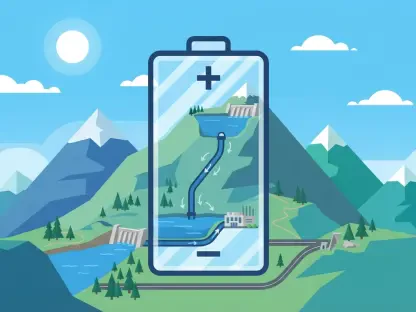

China continues to dominate the global energy storage landscape by accounting for approximately 54 percent of all new installations scheduled for the coming year. This dominance reflects a broader seismic shift as the world moves away from traditional fossil-fuel baseload power toward decentralized renewable systems. The fundamental challenge of the modern grid is no longer the generation cost, but rather the timing and stability of supply. Solar and wind have won the price war, yet their intermittency requires a solution that can bridge the gap between production and demand. Energy storage has emerged as this vital “hinge,” performing two critical functions: time-shifting and grid stability. By capturing excess energy during the day to discharge during evening peaks, these systems ensure that renewable power remains effective even when the sun sets. Furthermore, they provide the rapid-response precision needed to maintain grid frequency without the heavy turbines of legacy plants.
Scaling and Global Market Expansion
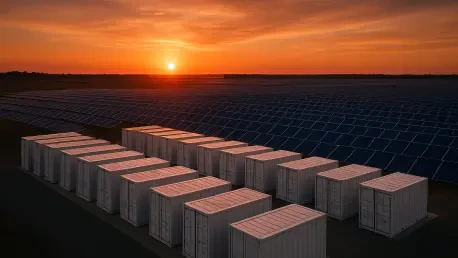
The deployment of utility-scale storage has entered a period of exponential growth, with the current year serving as a definitive landmark for the global industry. Global installations are projected to reach approximately 158 GW, which represents a massive 41 percent increase compared to the previous year’s figures. This surge signals that energy storage has moved from the periphery of utility planning to the absolute core of global infrastructure development. Geographically, this expansion is led by China and the United States, which together account for the vast majority of new capacity. While China remains the undisputed leader in manufacturing and deployment, the United States is seeing a record influx of capital into hybrid projects. These co-located facilities, where battery arrays are built directly alongside solar farms, have attracted over $25 billion in investment during the first half of the year, showcasing a significant shift in how developers approach reliability.
The rapid scale-up of storage capacity is not merely a response to environmental targets but a strategic necessity driven by the electrification of everything. As massive data centers and expansive electric vehicle charging networks continue to proliferate, the resulting grid strain requires a flexible buffer that traditional power plants cannot provide. Cumulative global capacity is now on a trajectory to hit the terawatt scale by the early 2030s, indicating that the industry has achieved the necessary momentum to be self-sustaining. This transition is also fueled by the need to replace aging fossil-fuel assets that are increasingly unable to compete with the low marginal costs of wind and solar. By providing firm capacity that can be dispatched at a moment’s notice, storage systems are effectively redefining the concept of baseload power for the modern era, ensuring that clean energy can satisfy the 24/7 demands of high-tech industrial operations.
Financial Stability and Technological Innovation
The financial profile of energy storage has matured significantly, evolving from a speculative bet on falling battery prices into a bankable infrastructure asset for global investors. In the current market, storage projects are increasingly viewed as safe havens for capital due to their predictable and diversifying revenue streams. Operators are now successfully layering different income sources, including energy arbitrage—buying power during low-cost overproduction and selling it during peak demand—and ancillary services that support grid health. As battery cost curves continue to decline, pension funds and major institutional infrastructure investors are being drawn to the long-term utility and steady cash flows these systems provide. This maturation of the business case has reduced the cost of capital for new projects, creating a virtuous cycle where cheaper financing leads to more deployment, which in turn drives further technological refinement and cost reductions.
This newfound economic viability is supported by a robust ecosystem of industrial leaders, such as CATL and Tesla, that provide the integrated hardware and software necessary to manage raw battery cells as reliable grid assets. Technological evolution is further accelerating this transition as the industry moves away from standard consumer electronics chemistry toward safer alternatives like Lithium Iron Phosphate. These LFP systems offer a superior safety profile and longer cycle life, making them ideal for high-density utility installations. Beyond the hardware, the current trend emphasizes the “intelligence layer,” where artificial intelligence manages battery assets in real-time to make split-second dispatch decisions based on weather and market prices. This fusion of advanced chemistry and predictive software ensures that storage is not just a passive reservoir, but a dynamic participant in the global market, providing synthetic inertia and frequency response with extreme precision.
Strategic Pathways and Future Infrastructure
Despite the rapid growth and technological progress, the transition faces several friction points like grid congestion and supply chain concentration. Many developed nations struggle with aging electrical infrastructure, creating long queues for connecting new storage projects that can delay capacity for several years. This bottleneck is compounded by regulatory frameworks that were designed for centralized power plants rather than distributed storage arrays. Furthermore, the high concentration of manufacturing creates geopolitical risks and vulnerability to trade shifts, making the diversification of critical mineral sourcing a top priority. Safety and insurance also remain critical hurdles as installations grow to gigawatt-hour scales, requiring rigorous standards to manage fire risks and secure affordable coverage for multi-billion dollar sites. Overcoming these structural and geopolitical challenges will be vital to ensuring that energy storage provides the long-term resilience required.
The global transition eventually proved that the integration of utility-scale storage was the most effective method for ensuring that renewable power resulted in a resilient and economically viable grid. Industry leaders successfully demonstrated that advanced battery systems could replace legacy thermal plants while providing superior grid services at a lower cost. As the shift moved forward, policymakers and operators focused on streamlining interconnection processes and diversifying supply chains to mitigate geopolitical vulnerabilities. These strategic steps established a foundation where a fully decarbonized energy network became a practical reality rather than just a theoretical goal. Stakeholders then turned their attention toward scaling long-duration storage and enhancing grid-edge intelligence to handle the increasingly complex demands of an electrified society. These actions ultimately secured the path toward a zero-emission future, anchored by a self-sustaining storage ecosystem.