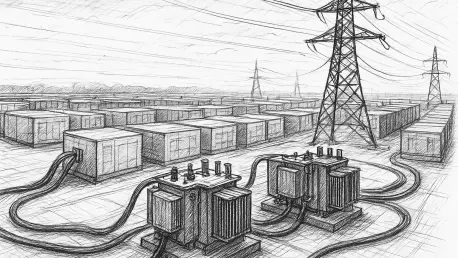

State electricity consumers in New South Wales are funding the half-billion-dollar Waratah Super Battery project through network charges designed to secure the regional power grid against blackouts. This massive installation, situated on the reclaimed grounds of the former Munmorah coal-fired power station, has officially transitioned from a promising prototype to a cornerstone of the Australian energy matrix. By reaching its full rated capacity of 850 megawatts, the facility has successfully moved past its initial developmental hurdles and technical setbacks to become the most powerful battery system currently integrated into the national grid. This transition signifies more than just a technological upgrade; it represents a fundamental shift in how the state manages energy reliability in an era of rapid decarbonization. The transformation of the Munmorah site is particularly symbolic, as the very location that once churned out massive amounts of carbon-intensive power now serves as the primary safeguard for a grid increasingly dependent on variable renewable resources like wind and solar. With the project now fully operational in 2026, the collaboration between Akaysha Energy and the network operator Transgrid demonstrates how legacy industrial infrastructure can be effectively repurposed to meet the rigorous demands of modern electrical engineering and environmental standards.
A High-Tech Safeguard for the Power Grid
Strategic Integration: The SIPS Framework
The primary function of the Waratah Super Battery deviates significantly from the traditional use cases associated with large-scale energy storage. While many battery systems are designed for energy arbitrage—the process of buying electricity when prices are low and selling when they peak—the Waratah system is predominantly contracted to remain idle. This “stand still” operational strategy is the core of the System Integrity Protection Scheme, a framework designed to ensure that the transmission network can withstand sudden shocks or equipment failures. In this capacity, the battery serves as a high-speed contingency resource, a virtual safety net that remains on constant standby to provide an immediate surge of power to the grid. This approach is essential for maintaining stability in a region where the closure of older baseload generators has left the network more vulnerable to fluctuations. By acting as a massive shock absorber, the battery ensures that the delicate balance between supply and demand is maintained even during extreme weather events or unforeseen mechanical failures across the transmission backbone. This specialized service is what justifies the significant investment from the state, as it provides a level of insurance that traditional market-driven batteries simply cannot offer.
Virtual Transmission: Maximizing Existing Infrastructure
Building on this specialized role, the System Integrity Protection Scheme operates through a complex interplay of sensors and automated control systems spread across the state. This logic allows the existing transmission lines to carry significantly more power than would be permitted under normal safety protocols. Typically, engineers must leave a substantial buffer in power lines to prevent a total system collapse if one line were to fail. However, because the Waratah Super Battery can inject up to 700 megawatts into the grid within milliseconds, that buffer can be significantly reduced, effectively increasing the usable capacity of the current wires. This virtual transmission capability is a game-changer for the New South Wales energy sector, as it allows for the more efficient flow of electricity from regional renewable energy zones to major population centers like Sydney and Newcastle. The ability to maximize existing infrastructure through digital control rather than physical expansion saves billions of dollars and years of bureaucratic delays. This sophisticated monitoring system tracks 36 transmission lines across 19 different sites, ensuring that the battery is always ready to act as the ultimate fail-safe for the entire regional network.
Engineering Excellence and Overcoming Adversity
Technical Capacity: Powering One Million Homes
The technical scale of the Waratah Super Battery is immense, featuring a total storage capacity of 1,680 megawatt-hours, which is enough to provide electricity to nearly one million homes for an hour. The physical footprint involves hundreds of specialized lithium-ion units and massive high-voltage transformers, including a replacement unit weighing 187 tons. These components work in unison to ensure that the facility meets its rigorous contractual obligation to provide a guaranteed two-hour injection of power whenever the grid is under stress. This level of output is not merely a theoretical maximum but a tested reality that has been verified through rigorous grid-connection trials. The facility employs state-of-the-art lithium-ion chemistry, which was selected for its high energy density and rapid response times. Each containerized unit is integrated into a central management system that monitors the state of charge, temperature, and health of every individual cell. This granular level of control is necessary to maintain the longevity of the asset, which is expected to provide critical services for at least the next decade while experiencing minimal degradation despite the high-power demands of its emergency response role.
Crisis Management: Local Solutions for Global Failures
The path to achieving these specifications was nearly derailed by a catastrophic equipment failure that highlighted the fragility of global supply chains. When a critical high-voltage transformer malfunctioned during the early phases of testing, the project faced the prospect of a multi-year delay due to the long lead times associated with international manufacturing. However, the project developers at Akaysha Energy made a strategic pivot toward domestic industry, engaging the Wilson Transformer Company to expedite the fabrication of replacement units. This decision to utilize local expertise not only saved several months of downtime but also reinforced the importance of sovereign industrial capabilities in the transition to renewable energy. By the middle of the current decade, the battery had successfully returned to 700 megawatts of capacity, eventually scaling up to its full 850-megawatt peak as the final high-capacity transformers were energized and integrated into the site. This recovery process served as a valuable case study for other large-scale energy projects, proving that domestic supply chains can provide the agility and resilience needed to overcome technical setbacks that would otherwise stall critical infrastructure development.
Economic Impact and the Future of Energy
Financial Oversight: The Cost of Delay
The financing of the Waratah Super Battery project reflected a unique model of public accountability, where costs were recovered through network charges on consumer utility bills. Because of the technical delays and the period of reduced capacity following the transformer incident, the Australian Energy Regulator enforced a substantial financial penalty on the project owners. This regulatory intervention reduced the total contract value by over A$90 million, bringing the final cost to approximately A$512.6 million. This mechanism ensured that electricity consumers were not forced to pay for a service that was not fully operational during the recovery period. Such oversight is critical in maintaining public trust as the energy transition moves forward, providing a clear example of how regulatory frameworks can protect the interests of the taxpayer while still encouraging private investment in large-scale technology. The financial structure of the project also highlighted the shift toward availability-based payments, where the primary value of the asset is its presence and readiness to act rather than the volume of energy it sells. This economic model is likely to become more common as the grid moves away from fossil fuels and requires more specialized services to maintain system strength.
Industrial Evolution: From Coal to Lithium
The successful activation of the Waratah Super Battery provided a definitive roadmap for the future of the Australian National Electricity Market. Although the retirement of the nearby Eraring coal-fired power station was postponed until 2029, the battery proved that lithium-ion technology was ready to handle the heavy lifting of grid stabilization. The project effectively demonstrated that digital assets could replace the physical inertia of rotating turbines, offering a more flexible and responsive solution to the challenges of modern energy distribution. Looking forward, the focus shifted toward optimizing these systems through advanced software and machine learning, which allowed for even more precise control over energy flows. The success at the Munmorah site encouraged the development of similar high-capacity projects across the country, aiming to create a decentralized network of storage hubs that could act in unison to prevent regional outages. By integrating these massive batteries with existing wind and solar farms, the state laid the groundwork for a zero-emission grid that was both reliable and cost-effective. Ultimately, the lessons learned from the Waratah project became the blueprint for the next phase of the global energy transition, proving that technological resilience and local manufacturing were the keys to a sustainable future.