
To prevent a catastrophic embankment failure during heavy rainfall, the Eugene Water & Electric Board is gutting the internal machinery of its historic powerhouse. Located on the scenic McKenzie River in Oregon, the Leaburg Hydroelectric Project represents a rare and fascinating case study in the evolution of aging energy infrastructure within the United States. Rather than pursuing typical modernization or expansion, this 15.9-megawatt facility is undergoing what engineers describe as a “functional hollowing” of its core systems. Having remained offline since 2018, the nearly century-old plant is being repurposed to serve as a massive, ornate storm drain for the region. This transition highlights the complex intersection of public safety, environmental regulations, and the shifting economics of power generation. As utility leaders navigate these challenges, the structure stands as a testament to the fact that sometimes, the most effective way to manage a historic asset is to fundamentally change its purpose to protect the community.
Mitigating Risks: The Infrastructure of the McKenzie Canal
The primary driver for this dramatic transformation is the structural design of the project’s five-mile-long canal, which has existed for a century. Originally engineered to divert massive quantities of water from the McKenzie River to the powerhouse, the canal has effectively become a catch-basin for natural runoff from several major creeks in the valley. In the high-precipitation environment typical of western Oregon, this creates a significant liability for the utility and the public. Even though the facility has been drained of river water since 2018 due to safety concerns, the canal continues to collect immense volumes of storm water that must be managed. Because this canal is elevated by an earthen embankment, any accumulation of water creates intense hydraulic pressure that threatens the structural integrity of the entire system. If this embankment were to breach, the resulting flood would be devastating for the residential areas located throughout the valley.
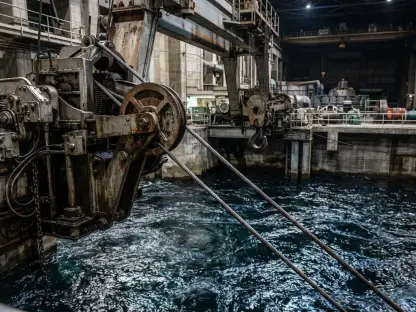
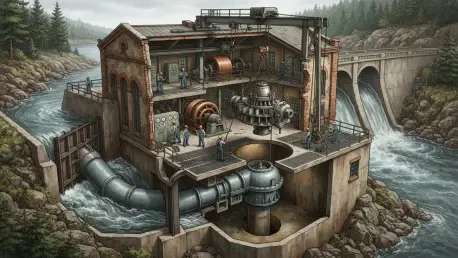
Inside the powerhouse, the mechanical hardware that once generated renewable energy now creates a dangerous bottleneck. The facility contains two Francis turbines, which utilize curved blades known as runners to extract energy from water flow. In their current stationary state, these runners act as physical blockages, functioning much like giant, immovable plugs in a drainpipe. Even with the internal gates set to the open position, the presence of the turbine blades prevents water from flowing freely through the penstocks. This resistance forces water to back up within the system, further increasing the stress on the vulnerable canal embankments during heavy rain events. To solve this, engineers determined that the internal hardware must be physically removed to clear the path for drainage. By cutting the blades off the runner, the utility effectively converts the restricted pipe into a wide, 12-foot-diameter hole that allows water to pass through without any resistance.
Technical Solutions: Gutting the Decommissioned Turbines
The modification of the powerhouse is a multi-stage project that has already yielded significant benefits for the safety of the region. EWEB completed the initial phase in late 2023, which involved the removal of blades from the first of two turbine runners. This specific intervention immediately increased the stormwater capacity of the facility by approximately 1,000 cubic feet per second. To provide context, the original design capacity for power generation was 2,500 cubic feet per second. By removing just one runner, the utility reclaimed nearly 40% of that capacity for pure drainage. Following this successful demonstration, the board moved forward with a second phase to perform the same operation on the remaining unit. This current project, being finalized as the 2026 season concludes, ensures that both penstocks are fully cleared. This allows the powerhouse to handle the maximum potential runoff volume that the canal can deliver during a major flood event.
The technical requirements for this $197,000 contract are extensive, as removing a turbine runner involves more than simple demolition. The primary contractor, Kaminski Construction, must collaborate with specialized welding teams to dismantle the massive components safely. One of the most critical aspects of the project involves the implementation of redundant containment systems. These systems are designed to ensure that no metal shards, industrial oils, or other hazardous debris can enter the McKenzie River, which is a vital ecosystem and a source of drinking water for the region. Workers are required to break out substantial concrete slabs to gain access to the draft tubes, which sit deep within the belly of the building. To facilitate this work, extensive scaffolding must be erected within the vertical shafts, and the environment must be meticulously dewatered. These measures reflect the high cost and complexity of ensuring that risk reduction does not create new environmental hazards.
Economic Realities: Balancing Power Costs and Safety Upgrades
The decision to dismantle the Leaburg project rather than repair it was based on a cold calculation of long-term energy costs and regional demand. Consultants determined that upgrading the century-old canal to meet modern seismic and safety standards would result in a levelized cost of energy of approximately $117 per megawatt-hour. By comparison, the utility can purchase power from the Bonneville Power Administration for significantly lower rates, making the investment in Leaburg economically unjustifiable. Furthermore, the facility only provided about 4% of the total power demand for the city of Eugene. When the massive capital requirements for safety upgrades were weighed against the relatively small energy contribution, the choice to decommission became clear. This reality is common for many small-scale hydroelectric projects in the West, where the cost of regulatory compliance often outpaces the value of the electricity produced by the aging hardware.
This turbine gutting project is only one component of a much larger, ten-year decommissioning roadmap. The utility has enlisted the expertise of McMillen, a firm recognized for its experience in large-scale dam removals, to oversee the eventual restoration of the site. The current “Leaburg Near Term Risk Reduction Subproject” carries a budget exceeding $3 million, indicating the level of investment required just to maintain a safe status quo. The ultimate goal is to remove the Leaburg Dam entirely and allow the McKenzie River to return to its natural, free-flowing state. Once this process is complete, the canal itself will be modified so that local creeks can reach the river through natural channels. This long-term vision eliminates the need for artificial embankments and drainage systems altogether. However, until those major demolition steps begin in the early 2030s, the powerhouse remains the most critical tool for preventing an immediate environmental disaster.
Architectural Value: Preserving the Heritage of Ellis Lawrence
One of the more poignant aspects of this transition is the fate of the powerhouse building itself. Designed in the Art Deco style by the renowned Oregon architect Ellis F. Lawrence, the structure features ornate Greek mythological motifs that reflect the optimism of the early industrial age. While many modern utility structures are purely functional and utilitarian, the Leaburg powerhouse is considered a significant piece of architectural history. Its current status as an “ornate storm drain” highlights the ongoing tension between preserving historical aesthetics and meeting the pragmatic needs of modern safety management. The building was constructed during an era when public works were viewed as civic monuments, and its exterior remains a beautiful landmark even as its internal heart is removed. Preserving the shell of the building while gutting its machinery allows the utility to maintain the site’s visual legacy while fulfilling its safety duties.
As a silent guardian against the elements, the Leaburg project serves as a harbinger for other aging, run-of-river plants in the Pacific Northwest. When the cost of maintaining structural safety exceeds the market value of the energy generated, infrastructure must be adapted to serve the public in new ways. The Walterville project, a similar facility nearby, faces many of the same questions regarding its long-term viability. For now, the Leaburg powerhouse stands as a unique industrial hybrid: a historic monument that no longer produces electricity but remains essential for disaster prevention. By utilizing the existing infrastructure as a high-capacity drainage valve, the utility has found a way to bridge the gap between its industrial past and a future focused on river restoration. This “slow-motion” retirement ensures that the transition is handled responsibly, protecting both the environment and the local community from the power of the water.
Future Landscapes: Transitioning to Full Site Restoration
Looking toward the next decade, the focus will shift from mechanical gutting to the final restoration of the McKenzie River ecosystem. The utility plans to submit its final applications to the Federal Energy Regulatory Commission by 2030, which will mark the beginning of the end for the dam and canal system. This timeline provides a structured approach to returning the landscape to its pre-industrial state while ensuring that all safety risks are mitigated in the interim. The project highlights the fact that decommissioning is rarely a single event, but rather a series of strategic engineering decisions that span years. By the time physical demolition of the dam begins in 2032, the powerhouse will have served its final purpose as a storm drain, and the natural flow of the local creeks will be restored. This phased approach allows for the careful management of sediment, fish passage, and water quality, ensuring that the legacy of the project concludes with an environmental success.
The transformation of the Leaburg site provided a definitive model for how utilities managed the transition of stranded energy assets. By prioritizing immediate risk reduction over the expensive pursuit of outdated power generation, the board established a clear pathway for environmental restoration. The utility successfully mitigated the threat of embankment failure by utilizing existing infrastructure in a novel way, turning a liability into a protective asset. This approach allowed for a measured, decade-long transition that respected the historical significance of the building while acknowledging the hard realities of modern energy markets. Furthermore, the decision-making process demonstrated that public safety and fiscal responsibility could be aligned through creative engineering solutions. As the river finally began its return to a natural state, the project stood as a successful example of how to retire industrial giants with dignity, ensuring the safety of the valley was maintained.