


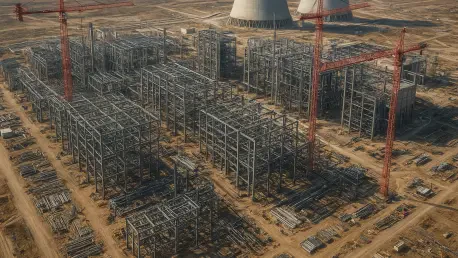

The transition to an AI-driven economy has exposed critical vulnerabilities in a national power grid that previously trended toward intermittent renewable energy sources. Under the current administration, the United States has pioneered a “tariff-first” economic framework that leverages market access to secure vital infrastructure. Rather than simply seeking foreign investment for retail or basic manufacturing, the government has pivoted toward the state-directed construction of massive baseload power facilities. This strategic reorientation aims to resolve the “energy bottleneck” that currently threatens to stall the domestic lead in the global Artificial Intelligence race. By transforming trade negotiations into infrastructure deals, the administration has successfully redirected capital from key allies like South Korea and Japan toward the American energy sector. Recent data indicates that of the $305.3 billion committed by these nations, approximately 81 percent is now earmarked specifically for electricity generation, marking a new era.
South Korean Investments: Nuclear and Gas Infrastructure
South Korea’s recent commitment to the American energy landscape serves as a cornerstone of this infrastructure surge, focusing on the deep synergy between Korean engineering and domestic demand. Following high-level negotiations, a $200 billion investment package was established, with a staggering $120 billion allocated specifically to the construction of eight large-scale nuclear power plants. This “nuclear renaissance” includes the deployment of the South Korean APR1400 reactor design, signaling a deep technological integration into the United States grid. These projects are designed to provide the carbon-stable, high-capacity electricity required for massive industrial growth across various states. By prioritizing nuclear energy, the administration is moving toward a long-term solution for power reliability that bypasses the fluctuations of older, weather-dependent systems. This approach ensures that the most sophisticated AI hardware is supported by a steady and dependable stream of power for decades.
In addition to long-term nuclear projects, South Korea is addressing the immediate need for rapid power deployment through high-efficiency natural gas facilities specifically designed for the AI sector. A notable example is the $22.3 billion investment in a 6.5 GW gas-fired power plant in Encinal, Texas, which is being developed with a unique “behind-the-meter” architecture. This facility is intended to supply electricity directly to a co-located AI data center, minimizing transmission losses and ensuring that the most power-hungry technologies have a dedicated and isolated energy stream. With a target operational date set for 2029, these projects are expected to provide a critical cushion for the American South, where electricity demand is rising at a rate three times the average of the previous decade. By focusing on the “fuel” for industry rather than just the “machinery,” this policy ensures that when massive data hubs are completed, they will not sit idle due to localized energy shortages.
Japanese Strategic Capital: Mega-Facilities and Reactor Deployment
Japan’s involvement in the domestic energy sector has been equally transformative, precipitated by strategic trade agreements that swap lower tariffs for massive infrastructure commitments. The first phases of Japan’s staggering $550 billion pledge have been almost entirely consumed by energy projects, including the construction of a record-breaking $33.3 billion gas-fired facility in Ohio. This 9.2 GW “mega-plant” is designed to anchor a sprawling data center complex, creating a self-sustaining ecosystem for high-performance computing and machine learning research. According to officials, this project represents the largest gas-fired power facility ever built, serving as a physical manifestation of the “Power America’s AI Future” initiative. This strategic intent allows the United States to gain vital physical assets that bolster national security and industrial capacity, while Japan earns steady revenue from utility operations. It reflects a shift where energy capacity is treated as the ultimate currency of economic superiority.
Beyond traditional large-scale gas plants, the Japanese investment portfolio emphasizes the modernization of the power grid through the deployment of Small Modular Reactors (SMRs). Working in collaboration with joint ventures like GE Vernova Hitachi, billions of dollars are being funneled into SMR projects across Tennessee and Alabama to revitalize regional networks. This $73 billion allocation is split between innovative nuclear technology and traditional gas plants to ensure a diverse and resilient energy mix. These smaller reactors offer the flexibility needed to power a decentralized network of data centers, providing high-density energy without the massive footprint of conventional plants. By distributing these investments across several strategic states, the administration is reinforcing the national grid against localized surges in demand while fostering domestic technological innovation in fission. This approach effectively uses allied capital to build a future-proofed electrical backbone that supports the next generation of digital infrastructure.
Strategic Next Steps: Actionable Strategies for Energy Resilience
The strategic extraction of allied capital effectively addressed the domestic infrastructure deficits that once threatened to undermine American technological leadership. By leveraging relationships with Korea and Japan to build a domestic energy surplus, the administration ensured that the nation possessed the physical strategic assets necessary for a dominant industrial position. This policy-driven approach resulted in over 15.7 GW of new capacity from just two flagship plants, providing a necessary buffer against the surging needs of the digital economy. The shift toward a “nuclear-first” and high-efficiency gas policy proved to be the most viable path for maintaining the 24/7 power required for AI supremacy. Leaders recognized that securing the electrical grid was the final piece of the puzzle for long-term economic stability. By treating energy as the ultimate currency of national security, the government cleared the way for a new era of industrial expansion that benefited from the stable capital of its closest global partners.
To maximize these gains, the modernization of regional transmission networks became the next critical priority for federal energy coordinators. Policymakers established specialized energy zones where regulatory red tape was minimized for projects co-located with high-performance computing centers. This streamlined approach allowed for the rapid synchronization of South Korean reactors and Japanese gas facilities with the national grid, preventing the typical decade-long delays associated with traditional energy expansion. Furthermore, the integration of advanced grid-balancing software was prioritized to manage the interplay between new nuclear baseloads and existing renewable sources. By focusing on these logistical solutions, the administration transformed a potential energy crisis into a sustainable foundation for the machine learning industry. These steps ensured that the United States maintained its competitive edge through a resilient, high-capacity electrical backbone that supported continuous innovation.







