
The shift toward sodium-ion battery technology moved from pilot demonstrations to gigawatt-hour level commercial delivery through new international partnerships in late 2026. This technological leap forward occurred simultaneously with a historic surge in project activity, as Chinese energy storage enterprises secured approximately 94 gigawatt-hours in total disclosed system orders during the third quarter alone. A remarkable 93% of these contracts originated from international markets, marking a definitive pivot away from domestic reliance and toward a global strategic offensive. While the sheer volume of these agreements suggests a period of unprecedented dominance, the industry is navigating a complex landscape defined by the “triple scissors difference.” This phenomenon highlights the widening gap between massive manufacturing capacity and the actual localized service requirements, alongside a disconnect between high bidding volumes and the number of projects that successfully reach commissioning. To solidify a permanent leadership position, these enterprises must address the underlying structural vulnerabilities that accompany such rapid, export-driven growth.
Global Expansion and the Domestic Profitability Crisis
Market Concentration: International Landmark Deals
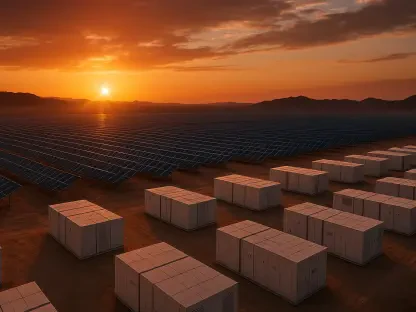
The global energy storage landscape transformed into a primary theater for Chinese manufacturers in the first half of the year, with domestic firms occupying every position in the top ten rankings for battery shipments. This dominance was characterized by a move toward massive individual contracts, as nineteen separate orders exceeded the one-gigawatt-hour threshold in the third quarter. Key industry leaders like BYD and Sungrow Power have been at the forefront of this trend, capturing monumental multi-gigawatt deals in the United Arab Emirates and Saudi Arabia. These projects utilize advanced liquid-cooled systems that represent the cutting edge of current hardware capabilities, proving that Chinese technology is now the preferred choice for the world’s most ambitious energy transition initiatives.
However, this rapid expansion into foreign territories introduces a significant “basket risk” due to the high concentration of revenue in specific regions. Europe and the Middle East currently account for over 70% of the signed international orders, leaving the industry highly susceptible to local policy shifts or regional geopolitical instability. While the scale of these landmark deals provides a massive boost to short-term shipment volumes, it also places immense pressure on companies to maintain these relationships in the face of fluctuating foreign economic conditions. The transition from a domestic-focused industry to a global powerhouse is effectively complete, but the long-term stability of this new market structure remains dependent on continuous favorable relations with a handful of key international partners.
Sustainable Pricing: The Domestic Stagnation Challenge
While the international sector flourished, China’s domestic energy storage market entered a period of relative dormancy and financial strain. Despite the fact that framework bidding for storage systems rose by nearly 95% year-on-year, the actual commissioned installed capacity fell by 18% during the same period. This discrepancy points to a growing backlog of planned projects that remain stalled due to economic unfeasibility or regulatory bottlenecks. The domestic market has largely devolved into a “race to the bottom” regarding pricing, where aggressive quotations often drop below the actual cost of production. This unsustainable environment has made survival nearly impossible for small and medium-sized enterprises, turning international expansion into a mandatory survival strategy rather than a mere growth opportunity.
The underlying issue stems from a domestic profit model that remains immature and overly dependent on policy incentives rather than market-driven arbitrage. Many independent storage stations across various provinces report internal rates of return that are either barely viable or entirely negative without government support. Estimates suggest that only a third of existing domestic projects are stably profitable, while the remainder are either breaking even or actively losing money. This creates a precarious situation where new energy assets risk becoming non-performing loans on institutional ledgers. Consequently, the push to export is driven as much by the need to escape these domestic pricing traps as it is by the desire to capture global market share, creating a volatile dynamic for the industry’s mid-tier players.
The Gap Between Capacity and Quality
Production Metrics: Nominal Overcapacity Versus Effective Shortage
The industry currently faces an alarming imbalance between supply and demand, with total planned production capacity for storage cells nearing 2,000 gigawatt-hours against a projected global requirement of roughly half that amount. This overcapacity, however, is not evenly distributed across the sector. While small-scale battery manufacturers struggle with utilization rates that have plummeted below 20%, top-tier firms report that their high-efficiency, advanced cells are actually in short supply. This structural distortion signifies an “effective capacity shortage” occurring within a broader environment of “nominal overcapacity,” where the market is flooded with generic, low-quality products while the sophisticated technology required for grid-scale stability remains a significant bottleneck.
This divide between the leaders and the laggards is forcing a consolidation that may eventually stabilize the market. Major developers are increasingly avoiding generic hardware in favor of high-performance cells that offer better long-term reliability and lower total cost of ownership. The glut of low-end capacity continues to drive down average market prices, yet it does little to satisfy the technical requirements of complex energy projects. As a result, the industry is witnessing a “cleansing” effect where companies unable to innovate are being pushed toward bankruptcy, while those with the research and development muscle to produce high-density, high-safety cells are actually expanding their market influence despite the overall surplus of manufacturing lines.
Chemical Innovations: Evolution of Large Cells and Sodium-Ion
Technological iteration remains a vital engine for growth, with the industry moving rapidly beyond the standard 314-ampere-hour cells that dominated previous years. Newer, larger capacity models reaching 587 and 588 ampere-hours are beginning to appear in major international orders, offering significantly improved energy density and system efficiency. These advancements allow for more compact and cost-effective storage solutions, which are essential for meeting the massive scaling requirements of utility projects in North America and the Middle East. The push for larger cells demonstrates that Chinese firms are successfully leveraging their manufacturing expertise to set new global standards for hardware specifications.
Beyond traditional lithium-ion chemistry, the transition of sodium-ion battery technology into commercial delivery has provided a new avenue for differentiation. New partnerships have facilitated the delivery of these systems at a gigawatt-hour scale, proving that alternatives to lithium are now viable for certain grid-scale applications. This diversification is crucial for mitigating the risks associated with raw material price volatility and supply chain disruptions. By leading the charge in both lithium-ion refinement and alternative chemistries, Chinese manufacturers are positioning themselves as comprehensive technology providers. This dual-track innovation strategy ensures that they can cater to a wide range of market needs, from high-performance applications to cost-sensitive, long-duration storage projects.
Regulatory Walls and Geopolitical Sensitivities
European Compliance: Sustainability and Mineral Traceability
As Europe solidifies its role as a primary destination for energy storage exports, Chinese firms are encountering a sophisticated regulatory wall that extends far beyond price competition. The European Union Battery Regulation has introduced mandatory “battery passports” and rigorous carbon footprint statements that require full transparency across the entire production cycle. Documentation must now include verifiable data on the origin of critical minerals like lithium, nickel, and cobalt, as well as the renewable energy ratio used during manufacturing. Failure to meet these administrative hurdles has already resulted in significant shipment detentions at major ports like Rotterdam, highlighting the risks of ignoring international compliance standards.
This regulatory environment is creating a new industry watershed, where only the largest manufacturers with robust compliance departments can successfully navigate the complexities of European law. Many smaller integrators are finding it difficult to produce the necessary documentation to satisfy the EU’s unified carbon footprint methodology, leading to project delays and increased insurance costs. This shift from simple hardware sales to a model of total lifecycle transparency represents a major challenge for the industry’s traditional business practices. For Chinese firms to maintain their 42% share of the European market, they must invest heavily in supply chain auditing and green manufacturing processes to ensure that their products are not just efficient, but also legally compliant.
Strategic Risks: Dependency on Middle Eastern Markets
The surge of massive contracts in the Middle East, particularly in the United Arab Emirates and Saudi Arabia, has provided the industry with some of its largest single-project revenue streams to date. These nations are aggressively pursuing energy transition goals to diversify their economies away from oil, leading to swift decision-making and high-volume procurement. However, this heavy reliance on the “petrodollar” economy introduces unique risks, as capital-intensive storage projects are often the first to be scaled back during periods of prolonged oil price volatility. The fact that such a massive portion of current order volumes is concentrated in this region makes the Chinese storage sector highly sensitive to Middle Eastern economic cycles.
Geopolitical stability also remains a wildcard that could disrupt these long-term commitments at any moment. While the current diplomatic and economic alignment favors Chinese manufacturers, any escalation in regional tensions could freeze the logistical and financial infrastructure necessary to fulfill these multi-gigawatt-hour contracts. Because 93% of the industry’s recent growth is tied to international markets, companies are essentially outsourcing their economic stability to the policy cycles and stability of foreign governments. To mitigate this, some firms are beginning to explore more diverse markets in Southeast Asia and South America, though these regions have yet to match the sheer scale and speed of the Middle Eastern energy transformation.
From Product Exporter to Global Service Partner
Operational Infrastructure: Closing the Local Service Gap
An energy storage system is not a one-time sale but a decade-long infrastructure commitment that requires continuous operation and maintenance to remain viable. Historically, many Chinese firms have relied on a “remote monitoring plus local outsourcing” model that is increasingly being rejected by international grid operators. Customers in Europe and the Middle East are now demanding “boots on the ground”—technical teams that speak the local language and can arrive on-site within hours of a system fault. The inability to provide this level of localized support has become an “invisible ceiling” for several manufacturers who find themselves excluded from second-phase projects in favor of local or Korean competitors.
Building a genuine global service ecosystem requires a massive investment in human capital and local technical training that goes beyond the capabilities of a simple equipment vendor. Leading firms have begun to establish regional support hubs that house spare parts and specialized engineering teams, but the industry as a whole still lags behind in after-sales maturity. If Chinese companies cannot prove their reliability over the full fifteen-year lifespan of these batteries, they risk damaging their reputation on the global stage. The successful transition from being a hardware exporter to a trusted global energy partner will depend on whether these firms can provide the long-term operational stability that grid operators require for critical infrastructure.
Global Footprint: The Integration of Overseas Manufacturing
To bypass trade barriers and satisfy “local content” requirements, major players like CATL and EVE Power have accelerated the development of massive manufacturing hubs in countries like Hungary. These localized factories now represent nearly 800 gigawatt-hours of planned cell production capacity outside of China, signaling a new phase of global integration. This shift toward overseas manufacturing helps mitigate the logistical costs and political risks associated with shipping finished products from China. However, building the physical infrastructure is only the first step; these companies must also successfully integrate into local business cultures and navigate foreign labor laws and environmental standards.
The period from late 2026 into the following two years will serve as a critical testing ground for these localized operations. The primary challenge will be to determine if Chinese-owned, foreign-based plants can achieve the same level of efficiency and quality as their domestic counterparts while operating under different regulatory regimes. Success in this area would allow Chinese firms to neutralize many of the geopolitical arguments currently used against them, effectively “becoming” local players in their most important markets. This evolution from a centralized export model to a decentralized, global manufacturing network is the final hurdle in securing a permanent leadership position in the international energy storage industry.
Path Toward Sustainable Global Leadership
The Chinese energy storage industry successfully reached a historic milestone in the third quarter of 2026, yet this achievement arrived with a set of complex operational challenges. The transition from a domestic focus to a 93% international order ratio proved that Chinese hardware was the world’s primary choice for energy transition. However, the period also revealed that manufacturing prowess alone was insufficient for long-term dominance. Companies that focused solely on volume found themselves trapped in domestic price wars or blocked by sophisticated international regulatory barriers. Conversely, those that prioritized compliance and high-end technological innovation managed to thrive despite the nominal overcapacity of the broader market.
Moving forward, the industry’s success depended on its ability to evolve from a simple hardware provider into a comprehensive service partner. The establishment of overseas manufacturing hubs and the deployment of localized maintenance teams were the key steps taken to solidify global trust. By integrating deeply into the business ecosystems of Europe and the Middle East, the most successful firms moved past the limitations of the export model. They proved that sustainable leadership required a balance of technical excellence, regulatory transparency, and long-term operational commitment. Ultimately, the lessons learned during this pivotal year provided the blueprint for a more resilient and integrated global energy storage market.