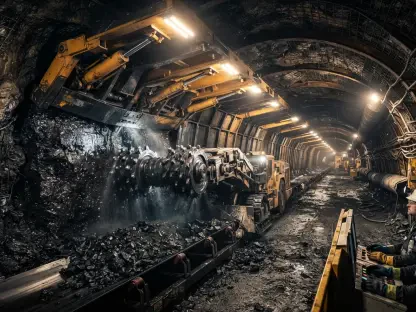

Quantifying the effectiveness of pressure relief requires more than observation; the initial compaction compensation ratio, or Cn(x), now provides a precise mathematical threshold. This innovation addresses a long-standing paradox in deep-level mining where mechanical stress relief does not immediately result in efficient gas extraction. At the Luling Coal Mine’s III1022 working face, the complexities of inclined seams and high geostress necessitate a more nuanced understanding of how coal behaves during protective seam mining. While the industry has historically focused on the moment of structural unloading, this study highlights a spatial and temporal disconnect that can compromise safety if ignored. As mining operations push deeper in 2026, the need for data-driven models becomes paramount to prevent gas outbursts. This article explores the mechanical-hydraulic mismatch, investigating why gas drainage often lags behind the physical expansion of the coal, ultimately offering a blueprint for safer, more efficient extraction.
The Mathematical Precision: Establishing the Cn(x) Standard
Developing the initial compaction compensation ratio represents a significant leap forward in geomechanical monitoring. This dimensionless criterion enables researchers to objectively define the onset of strong pressure relief by comparing mining-induced expansion against initial compaction strain. By applying this metric to the III1022 working face, the study utilized FLAC3D numerical simulations to simulate the stress environment and validate findings against actual field data. The results indicated that the protected coal seam does not achieve a state of strong relief immediately upon the commencement of mining. Instead, a specific threshold must be crossed where the expansion of the coal matrix overcomes the inherent stress of the overburden. This mathematical approach eliminates the guesswork traditionally associated with protective mining, providing engineers with a reliable indicator of when the coal has been sufficiently liberated to allow for fracture development.
The simulation and field validation revealed that the protected seam reached the critical strong pressure relief threshold, where the Cn(x) value equals 1, only after the mining face had advanced 128.8 meters. This specific distance serves as a turning point, marking the transition from minor stress fluctuations to a stable and continuous zone of relief. Such findings challenge the outdated assumption that pressure relief occurs linearly or instantaneously as the working face progresses. The staged progression identified at the Luling Coal Mine suggests that the geometry of the extraction area and the depth of the seam play decisive roles in determining the timing of stress liberation. By establishing this 128.8-meter benchmark, the research provides a concrete starting point for assessing the structural state of the coal, though it also reveals that mechanical relief is merely the first step in a much more complex hydraulic process that governs gas migration.
The Drainage Delay: Mapping the 151.6-Meter Gap
While the mechanical relief was triggered relatively early in the mining process, the hydraulic response exhibited a much slower trajectory. Researchers employed a continuous piecewise-growth model to analyze the total drainage rate, denoted as Q(x), to determine when the gas extraction system reached peak efficiency. The analysis showed that significant enhancement in gas drainage did not occur until the working face had reached an advance distance of 280.4 meters. This substantial difference between the onset of mechanical relief and the improvement in gas flow highlights a critical period of inactivity within the drainage network. During this phase, the coal is physically expanding and fracturing, but the methane remains largely trapped within the matrix or disconnected from the borehole infrastructure. Identifying this 280.4-meter milestone is essential for calibrating drainage expectations and ensuring that extraction systems are sized appropriately.
The most significant discovery of the study is the quantified spatial lag of 151.6 meters between mechanical unloading and effective gas capture. This gap represents a hazardous window where mine operators might mistakenly assume the seam is safe due to observed pressure relief, even though the gas extraction rates remain low. This delay is attributed to the time required for newly formed fractures to interconnect and create a permeable network that allows methane to reach the drainage boreholes. Furthermore, the gas-source mobilization must align with the physical placement of the extraction points, a process that is not instantaneous. Understanding this lag is vital for preventing under-drainage scenarios, which can lead to dangerous gas accumulations in the working area. By documenting this 151.6-meter interval, the research provides a crucial buffer that engineers must account for when designing ventilation and drainage schedules in high-risk deep coal seams.
Advanced Protocols: Improving Safety Outcomes
The findings from the III1022 working face provided a transformative framework for managing gas control in deep-level operations. By integrating the Cn(x) trigger with the Q(x) piecewise-growth model, the researchers established a unified advance-distance framework that replaced qualitative rules of thumb with precise, data-driven planning. This approach allowed engineers to predict the exact timing of drainage improvements, ensuring that safety protocols were grounded in the physical reality of the mine rather than optimistic assumptions. The study successfully demonstrated that mechanical relief was a necessary but insufficient condition for safe mining, as the hydraulic lag remained a persistent factor. This holistic view of the coal seam’s lifecycle during extraction helped to synchronize the timing of protective mining with the actual peak of gas drainage, thereby reducing the risk of sudden methane outbursts that have historically plagued the industry.
Building on these insights, the industry moved toward implementing real-time monitoring systems that could track the evolution of the pressure-relief zones and the subsequent drainage response. Future considerations for mine operators involved the strategic placement of surface and underground boreholes to bridge the 151.6-meter lag more effectively. By pre-calculating the conversion intensity, technical teams were able to adjust the spacing and orientation of drainage channels to coincide with the identified preferential windows. This proactive strategy shifted the focus from reactive gas management to a predictive model that anticipated structural changes before they occurred. These actionable steps ensured that deep-level mining remained viable and safe even as the geological conditions grew more demanding. Ultimately, the integration of geomechanical thresholds and hydraulic flow models redefined the standard for outburst prevention in the modern era of coal resource extraction.