
Christopher Hailstone joins us to discuss the unprecedented paralysis in the Strait of Hormuz and its cascading effects on the global economy. With a distinguished background in utility reliability and energy management, Hailstone provides a deep dive into the logistical nightmare of a “mixed-up” tanker fleet and the technical hurdles of rerouting the world’s most vital resource. Our conversation covers the fragile timeline for market normalization, the strategic role of the East-West pipeline, and the looming fuel shortages threatening the peak summer travel season.
If the Strait of Hormuz remains closed past mid-June, how would the market rebalancing process extend into 2027, and what specific logistical milestones must be met to shorten that window?
The mid-June deadline acts as a psychological and logistical tipping point where the backlog transitions from a temporary delay to a multi-year crisis. If the lane opens today, we are still looking at months of work just to clear the immediate congestion, but staying closed past June pushes our recovery into 2027. We would need to see a synchronized return to pre-conflict traffic levels, which involves clearing the hundreds of vessels currently idling in and around the Persian Gulf. The process requires a phased approach: first, securing the passage for the current daily trickle of two to five ships, and then scaling back up to the 70-vessel-per-day rhythm we saw before the war. Without these milestones, the sheer volume of “lost” time creates a deficit that the global supply chain simply cannot absorb quickly.
With over 600 ships currently stalled in the Persian Gulf and hundreds more waiting outside, how does this displacement affect global shipping routes?
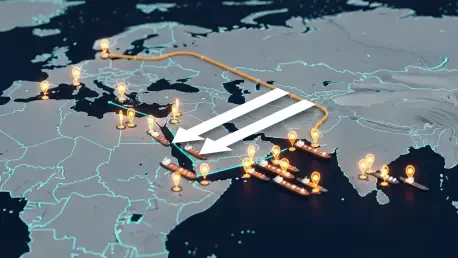
The global tanker fleet is currently in a state of chaotic displacement, with over 600 ships essentially trapped like sitting ducks inside the Gulf while another 240 vessels wait anxiously on the outside. This “mixed-up” fleet means that ships are physically located in the wrong parts of the ocean, unable to reach their intended cargo or delivery points. Many of these vessels have been idling for so long that they may soon abandon their posts to seek work in other regions, further thinning the available capacity for when the strait finally reopens. Repositioning these assets isn’t as simple as turning a key; it involves weeks of rerouting across thousands of miles of open sea to restore the basic logic of the supply chain. The operational strain is immense, as every day of idling wastes fuel, crew time, and money while the world’s energy circulatory system remains blocked.
While the East-West pipeline has expanded capacity to 7 million barrels per day, how does this bypass compare to the total volume lost through maritime bottlenecks?
The Petroline, or East-West pipeline, has become a critical lifeline by ramping up its capacity to 7 million barrels per day, effectively acting as a high-pressure bypass to the Red Sea. However, we must realize that even this massive technical feat cannot fully compensate for the 20% of global oil supplies that once flowed through the Strait of Hormuz. While the pipeline and the release of strategic reserves have helped narrow the net loss to 880 million barrels, the gross loss has already surged past the one-billion-barrel mark. Redirecting such massive volumes across the desert to the Red Sea involves significant logistical friction and cannot replace the sheer throughput of a fully functioning maritime lane. This shift highlights a desperate need for long-term infrastructure planning that doesn’t rely on a single, vulnerable chokepoint.
Global oil losses have surpassed one billion barrels, leading to critically low gasoline and jet fuel inventories. How will these shortages manifest during the peak summer travel season, and what specific strategies should energy companies use to manage the rapid drawdown of strategic and commercial reserves?
We are staring down the barrel of a critically low inventory crisis just as the summer driving and travel season begins to heat up. This shortage will likely manifest as surging prices at the pump and potential fuel rationing for airlines, as jet fuel stocks are particularly strained by the Middle Eastern supply gap. Energy companies are being forced into a defensive posture, drawing down commercial reserves at an unsustainable pace to keep the market from flatlining. To manage this, companies must coordinate closely with governments on the release of strategic reserves while simultaneously maximizing every drop of product flowing through the 7-million-barrel-per-day Petroline. It is a race against time to prevent dry pumps and grounded flights during the busiest months of the year.
Current daily traffic through Hormuz has plummeted from 70 vessels to as few as two. Given this unprecedented supply shock, what are the primary indicators of a return to pre-conflict stability, and how can stakeholders mitigate the weekly loss of 100 million barrels of supply?
The most visible indicator of recovery will be a steady climb in daily vessel counts, moving away from the current dismal average of two to five ships back toward the 70-vessel benchmark. We are currently witnessing the biggest energy supply shock in history, with 100 million barrels of supply vanishing every single week the strait remains blocked. Stakeholders can mitigate this by aggressively diversifying transit routes and leaning into every available barrel from the East-West pipeline to blunt the impact. Until we see a diplomatic breakthrough that allows for a safe and consistent flow of traffic, the strain on global supplies will only intensify with each passing day. The silence in the strait is deafening, and the world is feeling the weight of every missing tanker.
What is your forecast for the oil market?
My forecast is one of prolonged volatility and structural transformation; if the disruption persists beyond mid-June, we will not see a return to “normal” market conditions until 2027. We are currently navigating the deepest supply shock ever recorded, and the massive deficit of over one billion barrels will take years of disciplined production and logistical reconfiguration to erase. Even in an optimistic scenario where the strait opens tomorrow, the “mixed-up” state of the global fleet means the ripples of this crisis will be felt in fuel prices and supply chains for several seasons to come. Investors and consumers should prepare for a long-term reality where energy security takes precedence over low costs, as the world adjusts to a more fragmented and fragile distribution network.