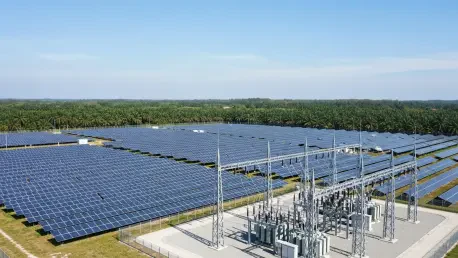

The quiet palm oil plantations of northern Kedah are witnessing a transformation that replaces shadows with silicon, as eighty thousand photovoltaic panels now capture the relentless tropical sun to redefine the nation’s industrial strength. While Malaysia has long been recognized for its vast natural gas reserves, a quiet revolution is taking place in the northern state of Kedah that signals a significant shift in the nation’s power dynamics. TotalEnergies, a name historically synonymous with fossil fuel extraction, is now breaking ground on a massive solar installation that proves the transition to green energy is no longer a distant goal but a current reality. This move marks a departure from traditional energy extraction toward a diversified portfolio that prioritizes sunlight as much as subsea minerals.
From Natural Gas to Solar Power: A Strategic Pivot in the Heart of Kedah
The shift toward renewables is not merely an environmental gesture but a calculated response to the changing topography of global energy markets. For decades, the extraction of liquefied natural gas anchored the regional economy, yet the emergence of the Kulim solar project demonstrates how legacy players are pivoting. By repurposing land and capital, the energy sector is proving that solar power can achieve the same scale and reliability once reserved for thermal plants.
Furthermore, this transition serves as a vital bridge for local communities, offering new technical roles in an increasingly digital economy. As the project progresses, it highlights how established energy giants can use their existing operational expertise to master the complexities of renewable logistics. This evolution ensures that the heritage of Malaysian energy production remains intact while its carbon intensity begins a sharp and necessary decline.
The Corporate Green Power Programme and Malaysia’s Decarbonization Roadmap
Understanding this shift requires a look at Malaysia’s ambitious decarbonization targets and the Corporate Green Power Programme (CGPP). As industrial and technology sectors within the country face increasing pressure to lower their carbon footprints, the demand for clean electricity has outpaced local supply. By aligning with national frameworks, global energy players are finding a new role: moving beyond simple fuel providers to becoming integrated renewable energy partners that support the country’s long-term environmental and economic stability.
The CGPP acts as the essential mechanism that allows corporations to bypass traditional, carbon-heavy power procurement in favor of direct green energy agreements. This policy framework incentivizes private investment by providing a clear pathway for developers to monetize large-scale solar assets. Consequently, the program has transformed Malaysia into a competitive hub for multinational firms that require verifiable green credentials to satisfy their global sustainability mandates.
Deconstructing the Kulim Solar Project: Infrastructure, Investment, and Impact
The center of this transformation is a 30 MWac solar facility in Kulim, developed through a joint venture between TotalEnergies and MK Land Holdings Berhad. This project is not merely an array of 80,000 photovoltaic panels across 115 acres; it is a sophisticated financial and technical undertaking involving a MYR 145 million investment facilitated by BNP Paribas. Beyond generating an estimated 1.5 TWh of clean electricity over the next two decades, the project introduces a critical 132 kV loop-in-loop-out (LILO) substation, which directly bolsters the local utility grid and ensures that the power generated can be reliably distributed to high-demand industrial hubs.
Technically, the integration of the LILO substation represents a significant upgrade to the regional power architecture. Unlike standard solar farms that might stress a weak grid, this facility is designed to enhance stability, allowing for the seamless injection of power into the national network. This infrastructure-first approach ensures that the energy generated is not lost to inefficiency but is instead delivered precisely where the manufacturing sector needs it most.
The Multi-Energy Strategy: Leveraging Legacy Partnerships for a Greener Future
TotalEnergies’ evolution in Malaysia is built on a foundation laid in 1985, utilizing its established presence as a major gas operator to facilitate its entry into renewables. By leveraging long-standing relationships with entities like PETRONAS and forming new alliances with global leaders like Masdar, the company is implementing a “multi-energy” strategy. This approach allows them to provide tailored, long-term Power Purchase Agreements (PPAs) to business-to-business (B2B) customers, offering price stability and green credentials that are essential for multinational corporations operating within the region.
This strategy effectively bridges the gap between old-world energy reliability and new-world sustainability requirements. By maintaining its role as a significant gas operator while expanding into solar, the company provides a balanced energy diet that mitigates the risks of a sudden transition. This dual-pronged focus allows them to support the current industrial base while simultaneously building the carbon-free capacity required for the next generation of economic growth.
Building a Resilient Grid: A Framework for Renewable Integration in Industrial Hubs
The success of the Kedah project provides a blueprint for how traditional energy companies can effectively integrate intermittent renewables into a national grid. The strategy involves combining large-scale solar assets with significant infrastructure upgrades, such as the aforementioned LILO substation, to mitigate the volatility typically associated with weather-dependent power. For Malaysia to remain an attractive destination for global tech and manufacturing firms, this framework of combining flexible energy assets with robust grid enhancements is the necessary path forward to meet the global ambition of net-zero electricity production.
The project demonstrated that the path toward a carbon-neutral future required more than just panels; it demanded a fundamental rethinking of how utility networks functioned. Stakeholders recognized that future developments must focus on energy storage and smart-grid technologies to manage the fluctuations of solar output. By prioritizing these advancements, Malaysia prepared itself to host more sophisticated, energy-intensive industries while maintaining its commitment to environmental stewardship.