
The global energy landscape has entered a state of profound volatility as recent military hostilities between the United States, Israel, and Iran have precipitated a collapse in crude oil availability across every major international market. Since the onset of this regional conflict on February 28, the industry has watched global supply plummet by an staggering 12.8 million barrels per day. This disruption is primarily centered on the Strait of Hormuz, a critical maritime artery that has become virtually impassable for large-scale commercial transit. The International Energy Agency has flagged this period as one of severe systemic turmoil, noting that inventories are being depleted at a rate never before observed in the modern industrial era. While temporary fluctuations are common in energy trading, the current situation represents a total paralysis of traditional logistics. Emergency measures have become the new baseline as governments scramble to manage a deficit that threatens to redefine the geopolitical power balance for years to come.
An Unprecedented Supply Deficit: The Mechanics of a Broken Market
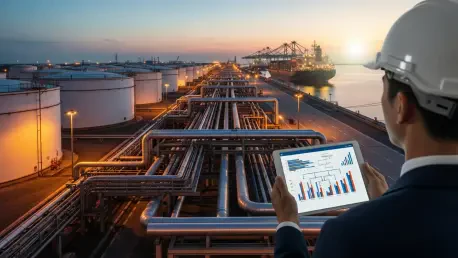
Market analysts at Morgan Stanley, in coordination with high-level executives from Saudi Aramco, have reached a sobering consensus that this event constitutes the single largest supply disruption in history. With the scarcity of physical crude driving international benchmarks like Brent futures to approximately $107 per barrel, the economic shockwaves are being felt from industrial manufacturing hubs to local gas stations. Experts caution that the path to stabilization remains fraught with complex technical and logistical obstacles that cannot be resolved through diplomatic negotiations alone. Reviving the market will require the extensive repair of damaged refinery infrastructure and the laborious process of restarting dormant oilfields that were shuttered during the initial weeks of the crisis. Furthermore, the global tanker fleet must be entirely repositioned to account for the closure of traditional routes, a task that maritime logistics experts estimate will result in a cumulative loss of one billion barrels throughout 2026. This period of scarcity is not merely a pricing issue but a fundamental breakdown of the machinery that fuels global trade and energy security.
The Shift Toward Efficiency: Navigating Long-Term Energy Resilience
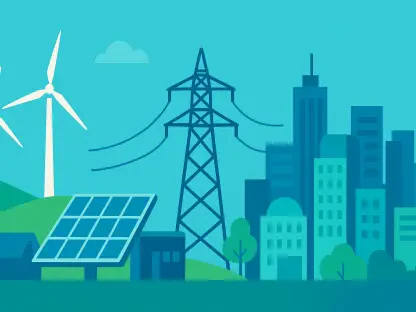
The global community responded to these pressures by initiating a massive shift toward aggressive conservation and the release of strategic commercial reserves. While the petrochemical and aviation sectors experienced the most immediate financial distress, the broader economy adapted through a forced demand contraction of 420,000 barrels per day. The departure of the United Arab Emirates from OPEC+ on May 1 necessitated a complete reconfiguration of production agreements among the remaining member nations, who moved to implement modest output increases to mitigate the risk of price spikes during the peak summer demand cycle. Policymakers prioritized the diversification of energy sources and the acceleration of decentralized power grids to reduce the long-term dependency on specific maritime corridors. Governments also incentivized the rapid deployment of high-efficiency logistics software and alternative fuel technologies to buffer against future logistical shocks. By focusing on systemic efficiency rather than just short-term supply fixes, the groundwork was laid for a more resilient energy architecture that moved beyond the vulnerabilities of a single-commodity reliance.