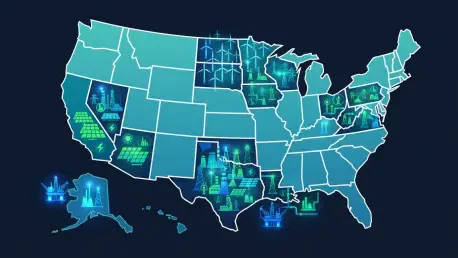

The Denver-Julesburg and Piceance Basins allowed Colorado to contribute a consistent 1.87 trillion cubic feet to the national energy portfolio during the 2025 calendar year. This specific regional success was part of a much broader and more impressive narrative for the American energy sector, which saw a transformative surge in domestic natural gas extraction. According to the latest comprehensive data from the U.S. Energy Information Administration, the nation reached a historic peak by withdrawing an unprecedented 47.73 trillion cubic feet of natural gas. This monumental figure reflects a rapid and sustained expansion of the industry, with production growing by seven trillion cubic feet in just a five-year window. Such a dramatic increase is not merely a statistical anomaly but the result of a fundamentally transformed industrial landscape where technological maturation and the aggressive development of shale resources have allowed the United States to shatter previous energy records. This shift has not only fortified domestic energy security but has also cemented the country’s position as a global titan in energy production, capable of meeting both internal demands and international export requirements.
The defining characteristic of this modern energy landscape is its high degree of geographic concentration. While a large number of states contribute to the national grid, the vast majority of the output is generated by a small, elite group of high-performing producers. In 2025, the top 15 gas-producing states were responsible for approximately 97 percent of the national total, creating a highly stratified production map. Even more remarkable is the dominance exerted by the top four states: Texas, Pennsylvania, New Mexico, and Louisiana. Together, this quartet of energy leaders generated more than 60 percent of all gross natural gas withdrawals. This intense concentration underscores the vital importance of specific geological formations, such as the Permian Basin, the Marcellus Shale, and the Haynesville Shale, which serve as the primary engines of the nation’s energy future. The strategic management of these resources has become a cornerstone of national economic policy, as the reliance on these core areas continues to grow with each passing year.
The Sovereign Scale: Texas and the Permian Dominance
Texas remains the undisputed leader of the American energy industry, maintaining a massive and widening gap between its own output and that of its closest competitors. In 2025, the state recorded a staggering 13.60 trillion cubic feet of gross natural gas withdrawals, a figure that accounts for 28.5 percent of the entire national total. The scale of production in the Lone Star State is so vast that it nearly doubles the output of the second-place state, illustrating a level of industrial capacity that is virtually unmatched on a global scale. The success of Texas is deeply rooted in its geographic diversity and the presence of several “super-basins” that have benefited from decades of infrastructure investment and technical refinement. As the state continues to optimize its extraction processes, its influence over national energy prices and supply chains remains absolute, providing a stable foundation for the broader economy.
The primary driver of this immense volume is the Permian Basin in West Texas, where natural gas is frequently produced as “associated gas” alongside massive oil extraction operations. This dual-commodity approach has made Texas an exceptionally efficient and prolific producer, as companies are able to extract two high-value resources from a single wellhead. Beyond the Permian, other regions like the Haynesville Shale in East Texas and the Eagle Ford Shale in South Texas provide substantial contributions that would be considered record-breaking on their own in almost any other state. Additionally, the Barnett Shale in North Texas continues to serve as a foundational element of the state’s energy legacy. Having been one of the first areas to prove the commercial viability of large-scale shale development, the Barnett remains a critical part of the state’s portfolio, offering consistent yields that complement the more volatile growth seen in newer shale plays.
PennsylvaniThe Appalachian Energy Anchor
Pennsylvania has undergone a dramatic and highly visible transformation over the last two decades, evolving from a relatively minor participant in the gas market into the second-largest producer in the country. In 2025, the state produced 7.68 trillion cubic feet of natural gas, representing 16.1 percent of the national total. This rise has effectively turned Pennsylvania into the anchor of the Appalachian Basin, a region that has become synonymous with the American shale revolution. The state’s meteoric ascent is almost entirely attributable to the Marcellus Shale, a massive rock formation sitting beneath much of the Commonwealth. Once considered a geological curiosity that was too difficult or expensive to tap, the Marcellus is now one of the most productive gas fields in the world, thanks to the widespread implementation of advanced extraction techniques such as horizontal drilling and hydraulic fracturing.
The industrial activity associated with this production is most heavily concentrated in the north-central and southwestern counties of Pennsylvania. These areas have become hubs of intense economic and technical activity, providing the necessary volume to keep the state at the forefront of the national energy market. The ability of Pennsylvania to maintain these high production levels has redefined the economic landscape of the Northeast, turning a region that was once a net importer of energy into a major exporter. This shift has had profound implications for regional energy costs and has driven the development of new pipeline projects designed to move Pennsylvania’s gas to coastal markets and industrial centers across the Eastern Seaboard. As the state continues to refine its regulatory framework and technical approaches, its role as a primary supplier of clean-burning natural gas appears set to continue for the foreseeable future.
New Mexico: Navigating the Delaware Basin Breakthrough
New Mexico has experienced the most rapid and aggressive growth among the top producing states in recent years, marking a significant shift in the regional energy balance. Since 2017, the state’s gross withdrawals have more than tripled, reaching a peak of 4.15 trillion cubic feet during the 2025 calendar year. This volume now represents 8.7 percent of the total U.S. production, placing New Mexico firmly in the third-place spot and ahead of long-established producers. The engine of this unprecedented growth is the Delaware Basin, a prolific sub-section of the Permian Basin located in the southeastern part of the state. Much like the situation across the border in Texas, New Mexico’s gas production is closely tied to its booming oil industry. This synergy has allowed for the extraction of enormous quantities of gas alongside crude oil, leading to a significant increase in the state’s total energy output and fiscal revenue.
While the Delaware Basin is undoubtedly the dominant force in the state, the San Juan Basin in the northwest also remains a steady and reliable contributor to the total. However, the intense development in the southeast has fundamentally shifted New Mexico’s energy profile toward shale-driven growth. This rapid expansion serves as a case study in how quickly a state can climb the national rankings when world-class geological resources are combined with modern drilling technology and a favorable investment climate. The state government has worked to balance this growth with environmental oversight, focusing on reducing methane emissions and improving the efficiency of gas capture. These efforts are crucial as New Mexico continues to integrate its production into the wider national infrastructure, ensuring that its newfound status as an energy powerhouse remains sustainable in the long term.
LouisianA Strategic Gateway for Gas Markets
Louisiana has long been a cornerstone of the American gas industry, and it successfully maintained its status in 2025 by withdrawing 3.82 trillion cubic feet of natural gas. This output represents 8.0 percent of the national total, a figure that reflects the state’s enduring relevance in a rapidly changing market. Louisiana’s current production is primarily centered on the Haynesville Shale in the northwestern region, a formation it shares with Texas. The Haynesville is known for its high-pressure reservoirs and deep wells, which require significant technical expertise to manage effectively. Despite these challenges, the basin remains one of the most attractive targets for energy companies due to its massive reserves and its proximity to major industrial consumers and coastal infrastructure, which reduces the logistical costs associated with moving gas to market.
The importance of Louisiana to the national energy grid extends far beyond simple extraction volumes. Its geographic location near the Gulf of Mexico makes it a critical logistical hub for the entire country, serving as a crossroads for pipelines moving gas from the interior to the coast. The state possesses an extensive and aging infrastructure network that is currently undergoing significant modernization to handle the increased volumes coming from shale plays. Furthermore, Louisiana has established itself as a global leader in liquefied natural gas export terminals. This infrastructure ensures that the gas produced both locally and in neighboring states can be easily chilled and loaded onto tankers for shipment to international markets in Europe and Asia. This strategic advantage makes Louisiana indispensable to the global energy supply chain, acting as a vital link between American producers and global consumers.
The Appalachian Synergy: Regional Strength in West Virginia and Ohio
The regional synergy between West Virginia and Ohio has created a massive hub of gas production that, when combined with Pennsylvania, rivals the output of the entire state of Texas. Together, these states form the core of the Appalachian Basin, which withdrew nearly 13.4 trillion cubic feet of gas in 2025. This equates to roughly 28 percent of the national total, demonstrating the collective power of the region. West Virginia, despite its relatively small geographic footprint, is a heavyweight in the energy sector, ranking fifth nationally. In 2025, it recorded 3.60 trillion cubic feet of gross withdrawals, continuing a trend of staggering growth. The state has seen its annual output increase by more than 1,000 percent since 2010, an explosion in productivity that has completely reshaped the local economy and provided a new source of industrial stability.
Ohio also plays a significant and growing role in this regional success story, producing 2.10 trillion cubic feet in 2025. Like its neighbors, Ohio’s production is concentrated in its eastern and southeastern counties, where the Utica and Marcellus shale formations are most accessible. These formations have redefined the state’s economic landscape over the last decade, attracting billions of dollars in investment for drilling, processing, and pipeline construction. The development of the Utica Shale in particular has provided a complementary source of gas and natural gas liquids that has helped diversify Ohio’s industrial base. As West Virginia and Ohio continue to develop their midstream infrastructure, the ability to process and move these massive volumes of gas has become as important as the drilling itself, ensuring that the Appalachian Basin remains a dominant force in the national energy discussion.
Oklahoma and the Resilience of the Mid-Continent Region
Oklahoma remains a central and highly influential player in the Mid-Continent region, withdrawing 2.88 trillion cubic feet of natural gas in 2025. The state benefits from a long and storied history of energy production and a diverse array of geological sources, including the deep reservoirs of the Anadarko Basin. Its 2025 figures represent a notable uptick in production, marking its highest output in several years and signaling a successful adaptation to the era of horizontal drilling. Oklahoma has focused its recent efforts on the SCOOP and STACK horizontal plays, which have proven to be highly productive and economically resilient even during periods of price volatility. This focus on high-quality shale assets has allowed the state to maintain its relevance despite the intense competition from larger basins in Texas and Pennsylvania.
The infrastructure in Oklahoma is some of the most mature in the country, providing a complex web of pipelines and processing facilities that support both local production and the transit of gas from other states. This central location makes Oklahoma a vital clearinghouse for the national gas market, with the Henry Hub in neighboring Louisiana often influenced by the flows through Oklahoma’s network. The state’s ability to modernize its older fields while simultaneously developing new shale assets has been a key factor in its continued success. As energy companies in the state continue to employ advanced data analytics and automated drilling technologies, the efficiency of Oklahoma’s production is expected to improve further, helping the state to defend its position as a top-tier energy producer in an increasingly crowded and competitive national landscape.
Western Frontiers: The Reliability of Rocky Mountain Supplies
Wyoming and Utah provide essential regional supplies that are critical for the energy stability of the western United States. Wyoming recorded 1.20 trillion cubic feet of production in 2025, focused primarily in the Green River Basin and the prolific Jonah and Pinedale fields. While Wyoming’s production has seen a slow decline from its historical peaks in the late 2000s, it remains a vital supplier for markets in California and the Pacific Northwest. The state’s gas is known for its high quality and is supported by a robust network of interstate pipelines that ensure it can reach distant consumers. Wyoming continues to explore new ways to incentivize production in its conventional fields while also looking toward potential shale opportunities that could stabilize its long-term output.
Meanwhile, Utah’s natural gas production has been on a recent and encouraging upward trend, reaching its highest level since 2016 during the 2025 calendar year. The majority of this gas comes from the Uinta Basin in the northeastern part of the state, an area that has seen renewed interest from operators looking for reliable, long-life assets. Utah’s growth is a testament to the continued viability of the Intermountain West as a major energy hub. The state has benefited from improvements in local processing capacity, which have allowed producers to move more gas to market with fewer constraints. Together, Wyoming and Utah ensure that the western half of the country has a steady and reliable supply of domestic energy, reducing the reliance on long-distance imports and supporting the regional industrial base with affordable fuel and feedstock.
Distinct Production Models: Alaska and North Dakota
Alaska presents a unique case in the American gas landscape, recording 3.55 trillion cubic feet of gross output in 2025. However, the Alaskan model is vastly different from the production seen in the lower 48 states. Because Alaska lacks a pipeline connection to the contiguous United States, much of the gas withdrawn on the North Slope is not sold into the commercial market. Instead, it is reinjected into oil fields to maintain reservoir pressure, which in turn facilitates the production of crude oil. This cycle of withdrawal and reinjection has remained remarkably steady for decades, making Alaska a massive producer on paper whose market impact is localized. Plans for a major LNG export project continue to be discussed, which would eventually allow this gas to reach global markets and transform Alaska’s role from a supporting player into a primary exporter.
North Dakota’s gas production is a direct and increasingly valuable byproduct of its famous oil boom in the Bakken formation. In 2025, the state withdrew 1.27 trillion cubic feet of gas, representing a nearly 23-fold increase since the turn of the century. Historically, much of this gas was considered a nuisance and was burned off or “flared” at the wellhead because there was no infrastructure to move it. However, strict new regulations and significant private investment in processing plants and pipelines have turned this formerly wasted resource into a major economic asset. The transition from flaring to capturing gas has allowed North Dakota to significantly increase its contribution to the national total while simultaneously improving the environmental footprint of its oil industry. This shift highlights the critical importance of midstream infrastructure in modern energy management and the ability of technology to turn a waste product into a valuable commodity.
Legacy Transitions: Addressing the Decline of Mature Fields
While the national story is one of record-breaking growth, several states are experiencing a natural and expected decline in their natural gas production as legacy fields age. Arkansas, for example, withdrew 323.3 billion cubic feet in 2025, a figure that is significantly lower than its peak levels from a decade ago. The Fayetteville Shale, which was once a centerpiece of the early shale boom, has seen a steady decrease in activity as operators shift their capital toward more prolific regions like the Permian or the Marcellus. This cycle of boom and decline is a standard feature of the extractive industries, and Arkansas is now focused on maximizing the efficiency of its existing wells rather than aggressively drilling new ones. The state remains a contributor to the regional grid, but its days of double-digit growth have largely passed.
Similarly, Kansas and California are seeing their influence on the national gas market continue to fade. Kansas, home to the historic Hugoton Gas Area, produced only 122.3 billion cubic feet in 2025. While the state was a primary driver of the American gas industry throughout much of the 20th century, its conventional reserves are now largely depleted, and it has not yet seen a major shale breakthrough. California ranks 15th in the nation, with its gas production dwindling to less than one-third of the levels recorded in 2000. Known primarily for its heavy oil production, California’s gas is largely “associated gas” from aging fields that are becoming increasingly expensive to operate. These declines illustrate the ongoing geographic shift in the industry toward the newer, more technically demanding shale formations that now provide the overwhelming majority of the nation’s energy supply.
Strategic Imperatives: Strengthening the Future Energy Grid
The record-shattering production levels of 2025 established a new baseline for the American energy sector, but maintaining this momentum required a shift in focus toward long-term sustainability and infrastructure resilience. Energy companies and policymakers recognized that the “shale revolution” had matured into a high-volume industrial era where the primary challenges were no longer just about extraction, but about the efficient movement and clean utilization of the resource. To address these needs, the industry prioritized the expansion of inter-regional pipeline networks and the construction of additional processing facilities to reduce bottlenecks in the Appalachian and Permian basins. These investments were aimed at ensuring that the record volumes produced in Texas and Pennsylvania could reach the areas of highest demand without causing localized price spikes or supply shortages.
Building on the lessons of the previous decade, the sector also moved toward integrating advanced carbon capture and methane detection technologies into the standard production cycle. This proactive approach helped to mitigate the environmental impact of such vast extraction volumes and ensured that natural gas remained a viable component of the national energy mix during the transition to a lower-carbon economy. For the states involved, the next steps involved diversifying their local economies to ensure that the wealth generated by the current gas boom could provide long-term stability even as global energy markets evolved. By investing in education, technology hubs, and transportation infrastructure, the leading gas-producing states successfully leveraged their natural resources to build a more resilient and forward-looking economic foundation that extended beyond the wellhead.