
Christopher Hailstone is a veteran of the energy sector, specializing in the complex logistics of utility management and the security of global electricity grids. With years spent navigating the volatile intersections of Middle Eastern geopolitics and supply chain resilience, he offers a seasoned perspective on the high-stakes maneuvers currently unfolding in Tehran and Riyadh. His expertise provides a crucial lens through which we can understand how regional stability—or the lack thereof—dictates the price of power and fuel across the globe.
This conversation explores the shifting diplomatic landscape in the Persian Gulf, focusing on the potential end of the “neither war nor peace” status quo and the operational hurdles of oil transit. We delve into the impact of depleted global inventories, the role of regional intelligence in security protocols, and the economic friction caused by rising insurance and freight costs.
Brent crude is trading near $114 while U.S. West Texas Intermediate has settled just below $100. How do these current price levels reflect the market’s reaction to recent diplomatic meetings in Tehran, and what specific technical indicators suggest that the “neither war nor peace” status quo is finally shifting?
The market is currently exhaling, but it is a shallow, nervous breath. When we see Brent futures lose 1.7% to close at $113.88 and WTI drop 1.8% to settle at $99.90, it tells us that traders are finally pricing in the possibility of a diplomatic off-ramp. The shift away from the “neither war nor peace” status quo is most evident in the Supreme Leader’s recent social media activity, which explicitly outlined conditions for ending the conflict. This move from vague hostility to concrete demands suggests a strategic pivot that the markets are rewarding with a slight cooling of the risk premium. However, the volatility remains high because any breakdown in these talks could instantly erase these marginal gains.
Iranian leadership has recently emphasized maintaining control over the Strait of Hormuz as a primary condition for regional security. What are the immediate operational implications for global shipping when ship-to-ship transfers increase in this area, and how do these maneuvers impact total tanker capacity and freight insurance premiums?
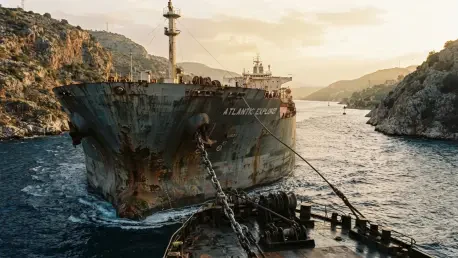
The operational reality in the Strait is becoming incredibly cumbersome and expensive for everyone involved. Because vessels remain exposed to targeted attacks, we are seeing a massive reliance on ship-to-ship transfers to move crude through these dangerous waters, a process that is effectively absorbing a huge portion of global tanker capacity. When ships are tied up in these slow, complex maneuvers instead of sailing their routes, the supply of available tankers shrinks, which naturally sends freight costs soaring. Furthermore, insurance premiums have risen sharply, reflecting the “war zone” reality of the Gulf, making every barrel significantly more expensive to deliver than it was just a few months ago.
Saudi Arabia has faced consistent Houthi militant strikes on energy infrastructure and civilian airports despite a resilient export record. In light of the recent direct talks between Saudi and Iranian officials, what specific security protocols must be established to protect these assets, and how does the involvement of Pakistani and Turkish intelligence change the negotiation dynamic?
Protecting Saudi infrastructure requires more than just physical defenses; it requires a verified cessation of the Houthi strikes that have plagued energy hubs and airports for the last eight months. The inclusion of senior military and intelligence officials from Pakistan and Turkey in the Tehran talks is a brilliant move because it adds a layer of regional accountability that goes beyond simple bilateral promises. These allies provide the technical and diplomatic “eyes” on the ground to ensure that de-escalation is actually happening rather than just being discussed. For the Saudis, whose exports have remained remarkably resilient despite the bombing of their civilian targets, these protocols are the only way to ensure long-term stability for their primary economic engines.
Global oil inventories have reportedly dropped by approximately 500 million barrels since February, reaching multi-year lows. Given that strategic stockpile releases have largely concluded, what is the step-by-step process for replenishing these commercial inventories, and how will this supply deficit sustain higher price floors even if a peace deal is reached?
We are facing a massive structural deficit because global oil inventories have plummeted by around 500 million barrels since February. Now that the government-mandated releases of strategic stockpiles are over, the world is essentially running on empty, with visible inventories at multi-year lows. Replenishing these stocks is a slow, methodical process that requires months of production exceeding consumption, which is difficult to achieve in the current high-demand environment. This means that even if a peace treaty is signed tomorrow, the desperate need to refill these commercial tanks will keep oil prices higher for longer, as the market must compete for every available barrel just to get back to a “safe” baseline.
There is a looming decision regarding whether to pursue a formal deal with Iran or intensify military operations in the region. How does the threat of additional strikes complicate long-term investment in Middle Eastern energy infrastructure, and what metrics should analysts watch to determine if the market has truly normalized?
The looming threat of intensified military operations acts as a massive deterrent for the long-term capital investments required to maintain and expand energy infrastructure. If an investor thinks a refinery or a pipeline might be targeted in the next round of strikes, they simply won’t write the check, which leads to a slow decay in regional production capacity. To see if the market has truly normalized, analysts shouldn’t just look at the price of a barrel; they need to watch the insurance and freight costs. Until those specific “friction” costs return to historical norms, the market is still operating under a wartime mentality, regardless of whether a formal deal is on the table.
What is your forecast for global oil prices through the end of the year?
I expect Brent crude to remain stubbornly high, likely hovering near $110 a barrel through the end of the year. Even though Middle Eastern exports have shown some growth compared to the earlier, more chaotic stages of the conflict, the market has not normalized in any meaningful way. The combination of depleted inventories and the time required to rebuild them means we are in a “higher for longer” cycle. Unless there is a dramatic and permanent cessation of hostilities in the Strait of Hormuz that immediately lowers insurance costs, the floor for oil is going to remain very firm.