
Christopher Hailstone brings a wealth of experience to the table as a seasoned veteran in energy management and utility infrastructure. As a recognized expert in grid reliability and security, he has spent decades navigating the complexities of how we generate and deliver power to a changing world. In this discussion, we explore the shifting tides of the global energy transition, specifically the massive pivot toward green hydrogen in the East. While Western nations are grappling with cost pressures and scaling back their ambitions, China and India are aggressively positioning themselves as the new heavyweights of the hydrogen economy. We delve into the implications of China’s multi-billion dollar investments, India’s strategic use of subsidies to secure market stability, and the technical hurdles that remain as the world attempts to move away from traditional fossil fuels in heavy industry.
China invested $3.7 billion in green hydrogen last year, more than doubling the investment seen in the United States. How does this spending gap impact the global race for clean energy dominance, and what long-term consequences might Western countries face for scaling back their initial hydrogen ambitions?
The sheer scale of China’s $3.7 billion investment is a clear signal that they are playing a very different game than the rest of the world. By doubling the spending of the United States, Beijing is effectively buying its way to the front of the line, ensuring they control the supply chains and the technological blueprints for the next century. When Western countries pull back due to immediate cost constraints, they risk becoming consumers of foreign technology rather than the innovators driving the market. We are seeing a monumental shift where the intellectual and industrial center of gravity for green hydrogen is moving East, leaving the West to potentially face higher costs and reduced energy sovereignty in the future. It is a sobering reality to see Western projects stall while China prepares to bring 2.6 million tonnes of capacity online by 2031 with a cumulative $26 billion investment.
Large-scale projects are now using renewable energy to power electrolyzers for fertilizer manufacturing and low-emission steelmaking. What are the specific technical challenges of integrating hydrogen into these heavy industries, and what step-by-step infrastructure changes are required to transition away from traditional fuels?
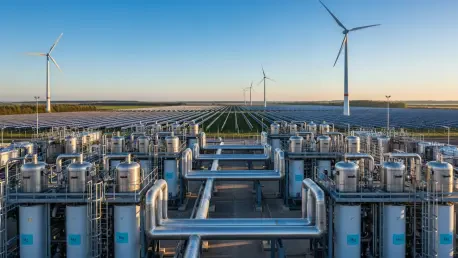
Integrating hydrogen into environments like steel mills or fertilizer plants is not as simple as flipping a switch; it requires a complete reimagining of the industrial heat and chemical processes. We are talking about massive banks of electrolyzers, like those in the $2 billion projects we see emerging, which must be fed by a constant and reliable stream of renewable energy. The technical challenge lies in the intermittency of wind and solar power, which can clash with the “always-on” nature of a blast furnace or a chemical reactor. To make this work, industries must build out local storage solutions and reinforced grid connections that can handle the massive electrical load required to split water into hydrogen. It is a gritty, high-stakes engineering feat that involves retrofitting ancient industrial corridors with high-pressure pipelines and specialized burners that can handle the unique properties of hydrogen.
India is targeting an annual output of 5 million metric tonnes by 2030, supported by $2.1 billion in subsidies and guaranteed buyers. How does securing dedicated off-takers like refineries and fertilizer plants stabilize the market, and what metrics should private investors track to determine project viability?
India’s strategy is brilliant in its pragmatism because it addresses the “chicken and egg” problem of the hydrogen economy by guaranteeing that the product has a home before the first molecule is even produced. By designating refineries and steelmakers as guaranteed off-takers, the government removes the terrifying demand risk that usually scares away private capital. Investors should be looking closely at the “levelized cost of hydrogen” and the reliability of the renewable energy inputs, but the most critical metric is the gap between the subsidy-backed price and the cost of traditional grey hydrogen. With $2.1 billion in subsidies on the table, India is creating a shielded environment where projects can reach maturity without being crushed by early-stage market volatility. This approach creates a sense of certainty that is palpable in the boardroom, turning a high-risk gamble into a structured infrastructure play.
While global production capacity could reach 49 million tonnes by 2030, high electrolyzer costs and distribution gaps remain significant obstacles. What practical innovations could drive down equipment costs in the next decade, and how should nations prioritize investments between production technology and transport infrastructure?
To move from our current state of less than 1 million tonnes to the projected 49 million tonnes, we have to treat electrolyzer manufacturing like we treated solar panels a decade ago—moving from boutique assembly to massive, automated gigafactories. The innovation will come from simplifying the materials used in membranes and catalysts, reducing the reliance on rare metals that drive up the price tag of every unit. However, production is only half the battle; we cannot ignore the physical reality of moving a gas as light and leaky as hydrogen across vast distances. Nations must find a balance, perhaps prioritizing regional “hydrogen hubs” where production and consumption happen in the same backyard to minimize the need for expensive, long-distance pipelines. It’s a delicate dance between perfecting the machine that makes the gas and building the veins that carry it to the heart of industry.
Beijing has designated green hydrogen as a frontier industry, signaling a deep policy commitment to energy security. In terms of global trade, how might this shift affect the pricing of low-emission exports, and what specific trade-offs do emerging economies face when balancing industrial growth with environmental targets?
When a superpower like China labels hydrogen a “frontier industry” in its five-year plan, it means they are willing to prioritize long-term dominance over short-term profits. This will likely lead to a “green premium” on exports, where low-emission steel and fertilizers become the gold standard in international trade, potentially pricing out those who stick to coal and gas. For emerging economies, the trade-off is agonizing: do they invest their limited capital in expensive green tech to satisfy global climate goals, or do they use cheaper, dirtier fuels to lift their populations out of poverty? China and India are attempting to do both by framing green hydrogen as a tool for energy security, essentially betting that clean energy will eventually become the most economical path to industrial power. It is a high-stakes calculation where the cost of being left behind in the global green market is far higher than the initial $26 billion investment.
What is your forecast for the global green hydrogen market?
The global market is currently at a critical junction where the gap between ambitious announcements and actual realized output is wider than ever. While the IEA suggests we could reach 49 million tonnes by 2030, my forecast is that we will see a two-speed world: a fast-moving Asian sector driven by state mandates and a more cautious, fragmented Western market. We will likely see a massive shakeout of smaller players in the next five years, leaving behind a few dominant giants who have mastered the art of scaling electrolyzer technology. Ultimately, green hydrogen will transition from an expensive experimental fuel to the backbone of heavy industry, but the path there will be defined by those willing to endure the current high costs for the sake of future energy independence. It won’t be a smooth ride, but the momentum in the East suggests the hydrogen age is becoming an inevitability rather than just a possibility.