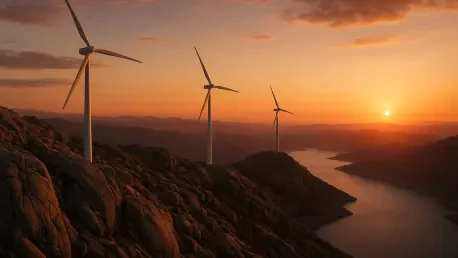

This high-altitude facility provides a blueprint for other mountainous regions worldwide to transition from merely generating clean energy to managing it with precision. Deep within the rugged granite peaks of northern Portugal, a transformative clean energy project has recently reached operational status, signaling a significant shift in how renewable resources are harnessed and managed. Known as Tâmega Norte, this initiative represents a $402 million investment aimed at overcoming the most persistent hurdle in the transition to green energy: the reliability and consistency of power delivery. Situated across the high-altitude divide of the Braga and Vila Real districts, the facility is not merely a collection of wind turbines but a sophisticated “giga-battery” that integrates wind power with advanced pumped-storage hydroelectric technology. By linking these two distinct forms of energy generation through a shared electrical infrastructure, Portugal has established the first grid-connected wind-hydro hybrid plant on the Iberian Peninsula.
Maximizing Efficiency Through Integrated Storage
The Mechanics of a Self-Balancing Energy Loop
The core innovation of the Tâmega Norte project lies in its operational synergy. Historically, wind power has been criticized for its intermittency—the fact that electricity is only generated when the wind blows. To mitigate this, engineers designed Tâmega Norte to function as a self-balancing energy loop. The installation features 27 high-capacity turbines that work in tandem with a massive pumped-storage hydroelectric system. The mechanics of this hybrid system are elegant in their efficiency. When mountain winds are strong and the turbines produce more electricity than the regional grid requires, the excess energy is redirected. Instead of going to waste, this surplus power fuels high-capacity pumps that transport water from lower reservoirs to higher elevations. Effectively, this converts kinetic wind energy into potential gravitational energy stored in water. Conversely, when wind speeds drop or demand spikes, the hydroelectric component is activated to generate electricity instantly.
Ensuring Grid Stability With Pumped Storage
This unified architecture ensures that the national grid operator receives a steady, predictable stream of clean power regardless of shifting weather patterns. By utilizing the water as a storage medium, the plant effectively functions as a massive natural battery that does not suffer from the degradation or chemical waste issues associated with lithium-ion alternatives. The system provides a level of dispatchable power that was previously only available from fossil fuel sources, like coal or natural gas. Furthermore, the integration of these two technologies into a single grid connection point reduces the complexity of managing the national power supply. It allows for a more streamlined distribution process where the variation in wind speed is smoothed out before it ever reaches the consumer. This stability is critical for industrial zones that require a constant voltage to maintain heavy machinery operations. Consequently, the project proves that large-scale renewable systems can meet the rigorous demands of modern infrastructure.
Overcoming Logistic and Environmental Hurdles
Innovative Transport Solutions for Massive Components
Constructing a project of this magnitude in the remote municipalities of Cabeceiras de Basto and Montalegre presented extraordinary logistical and engineering hurdles. The 27 turbines are among the largest onshore units ever deployed, with rotor heights reaching 564 feet. Moving components of this size through narrow, winding mountain roads with sharp hairpin turns was physically impossible for traditional transport vehicles. To solve this, logistics teams utilized specialized BladeLifter technology. These hydraulic systems allow massive 260-foot turbine blades to be tilted at steep angles—between 25 and 30 degrees—during transport. By lifting the blades vertically, transport crews were able to navigate tight cliffside corners without the need to widen rural roads or clear protected forest areas. This innovation not only saved time but also preserved the natural landscape of the region, ensuring that the infrastructure development did not result in unnecessary environmental degradation.
Regional Cooperation and Financial Investment
The realization of the Tâmega Complex involved a massive financial undertaking and international cooperation. The total investment for the dual-phase project is approximately $402 million. Specifically, $276 million was directed toward the now-operational Tâmega Norte, while the remaining $126 million is earmarked for the upcoming expansion phase. The project was financed through partnerships with the European Investment Bank and Norges Bank, with the energy firm Iberdrola maintaining a significant operating stake. This financial structure reflects a growing confidence among global investors in hybrid renewable assets that offer both generation and storage capabilities. The industrial supply chain for the project highlights a pan-European effort. While Danish firms provided the high-output 7.2-megawatt turbines, the structural components and towers were manufactured by specialized companies in the Basque region. This collaborative approach has resulted in a facility capable of generating 414 gigawatt-hours of electricity annually.
Redefining the Future of Renewable Power
Establishing a Resilient and Autonomous Grid
The broader implications of the Tâmega Norte project extended far beyond the borders of Portugal. By proving that wind and water could be physically and operationally locked into a single grid connection, the project demonstrated a viable path for eliminating the need for fossil-fuel backups. In traditional setups, grid managers often had to keep gas-fired plants on standby to compensate for sudden drops in wind or solar production. The hybrid model at Tâmega made this redundancy unnecessary, as the water reservoirs acted as a natural, carbon-free insurance policy. Moving forward, policymakers focused on prioritizing the development of similar hybrid zones that combined multiple renewable technologies at a single site. This approach reduced land use and simplified the regulatory process for new installations. The success of this facility suggested that the next phase of the global energy transition would focus heavily on regional storage hubs that integrated diverse green sources efficiently.
Actionable Blueprints for Global Energy Management
For regions looking to replicate this success, the focus shifted toward the integration of smart grid software that could predict weather patterns and adjust pump-storage operations in real time. The Tâmega Norte facility functioned as a testbed for these advanced control systems, which proved essential for maintaining voltage stability during peak demand. Future investments were directed toward training a specialized workforce capable of managing these complex, multi-modal energy systems. Furthermore, international cooperation in the supply chain ensured that the best technologies were deployed at every level of the project. Experts suggested that standardizing the interfaces between wind turbines and hydroelectric controls would accelerate the adoption of hybrid plants globally. By treating renewable energy as a holistic system rather than a series of isolated projects, nations achieved energy independence much faster. The project concluded that combining natural geography and engineering was the key to unlocking a sustainable grid.